
When Sarvam AI unveiled its sovereign models—Sarvam 30B and Sarvam 105B—at the recently concluded India AI Impact Summit, it drew significant attention from global tech leaders. The announcement was important both because of the models’ scale and their architecture: a multilingual, voice-first AI stack trained entirely on domestic infrastructure.
Rather than concentrating its ambitions on a single large language model, Sarvam is building a vertically integrated AI ecosystem. Its strategy spans foundation models, speech and translation systems, document intelligence, enterprise-grade agentic orchestration, and even indigenous hardware.
So what underpins these models? How are they architected, what technical design choices define them, and how much computational capacity do they truly command? The answers lie in a combination of sovereign compute, efficiency-driven architecture and tightly integrated application-layer design.
Training a Frontier Model on Sovereign Compute
The flagship Sarvam 105B model was trained on 4,096 NVIDIA H100 GPUs deployed through the Yotta Shakti Cloud, operated by Yotta Data Services, under the umbrella of the IndiaAI Mission. This makes it one of the few large-scale foundation models trained entirely on domestic infrastructure in India.
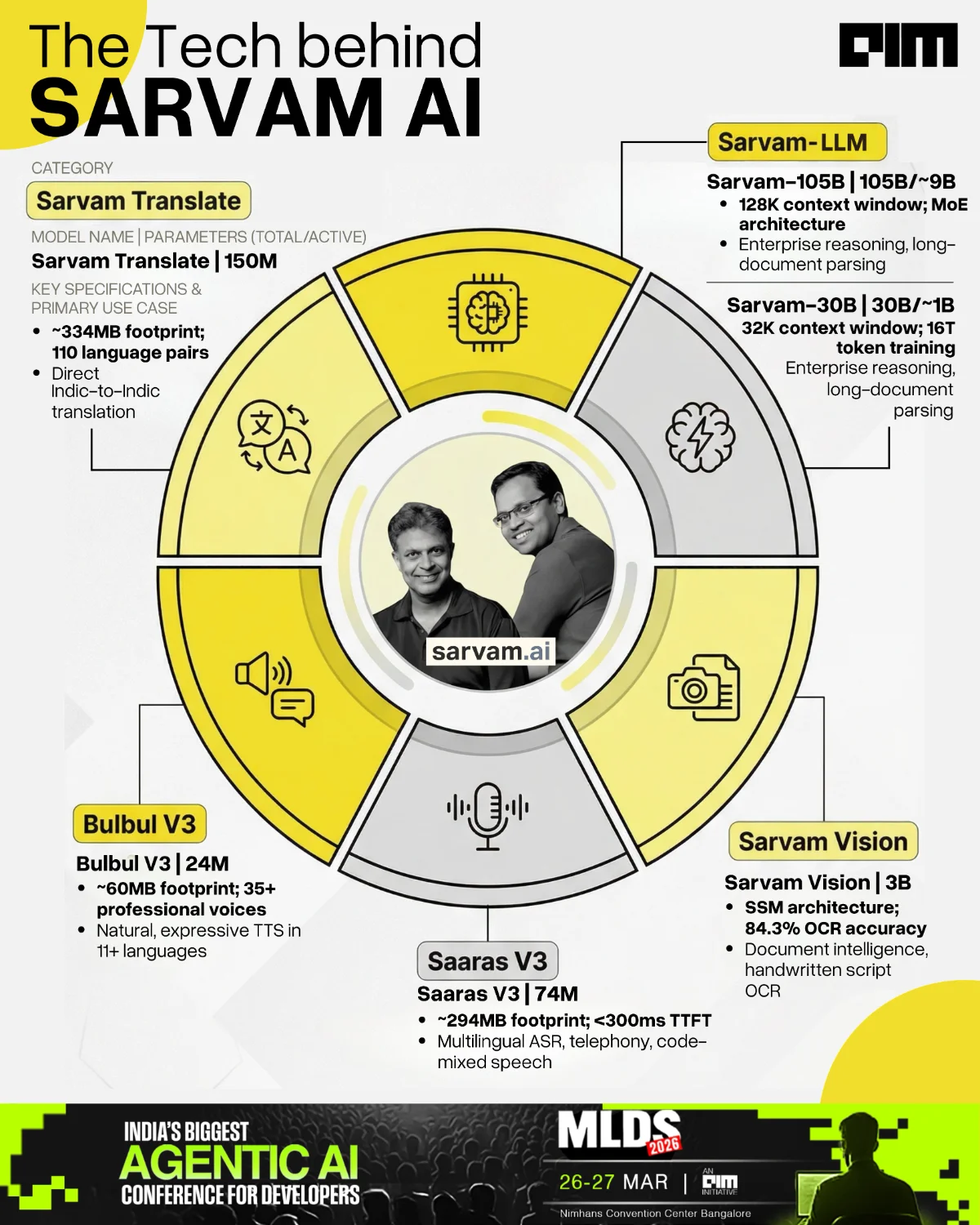
With 105 billion parameters, the model sits within the frontier class of large language models. However, its architecture relies on a mixture-of-experts (MoE) design, activating only around nine billion parameters per token during inference. This selective activation significantly reduces compute costs compared with dense architectures of similar scale.
Pratyush Kumar, Co-founder of Sarvam, claims, “Despite being one-sixth the size of 600B-parameter models, such as DeepSeek R1, the 105B system achieves comparable performance across several demanding benchmarks.” The company also reports surpassing Gemini 2.5 Flash on specific Indian-language benchmarks and outperforming Gemini 3 Pro in certain document understanding evaluations.
Beyond raw parameter count, the model features a 1,28,000-token context window, enabling it to process lengthy regulatory filings, loan documents and financial reports without truncation. Production targets include a P95 time-to-first-token under one second and an inter-token latency of under 15 milliseconds—performance thresholds aimed squarely at enterprise-grade deployment.
Sarvam also claims improvements in token efficiency for Indian languages. “We achieved fertility rates between 1.4 and 2.1, which means that the system can represent Indian-language text using fewer tokens than global models trained predominantly on English corpora, an important factor in lowering inference costs,” Kumar says.
An Agentic Orchestration Layer
At the application layer, Sarvam integrates an agentic orchestration framework designed to handle multi-step reasoning and task execution. The system interprets user intent, processes structured and unstructured data, generates code where required, and delivers completed outputs in document-ready formats.
Within its enterprise platform, branded ‘Sarvam for Work’, this orchestration framework, known as Arya, treats workflow state as an immutable ledger. By preserving intermediate steps, it prevents context drift during complex and multi-stage operations and improves reproducibility and auditability. These features matter particularly in regulated industries.
In practice, this positions Sarvam as a conversational assistant as well as a productivity engine capable of participating in build-debug-optimise cycles, drafting professional documents, analysing datasets and autonomously executing structured workflows.
Sarvam Indus: India’s ChatGPT Rival
On the final day of the summit, the company unveiled Sarvam Indus, a sovereign Indian AI assistant powered by the Sarvam 105B model. Designed as a domestic alternative to platforms like ChatGPT and Gemini, Indus natively supports 22 Indian languages, as well as Hinglish, through a voice-first interface. Indus offers real-time web search, document analysis, and high-accuracy OCR, extending advanced AI capabilities across India’s diverse regional dialects. The app is currently available in a limited beta across Android, iOS and the web.
Purpose-Built Vision Model for Indian Documents
Complementing the 105B text model is Sarvam Vision, a three-billion-parameter vision-language model built specifically for document intelligence in Indian contexts.
Unlike general-purpose multimodal models, Sarvam Vision adopts an inference-efficient state-space model architecture and focuses narrowly on layout-aware extraction, script recognition and visual grounding. The company reports 87.36% word accuracy across 22 Indian languages and 95.84% character accuracy in regional scripts. On the English olmOCR-Bench, it records 84.3% accuracy—performance it claims surpasses larger global systems in this domain.
The model supports coordinate-level grounding, enabling it to pinpoint information within scanned documents, parse complex tables and interpret charts. It is also designed to read handwritten regional text and archaic fonts, capabilities that are particularly relevant in a country where legacy paperwork remains prevalent.
By narrowing its scope to document intelligence rather than general image understanding, Sarvam is making a strategic trade-off: specialised optimisation over brute-force scale.
The Edge Stack: Speech, Voice and Translation
If Sarvam’s long-term ambition is to serve India’s next billion AI users, voice infrastructure is central to that vision. The company argues that most Indian users will interact with AI through speech rather than typed English prompts.
Its speech-to-text model, Saaras V3, contains just 74 million parameters and occupies approximately 294MB in FP16 precision. Despite its modest size, it processes audio at 8.5 times real-time speed and delivers a time-to-first-token under 300 milliseconds. It supports all 22 officially recognised Indian languages, handles 8kHz telephony audio and natively processes code-mixed speech such as Hinglish.
On the output side, Bulbul V3—a 24-million-parameter text-to-speech model—occupies around 60MB and offers over 30 high-quality voices across 11 languages. It can clone a new voice with roughly one hour of audio input while maintaining the same compact footprint, a feature that could prove useful for enterprises and accessibility applications.
Sarvam Translate, a 150-million-parameter system, supports 110 bidirectional language pairs across Indian languages without routing through English as an intermediary. Direct translation reduces both latency and semantic drift. On modern mobile hardware such as Snapdragon-class processors, it reportedly achieves approximately 30 tokens per second.
Together, the speech and translation stack reflects a clear design philosophy: lightweight systems optimised for on-device deployment with minimal latency. Rather than assuming persistent cloud connectivity, the models are engineered to operate across telephony networks, rural bandwidth constraints and edge hardware.
From Cloud to Wearable Hardware
Sarvam’s integration extends beyond software. The company has unveiled Sarvam Kaze, a pair of AI-enabled smart glasses designed to run its edge models locally.
Equipped with a camera and audio sensors, the device supports real-time translation and multimodal understanding in more than 10 Indian languages. Because inference occurs on-device rather than in the cloud, latency is reduced and user privacy enhanced. Commercial launch is expected in May 2026.
The move into hardware signals a broader strategic shift. While most AI firms concentrate exclusively on model development, Sarvam appears to be pursuing end-to-end control—from data centre training clusters to wearable deployment.
Benchmark Claims and Competitive Positioning
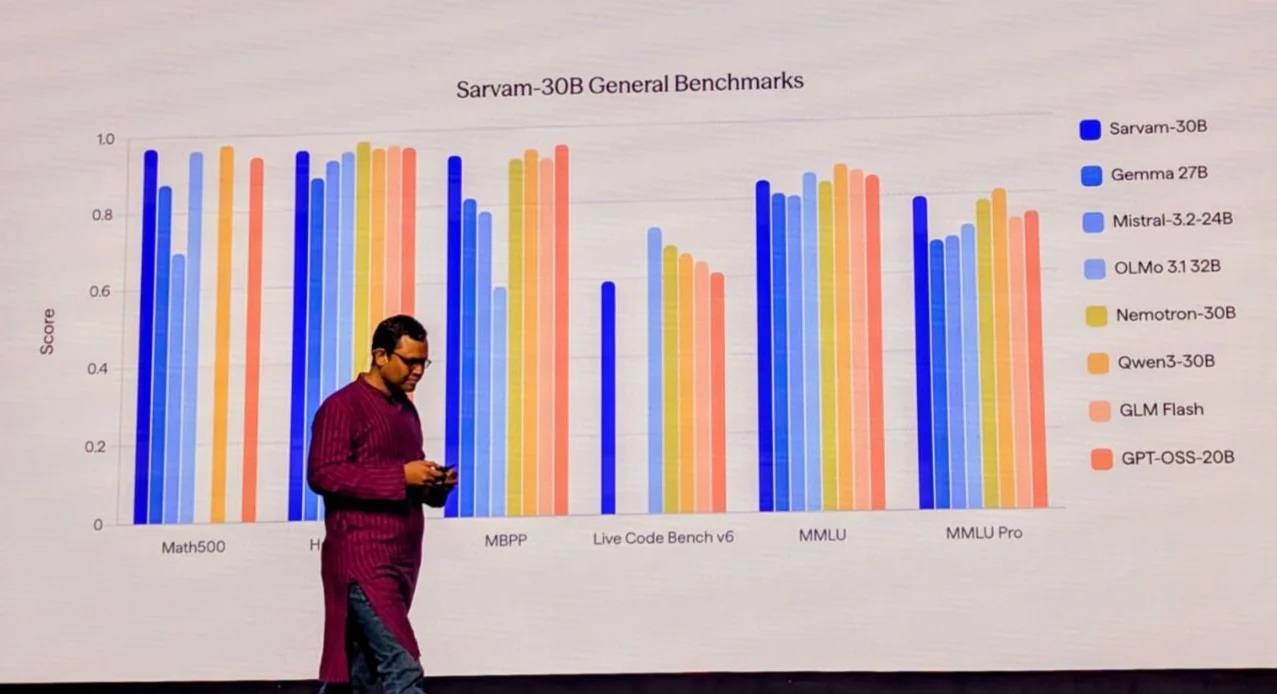
Sarvam reports strong performance across hard reasoning and programming benchmarks, including GPQA Diamond, AIME 25, MMLU-Pro, BIG-Bench Hard, LiveCodeBench and BrowseBench. It claims to be competitive in logical reasoning, code generation and web-grounded responses, while outperforming global peers in Indian-language tasks.
While independent verification of such claims will determine long-term credibility, the architectural choices—MoE efficiency, extended context windows, token optimisation and specialised VLM design—suggest deliberate engineering trade-offs rather than brute-force scaling.
Instead of competing directly with trillion-parameter research models, Sarvam is optimising for deployment economics and linguistic inclusivity.
A Different Model of AI Scale
What distinguishes Sarvam is not simply the scale of its 105B model but the coherence of its ecosystem. The company is assembling an integrated stack that spans a frontier-class MoE foundation model; a document-specialised vision-language system; lightweight speech models engineered for telephony environments; and a direct translation framework built for Indian language pairs.
Layered on top of this is an enterprise-grade orchestration engine designed to manage complex, multi-step workflows, alongside on-device wearable hardware capable of running edge models locally.
This full-stack approach contrasts with that of global AI providers, which typically focus on cloud-hosted APIs.
Government Integration and Sovereign AI
Sarvam’s trajectory is closely aligned with India’s policy ambitions. As a primary beneficiary of the IndiaAI Mission, the company has received government-backed GPU subsidies and infrastructure support.
It has also collaborated with the Unique Identification Authority of India to integrate multilingual, voice-based interfaces into Aadhaar services. In a country marked by linguistic diversity and varying literacy levels, voice-enabled public services could materially alter citizen access.
State-level partnerships with Odisha and Tamil Nadu further extend this approach, involving sovereign AI parks, data residency frameworks and sector-specific tools for agriculture, mining and workforce training.
The emphasis on domestic compute, local data residency and language coverage reflects a larger geopolitical reality: AI capability is increasingly seen as strategic infrastructure rather than merely commercial software.
If the strategy succeeds, India’s AI experience may look fundamentally different from Western deployments: voice-first, multilingual by default, optimised for edge hardware and deeply integrated into public services.

Your reaction