
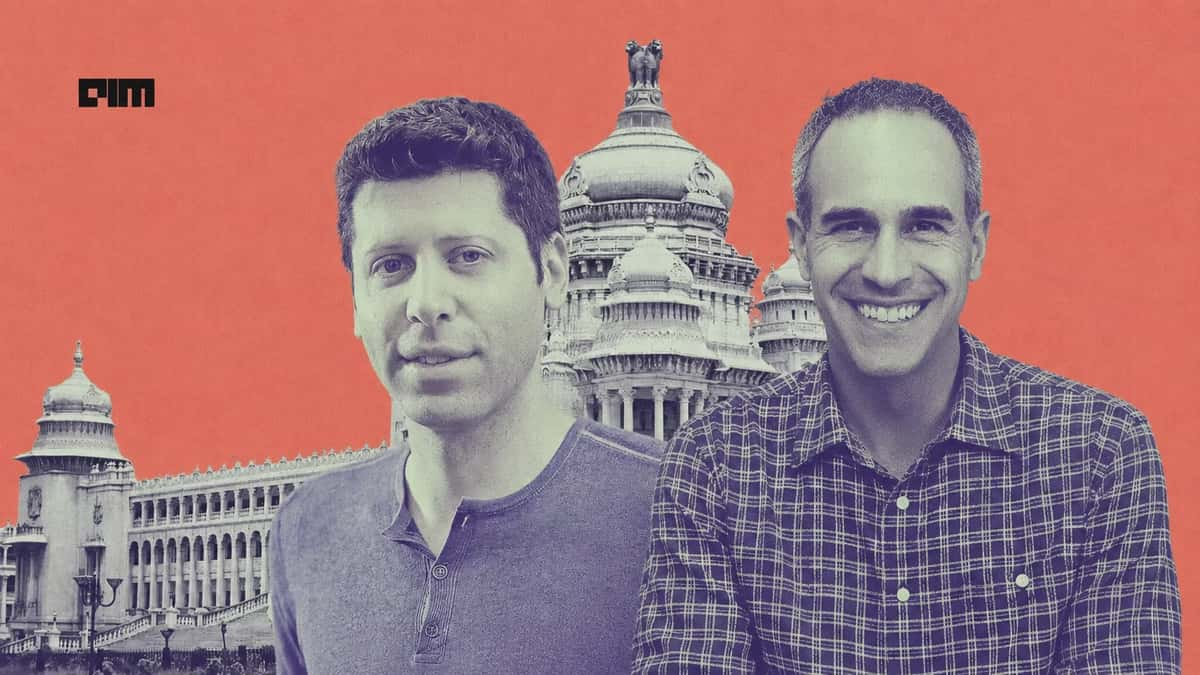

Marc Manara, who leads OpenAI’s Startups, VC and Private Equity teams, spends much of his time working with startups building on OpenAI’s models.
That also means he regularly speaks to founders worried about one question: what happens if OpenAI decides to build the same product they are building?
That question was the theme of a fireside chat between Manara and Pratik Poddar, Partner at Nexus Venture Partners, hosted by Newton School in Bengaluru. The gathering brought together AI founders, builders and startup operators from across the city’s ecosystem.
You Get Upset on New Model Launches, You Lose
Addressing what makes an AI startup truly defensible, Manara quoted a line he credits to OpenAI CEO Sam Altman.
“If you get excited when the new model comes out that your product is getting better, that’s a really good place to be building,” he said. “But if you’re upset that the model got smarter, that’s probably a less defensible and harder business to build.”
Manara explained that some startups are building capabilities that frontier models are actively catching up to.
If a new model replaces the scaffolding a company has built, it is unlikely to be a durable business. Instead, he argued, founders should build products that become more valuable as model capabilities improve.
He also said startups should not overestimate the likelihood of frontier AI labs entering every category. Customer support and coding, he argued, are large enough markets for multiple successful companies to exist. More importantly, frontier labs have limited resources and cannot build highly specialised products for every niche.
“We’re still a limited resource company despite having raised a lot of money,” he said. “We can only tackle so many problems really well.”
Manara’s argument also reflects a shift underway inside OpenAI itself.
In recent months, the company has shut down products such as Sora and moved to consolidate efforts around coding, enterprise software and ChatGPT, as executives acknowledged that trying to pursue too many initiatives at once had stretched resources.
Reports have also suggested OpenAI is scaling back side projects to focus more heavily on enterprise customers and developer tools.
Manara added that startups focused on narrow customer problems have a natural advantage because large model providers are less likely to build products tailored to those specific use cases.
Speed is The Moat
Furthermore, Manara also argued that execution speed has become a competitive advantage in AI. “Speed is more important than ever,” he said, adding that companies that adopt newer models quickly can steadily pull ahead of competitors as model capabilities improve.
Manara also distinguished between products that AI could replace directly and products that could become less relevant because workflows themselves change.
Products that can be “vibe coded” quickly and are not deeply embedded inside enterprise systems face greater risk, he said.
At the same time, he believes enterprise platforms such as Salesforce remain difficult to displace because of years of integrations, customisation and enterprise adoption, even if building a basic CRM has become significantly easier.
Manara also pointed to recent industry developments, including Airtable’s acquisition, which he said had raised questions about the future of similarly positioned SaaS companies.
However, he argued that the larger risk is not always direct competition. In some cases, AI fundamentally changes workflows, reducing the need for certain products altogether. Design software, he suggested, could be one such category if developers increasingly ‘vibe code’ working prototypes instead of creating pixel-perfect mockups.
He also pointed to design software as an area worth watching.
Rather than AI replacing existing design tools directly, developers may increasingly skip traditional design workflows and generate working prototypes immediately using AI.
Manara also described changes in how AI startups are being built. “The biggest pattern is companies are just staying smaller a lot longer,” Manara said.
He cited an eight-person startup generating “tens of millions in revenue” while using AI across engineering, hiring and customer support. Enterprise sales, he added, remains an exception, describing it as one function that “probably uniquely requires humans”.
He also said traditional product and engineering roles are beginning to converge, with engineers taking on more product responsibilities and product managers becoming increasingly technical.
Some startups are also creating dedicated AI engineering teams focused on model evaluation, platform optimisation and model selection.
Building Global Products From Bengaluru
On model economics, Manara noted that GPT-5.6 Luna’s price had fallen by 80% the previous week. He expects inference costs for a given level of intelligence to continue falling over time, allowing startups to build more generous free tiers and more agentic products at lower cost.
Manara also pushed back on the idea that founders need to be in Silicon Valley to build globally competitive AI companies.
“I think today you can build a globally competitive company from literally anywhere,” he said, pointing to Bengaluru’s “exceptional depth of technical talent”.
He nevertheless argued that founders should maintain regular touchpoints with the Bay Area, where much of the frontier AI research is taking place.
“You just have to find the connectivity to be able to be in the loop of what’s happening.”
OpenAI has been expanding its engagement with startups through OpenAI for Startups, a global programme that provides founders with technical resources, developer education, community events and access to OpenAI engineers, rather than functioning as a traditional accelerator or investment programme.
The programme offers live ‘Build Hours’, developer cookbooks, starter repositories, technical guides and founder roundtables, alongside dedicated technical support for startups building with OpenAI’s models.
The company has also expanded its startup presence in India by hiring Solutions Architects and building an applied AI team in Bengaluru to work directly with founders.
During his visit to Bengaluru, Manara said much of OpenAI’s work with startups involves hands-on technical collaboration, including building evaluation frameworks, improving AI systems and helping founders optimise their products beyond simply providing API credits.
- How This Indian AI Unicorn is Disrupting Hollywood With Digital Humans
- The AI Underwriting Engine Behind Recur Club’s ₹500 Cr Festive D2C Capital Push
- Loan Collection in India is Still Largely Manual. This AI Startup is Changing That
- The Antithesis Approach to Breaking AI-Generated Code
- The Hardest Test for India’s AI Dream
- Most of India's Nearly $500 Mn AI Boom is Squeezed Into Just 4 Deals