
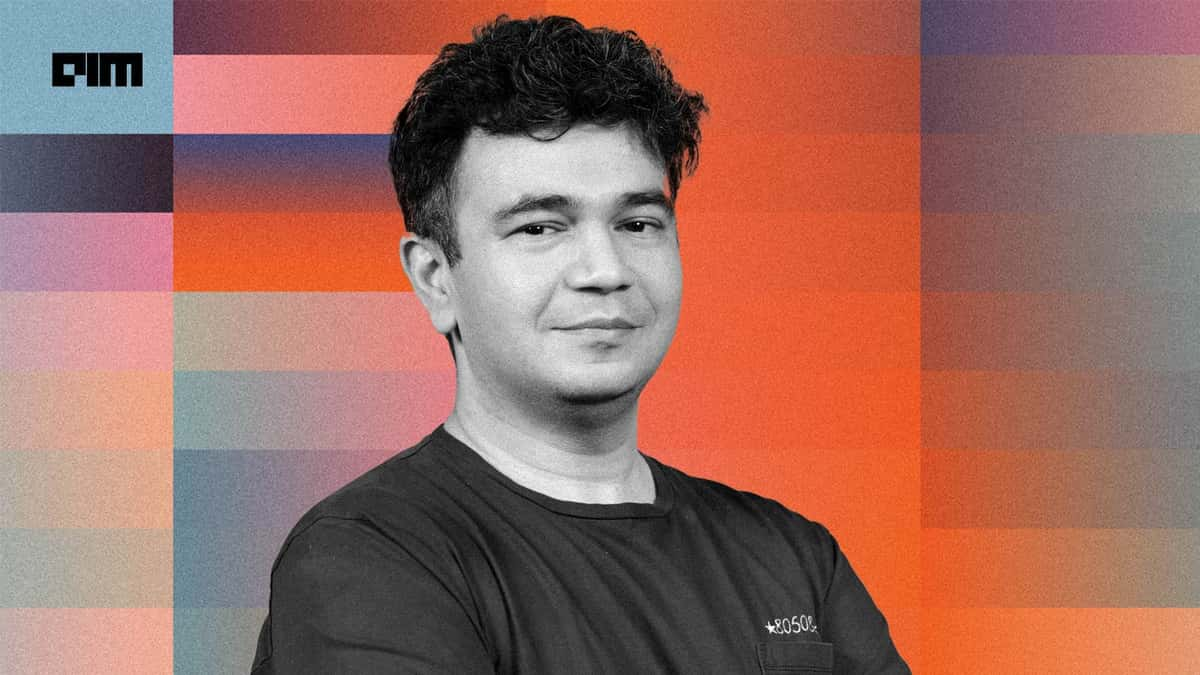

When healthtech platform Practo was founded in 2008, most hospitals in India still operated on paper files stacked inside cabinets. Yet, co-founder Abhinav Lal believed healthcare’s next major leap would come not from biology or pharmaceuticals, but from computer science and data.
Eighteen years later, as AI reshapes healthcare globally, Lal says the fragmented medical data problem Practo originally set out to solve may finally have a technological answer.
“After 18 years, things still feel very exciting,” Lal tells AIM in an interview. “I think we are at a point where a lot of ideas that we had when we started are technically becoming possible now.”
Practo began with a deeply personal problem. A friend urgently needed medical records of his father ahead of a knee surgery, but the records were inaccessible. That incident led Lal and co-founder Shashank ND—then students at the National Institute of Technology Karnataka—to think about the state of healthcare data in India.
“The health data by itself and longitudinal health data specifically are extremely valuable, but extremely fragmented,” Lal notes. “None of us had clarity on it. And that’s the problem we set out to solve.”
But solving that problem turned out to be far more complicated than digitising records. The founders eventually realised they had to solve “15 other problems” before healthcare data itself could become useful.
In hindsight, he sees Practo less as an appointment-booking platform and more as an infrastructure company built around healthcare-focused data science.
“Our hypothesis when we started the company was that the next leap in healthcare would actually come from computer science and data science,” he says.
That belief influenced some of Practo’s earliest technical decisions. At a time when most enterprise software in India was offline, Practo chose to become entirely cloud-based. It was a risky bet in 2008, when India’s internet infrastructure was still maturing, and most users accessed the internet through slow dongles.
“Every single software in the market was offline software,” Lal recalls. “Cloud was not even a term at that point. But we said it’s going to be web, it’s going to be completely online.”
Another defining decision came while building electronic medical records systems for doctors. Initially, Practo tried creating highly structured systems with strict medical coding standards. Doctors rejected it almost immediately.
“We showed it to doctors, and they laughed in our faces,” Lal quips. “Nobody wanted to use the product.”
That experience reshaped Practo’s philosophy around healthcare data. Instead of forcing doctors into rigid workflows, the company allowed records to remain flexible and unstructured.
“Our hypothesis at that point in time was that eventually the technology would get to a point where even unstructured data would be useful,” he shares. “As long as it is digital and not handwritten, sitting in a paper cabinet, it is valuable.”
Today, Lal believes AI has validated that approach.
“We have gotten to a place where most of the labelling can happen automatically,” he adds, referring to AI systems that can structure and interpret medical data. “Even frontier models off the shelf can give you better than human accuracy in labelling medical data.”
Practo has been experimenting with machine learning since 2014–15, beginning with search and doctor recommendation systems. The company’s earliest AI efforts focused on understanding patient intent and matching users with relevant doctors and specialities.
Now, AI is deeply embedded in the company’s workflows. Practo uses internal AI tools across customer support, sales, and operations, while also piloting doctor-facing copilots and consumer healthcare chatbots.
Lal reveals that nearly 60–65% of the company’s code is already AI-generated. “There are certain areas where the code is 100% AI generated now,” he notes. “I think in the next quarter or two we will be closer to 100% AI-generated code.”
Yet Lal remains cautious about how AI is applied in clinical care. He repeatedly stressed that healthcare is fundamentally probabilistic, making blind dependence on large language models dangerous. “Everybody thinks healthcare is a deterministic system. It’s not.”
According to Lal, most current AI systems remain unreliable for diagnosis and can easily reinforce user assumptions. “They are sycophantic. They will agree to everything that you say,” he explains. “You can convince the LLM to tell you you have a gallbladder problem and should eat this medicine.”
Instead of replacing doctors, Lal sees AI as a tool for healthcare navigation and augmentation—helping patients find the right care while assisting doctors with decision-making.
For Lal, the urgency behind AI adoption is also tied to a larger healthcare access crisis. He points out that most doctors in India remain concentrated in major urban centres, leaving large parts of the country underserved. “Top 10 cities account for the majority of the doctors,” he says.
He believes AI could eventually help bridge that gap, much like coding copilots are changing software development today.
“We have been asking doctors to have the full map of diseases, symptoms, and conditions available in their heads and do it right 100% of the time,” Lal said. “I think we are going to see a similar innovation happening on the provider side, where doctors will focus on higher-order problems and give better care.”
- Drizz Is Taking on the Reliability Challenge in AI App Testing
- How This Indian AI Unicorn is Disrupting Hollywood With Digital Humans
- The AI Underwriting Engine Behind Recur Club’s ₹500 Cr Festive D2C Capital Push
- Loan Collection in India is Still Largely Manual. This AI Startup is Changing That
- The Antithesis Approach to Breaking AI-Generated Code
- The Hardest Test for India’s AI Dream