Key takeaways
- Remix is a React-based framework aiming to improve web app performance and search optimisation through server-side rendering.
- Unlike Next.js, Remix focuses solely on server-side rendering and does not support static site generation or incremental static regeneration.
- JAM stack applications, which use static generation, are popular for their speed but pose challenges when data changes.
- Remix requires developers to utilise an actual server for application hosting, emphasising its dedication to server-side rendering.
There is a race going out there in the tech world—who renders web apps faster. React, React Native, Gatsby, Next.js, and Astro are all huddling to outrun each other to help developers build a faster-loading web app. The latest is ‘Remix’, a React-based framework for developing web applications, which is also trying to catch up in the race.
Remix allows developers to render code on the server which tends to result in better performance and search optimization as opposed to using React only on the client side.
It seems as though the problem has already been solved by Next.js, however the company has been trying to do it in a different way. It only does server side rendering (SSR). In addition, it doesn’t do static site generation or incremental static regeneration like NextJs does.
That’s somewhat interesting considering JAM stack applications that use static generation have been quite popular in recent years and have also delivered better performance. They are fast and easy to deploy, but the biggest challenge with it is that developers have to build those pages whenever the data changes.
With Remix, it goes all on to server-side rendering, which means developers will need to hire an actual server to run the application.
Why Remix is solving the problem via SSR
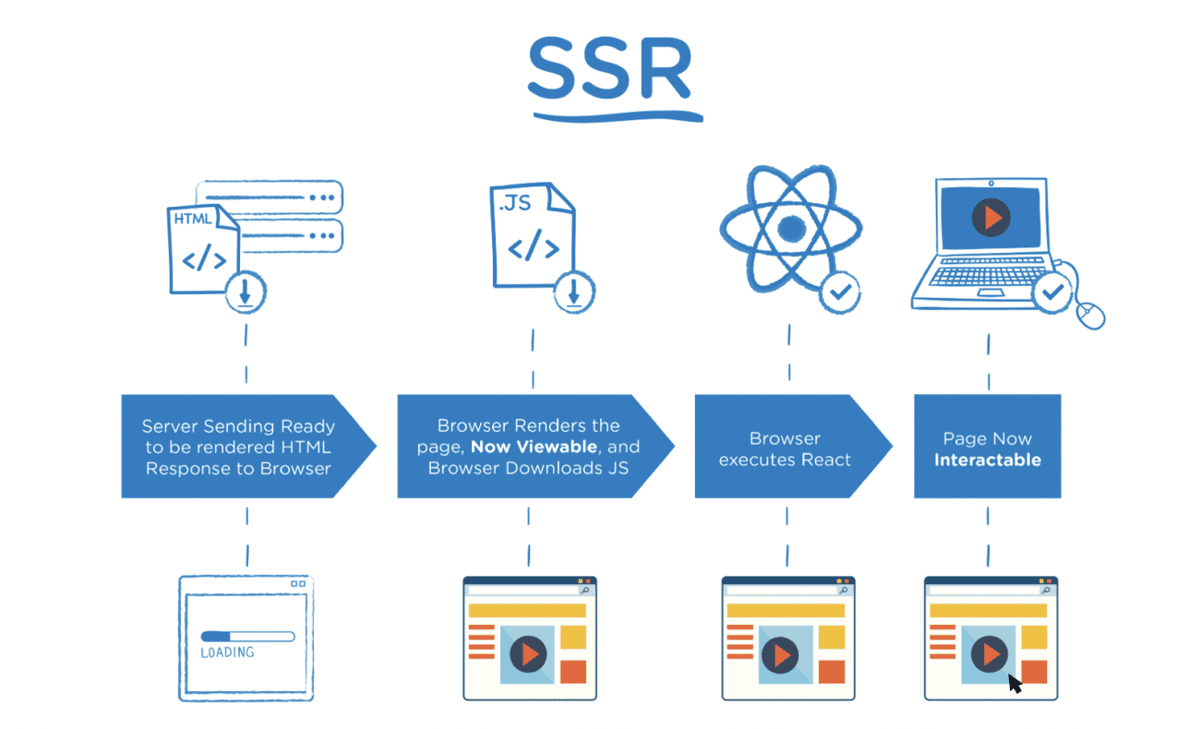
In server-side rendering, the server’s response to the browser is the HTML of the page that is ready to be rendered. It means that the browser will start rendering the HTML from the server without having to wait for all the JavaScript to be downloaded and executed. Then, React will need to be downloaded and go through the process of building a virtual dom and attaching events to make the page interactive while the user can start viewing the page simultaneously as all of that is happening.
According to experts, a server-side rendered (SSR) application makes it possible for pages to load more quickly, thereby enhancing the user experience. Since content may be rendered server-side before the page loads, this is excellent for SEO because search engines can simply index and crawl the content. Web browsers give priority to web pages with faster load speeds, so web pages are correctly indexed.
Besides, for users with sluggish internet connections or obsolete equipment, server-side rendering makes it easier for web pages to load quickly.
While there are certain advantages with this approach, there are disadvantages too.
The risks involved
As server-side rendering is not the norm for JavaScript websites, the server bears the full cost of rendering content for users and bots, which can be both expensive and resource-intensive.
Although it is effective to render static HTML on the server, doing so for larger, more complicated apps can cause load times to increase. Besides, third-party JavaScript code might not be compatible with server-side rendering. Even though rendering on the server is appropriate for static site generation, more complicated apps may have an overall slower page rendering due to frequent server calls and entire page reloads.
Is Remix better than Next.js?
Since websites often consist of numerous pages that display either static or dynamic content, ‘routing’—or, the process of moving between different pages within a website—is a crucial function.
A file-based route, where the user generates a file and it is immediately accessible via their browser, is supported by both Remix and Next.js. For instance, after bootstrapping a new project in Remix, you can add a new file to the routes folder. Additionally, both frameworks feature client-side route navigation—which enables users to access pages without having to reload their browsers—along with dynamic routes.
Remix uses nested routes, which makes it unique. Although Remix enables the user to design a hierarchy of routes where each route is a separate file that can choose where its children should be shown, Next does support nested routes from a file perspective—implying that the user can have several active routes on a single page.
Remix offers most of the functionality offered by Next but it makes an additional effort to steer clear of React by offering a higher level of abstraction. Conversely, Next does not try to hide the fact that it is completely dependent on React.
Next may be the preferable option for React experts as it deals with more well-known ideas, but for new developers who are less experienced with React, it may be far simpler to begin by utilising Remix directly.
The age of each framework is another inevitable reality. Remix is just an entrant into the game while Next has been there for nearly half a decade. The age factor allowed Next to add a lot of performance optimisation such as inline-font optimization, image optimization and more into it—which Remix just hasn’t had the time to add yet.