
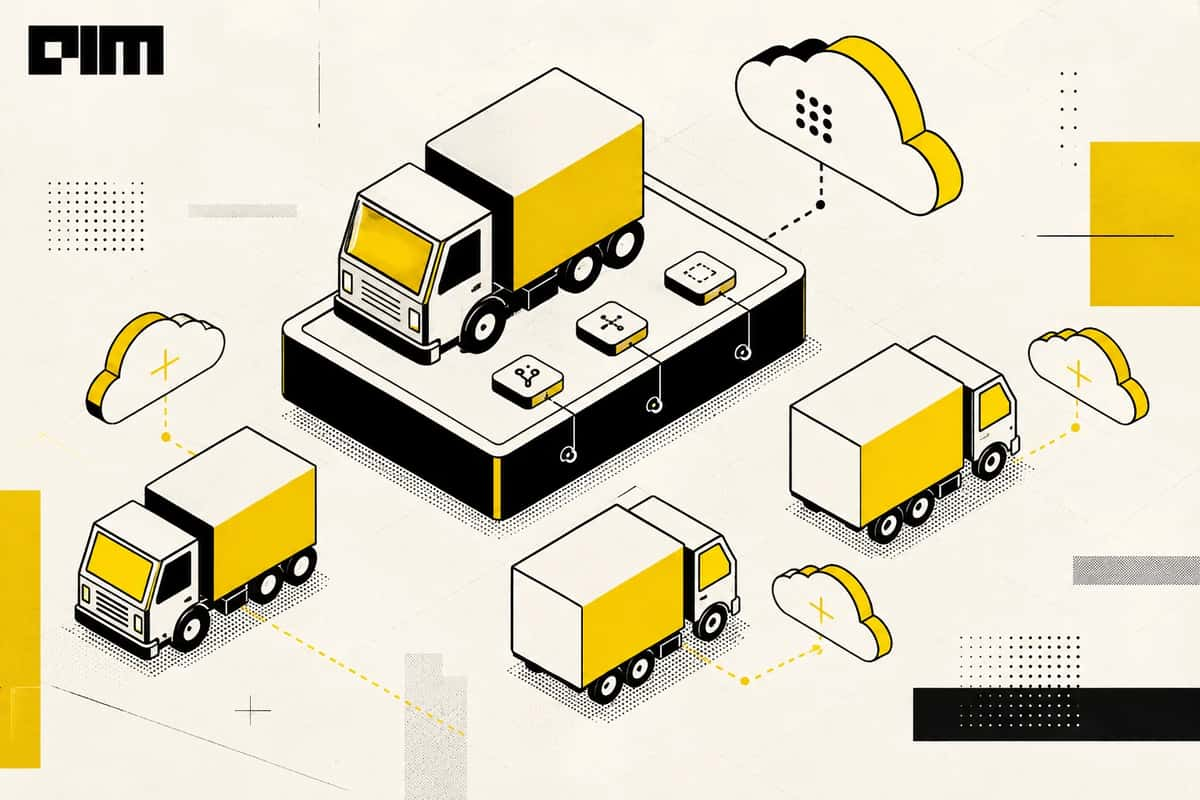
For a commercial vehicle maker, connecting a vehicle is only the beginning. The harder problem is what happens to the data after it leaves the vehicle.
Every connected truck, bus or fleet vehicle generates a constant stream of information from telematics devices and sensors. That data needs to be ingested, transformed, processed and pushed into systems that power everything from fleet tracking and driver scoring to predictive maintenance and route optimisation.
For Volvo Eicher Commercial Vehicles (VECV), that challenge has grown significantly. The company now has more than 2,50,000 connected vehicles on its digital platform, MyEicher, making the underlying data infrastructure a critical part of its connected-vehicle strategy.
“The connected platform that we have developed is serving those connected vehicles for our customers,” says Ajay Mittal, General Manager of IT at VECV.
How Did it Start?
VECV, a joint venture between Volvo Group and Eicher Motors, began its connected vehicle journey in April 2020, when it announced that all vehicles produced from that point would be connected through telematics. The move covered its range of heavy-duty trucks, light and medium-duty trucks and buses.
The scale has grown rapidly since then. But as the connected vehicle programme expanded, the company found that its existing streaming infrastructure was becoming a constraint.
The problem was not simply the volume of data. The platform was tied closely to a cloud provider, making deployment and cost management more difficult. It also lacked capabilities specific to commercial vehicles. Processing different telematics protocols, implementing geofencing or integrating with fleet management systems often meant building additional code and services around the core streaming platform.
That created another problem. Engineering teams were spending time managing infrastructure and application logic instead of building new mobility features.
VECV needed a streaming layer that could scale with its vehicle population without locking the company into a particular cloud environment. It also wanted greater control over where its data lived and how it was processed.
Where Zeliot’s Condense Platform Comes in
Condense is a Kafka-native streaming platform designed for real-time mobility applications. VECV deployed it within its own Google Cloud environment through a Bring Your Own Cloud model. Instead of sending its vehicle data through an externally controlled streaming environment, Condense became the data gateway inside VECV’s own cloud.
That distinction matters for a connected vehicle business. Vehicle data can contain sensitive information, including personally identifiable information, and VECV wanted the architecture that would keep that data within its own environment.
Mittal says the approach let VECV retain control over its data, security and compliance requirements while using Condense as the streaming layer.
The platform now sits at the front of VECV’s connected architecture. Data from vehicles and telematics devices enters through Condense, where it can be transformed and routed into downstream systems such as MyEicher, analytics platforms and other applications.
The architecture is also designed to handle a fragmented vehicle ecosystem. Connected vehicles do not necessarily generate data in one standard format. Condense supports ingestion across more than 500 telematics protocols, helping VECV handle both its standard devices and aftermarket devices used in its multi-fleet offerings.
That device-agnostic approach is becoming increasingly important as vehicle digitalisation expands beyond basic tracking.
VECV is now adding capabilities such as driver state monitoring and other vehicle digitalisation features. Condense is intended to act as a common gateway for these new data sources, rather than forcing the company to build a separate integration layer for every new device or service.
The Data Solution
There is also a shift in what VECV wants to do with the data.
The company is looking beyond simply collecting and storing information. Its connected platform is being used for track and trace, analytical insights and operational intelligence. At the same time, VECV is working on data operations and KPI monitoring closer to the edge of its cloud environment, with the goal of identifying issues and generating insights in near real time.
That is particularly important for commercial fleets, where being reactive can have a direct operational cost.
The migration also had a financial dimension. According to the company, the move to Condense reduced cloud spending by 20%, while development and operations effort fell by 40%. VECV also says the use of pre-built mobility modules helped accelerate its go-to-market timeline by six months.
The underlying idea is fairly simple: instead of treating streaming as generic infrastructure that has to be assembled and maintained around the business, make it part of the mobility stack itself.
For VECV, the other major consideration was scale. The company evaluated Condense for its ability to handle increasing vehicle volumes before moving ahead. Cloud costs, operational manageability, scalability and deployment flexibility all became part of the technology decision.
The Journey is Far From Over
As more vehicles become connected and new digital features are added, the streaming layer will have to handle more devices, more data and more real-time applications. VECV is also looking at command-centre capabilities, SIM management and additional integrations with telecom service providers.
The larger lesson is that connected mobility is increasingly becoming a data infrastructure problem. Having 2,50,000 connected vehicles is useful only if an organisation can turn the data they generate into something its customers, dealers and internal teams can actually use.
For VECV, Condense is becoming one of the building blocks underneath that transformation: a cloud-agnostic data gateway that gives the company control over its infrastructure while taking some of the operational burden away from its engineering teams.
As commercial vehicles become increasingly software-defined, that data layer may prove just as important as the connectivity itself.
- Internet on Alert as AI Uncovers Critical Flaws in PHP Used by 70% of Websites
- From Claude Code Mods to Super Mario: What People Are Building on Jev
- 8 Reasons Why Anthropic’s New Report is an AI Doomer’s Worst Nightmare
- Anthropic Stands Alone Against Open Models
- The $205 Bn AI Bet Google Can’t Afford to Lose
- GLM 5.2 Wins Over Developers After Anthropic Fable Ban