Key takeaways
- Current NLP applications mainly focus on chatbots that often require short, one-word answers.
- Open-domain question answering is essential for evaluating natural language understanding capabilities.
- Existing QA systems are limited to single-word or phrase responses and struggle to provide detailed explanations.
- Facebook AI has introduced a large-scale dataset for long-form question answering to enhance the quality of AI responses.
- The ELI5 dataset aims to enable machines to generate comprehensive and complex answers, advancing AI capabilities.
 Most of the modern day NLP applications are deployed for chatbots, which is a conversational task involving questions which require mostly one word answers. This makes open-domain question answering (QA) a crucial benchmarking task in natural language understanding (NLU).
AI researchers and linguists have been collaborating to figure out a way to supplement the pursuit of General AI with a structure, universal at its core and flexible in its deployment.
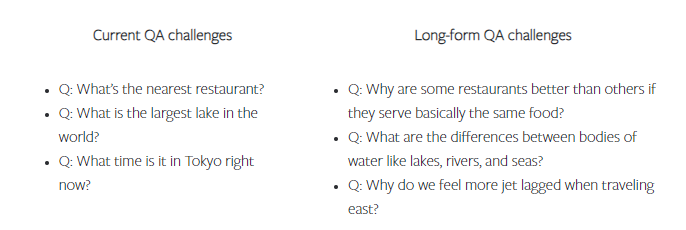
Most existing QA tasks are constrained — both to specific knowledge domains and to answers of a single word or phrase from the input passage. They require identifying a simple fact in a single web document, which is then presented as the answer, but existing QA systems can’t offer rich explanations the way people do.
To help advance question answering (QA) and create smarter assistants, Facebook AI has shared the first large-scale data set, code, and baseline models for long-form QA, which requires machines to provide long, complex answers.
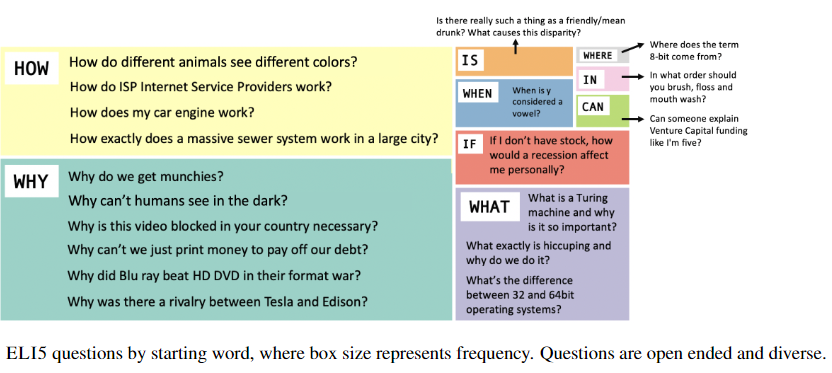
Overview Of ELI5 Dataset
Generating Abstract Models

- extractive models, which produce answers that are copied word for word from the supporting documents, and
- abstractive models, which can rewrite the information in the supporting documents as needed.