



Key takeaways
- Intel plans to manufacture five new semiconductor nodes within four years to advance its AI strategy.
- Two new nodes, Intel and Intel Core Ultra, were announced at the AI Everywhere event.
- Gaudi3 AI accelerator, a significant product, was revealed, showcasing Intel's commitment to AI innovation.
- Intel's roadmap indicates that significant progress on AI products is already underway.
- CEO Pat Gelsinger emphasizes overcoming skepticism about the ambitious manufacturing timeline.
Intel has a well thought out plan for the upcoming years when it comes to AI. And it was pretty evident at the recent AI Everywhere event hosted by the company, where the company announced a line of products like AI PCs, five semiconductor nodes, and the upcoming Gaudi3 AI accelerator.
“Shortly after my return to Intel Corporation, we set out a tremendously audacious goal – to manufacture five new process technology nodes in just four years,” Pat Gelsinger, CEO of Intel posted on LinkedIn.
Two nodes, Intel & and Intel Core Ultra were announced at the AI Everywhere event. While Intel 3 is going into production next year, Intel 20A which he calls a work of art, and the last 18A will be available by the end of next year and are developing in the fab. Gelsinger posed with them like a happy family.
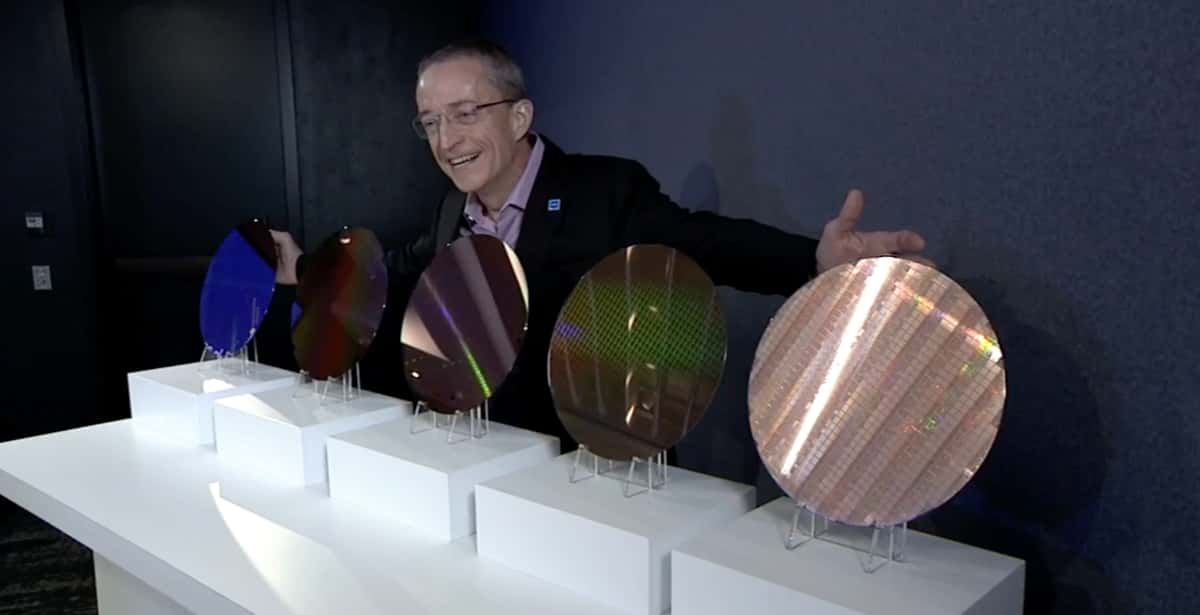
“I like to just have one other little thing to show off here and they just brought it out of the lab,” just before the end of the conference, Gelsinger walked in with the first ever Gaudi3 AI accelerator.
“When we first announced this goal, many stated this would be nearly impossible. But we're doing what we set out to do - a decade of semiconductor work in just four years. Two out of these five nodes are complete. The remaining three are underway and on-track.” Intel’s roadmap for AI looks great and a lot of it is already underway.
Gelsinger believes that the supercomputer that Intel is building will be the largest in Europe, powered by Gaudi3. Intel also announced the 5th generation of Xeon processors that would power Microsoft, Google, and IBM’s data centres.
The expansionist agenda
To ensure that the roadmap works well, Intel has secured a $3.2 billion grant from the Israeli government for the construction of a new $25 billion chip plant in southern Israel. This marks the largest investment ever made by a company in Israel. Intel's expansion plan at its Kiryat Gat site, located 42 km from Hamas-controlled Gaza, is described by Intel as a crucial step in fostering a more resilient global supply chain.
Gelsinger has projected that the GPU market size would be around $400 billion by 2027. This definitely gives room for a lot of competitions to thrive, and thus there is a lot expected from Intel. Thus, he has led Intel's substantial investments in building chip factories across three continents to regain dominance in chip manufacturing.

In Germany, Intel is set to invest over 30 billion euros ($33 billion) in establishing two chip-making plants in Magdeburg, as part of a multi-billion-dollar investment initiative in Europe to boost chip production. Germany has offered substantial subsidies to secure its largest-ever foreign investment.
Additionally, Intel also announced a plan in 2022 to invest up to $100 billion in building what could be the world's largest chip-making complex in Ohio.
Intel also has a bunch of partnerships for its AI PCs goals. At the event, Gelsinger and his team announced the launch of Intel Core Ultra and Intel Arc GPUs for pushing the goal of making every PC in the world an AI PC. This will be achieved by its partnership with Dell, Lenovo, HP, Supermicro, and Microsoft, for bringing the hardware onto their devices.
Intel’s unique position in the industry, marked by openness, scalability, and end-to-end solutions, allows for the seamless infusion of AI capabilities into every platform. This is well established given that Intel was the first to produce the first commercial microprocessor chip in 1971, and has been the leader in developing components for PCs.
A long roadmap
During Intel’s recent conference call, Gelsinger stated, “Our Gaudi roadmap remains on track with Gaudi3 out of the fab, now in packaging and expected to launch next year. Looking ahead to 2025, Falcon Shores will integrate our GPU and Gaudi capabilities into a unified product.”
Gaudi3 is expected to arrive with a 5nm chip. The accelerators are set to provide a significant boost with up to 4 times the BFloat16 capabilities, double the compute power, 1.5 times the network bandwidth, and a 1.5 times increase in HBM capacities (144 GB compared to 96 GB).
In 2025, the successor to Gaudi3, Falcon Shores, will merge the AI capabilities of Gaudi with the powerful GPUs from Intel, all within a single package. This is something that would give Intel the edge over others.
Intel is also planning to onboard another version of the AI accelerator superchip, Falcon Shores 2, by 2026, which would be based on the Gaudi3 architecture. “We have a simplified roadmap as we bring together our GPU and accelerators into a single offering,” Gelsinger said. Though this is a far-out vision, the reveal at the AI Everywhere conference also gives out some hope for the company.
Intel has a long road ahead to compete with NVIDIA and AMD, and Gelsinger is definitely helping the company pave the path faster.
Spotted an error? Tell our editors. Read our editorial standards and corrections.


