

Setting sail on a futuristic world where AGI and super intelligent beings thrive amongst humans, a world where you have to prove yourself to be human -- Worldcoins are supposedly out to help you. Using orb-sized devices that once scanned your iris, your biometric is going to be the human identifier needed to survive. As dystopian as the futuristic world sounds, OpenAI CEO Sam Altman’s Worldcoin is preparing for it.
The project is released to the world, but with a catch. The very place where Worldcoin was founded, will be deprived of the service. Worldcoins will not be available in the US. Surprised?
Worldcoin, an iris biometric cryptocurrency founded in 2019 by Altman, Max Nivebdstern, and Alex Bania is backed by VC firm Andreessen Horowitz. The project provides crypto tokens WLD in exchange for scanning your eyeballs during registration, and aims to distinguish humans from AI online, and enable a global democratic process and increase economic opportunity. While this marks Altman’s foray into cryptocurrency, the company’s access to human assets in the form of biometrics has raised a lot of questions, but that didn't stop a 17% uptick in its prices within 24 hours of its worldwide release.
Not Under My Watch
The biggest irony of all this is that in a country where the latest technology developed by Silicon Valley sees the light of day before the rest of the world, Worldcoin is facing the opposite route. Owing to regulatory restrictions in the cryptocurrency market, the company cannot operate in the country. Following the crypto debacle that occurred with FTX’s Sam Bankman-Fried, US regulators have been vigilant with its control.
A number of regulatory bodies such as the Securities and Exchange Commission (SEC), the Commodity Futures Trading Commission (CFTC), the Federal Trade Commission (FTC) and many others govern the crypto market in the US. However, none of them have banned any form of cryptocurrency in the US. It is possible that Worldcoin is taking a precautionary approach to avoid any form of backlash that may occur.
Though not available for US citizens, the ‘Orb tour’, for educating and answering questions about the same has been set up in Miami, San Francisco and New York City. Altman said that when he started the project, he did not think that it would end up becoming ‘world minus the US coin'. He doesn’t seem perturbed by the situation -- “95% of the world’s population is not in the US. The US does not make or break a project like this.”
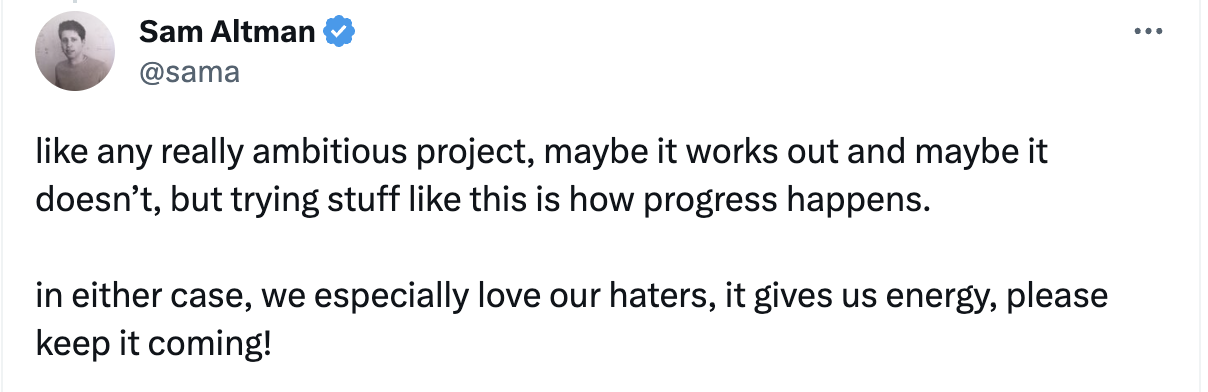
Source: Twitter
Coin for the ‘World’
From its beta period, the project has over 2 million users, and has now scaled its operation to 35 cities across 20 countries. The EU, which is believed to have one of the strictest regulatory bodies when it comes to security and privacy, have surprisingly allowed Worldcoin. The EU is known for penalising tech companies for using sensitive user data, and even banning apps, for instance, Meta’s Threads was not launched in the EU owing to privacy concerns. So considering how such restrictions have prevented the functionings of big tech in this region, the move to allow Worldcoin there was astounding.
However, it looks like countries are slowly waking up to it. In the latest development, the regulatory bodies in the UK said that they will be making enquiries about the Worldcoin project. It is possible that other countries may follow.
Route through Developing Markets
In a country such as India, where there are no guidelines or regulations in place for any form of disputes around cryptocurrency, trading will be done at investors' risk. Hence, the whole operation in India is not under any form of restrictions at the moment. Orb operators are set up across 18 locations in India, including Bengaluru. It is interesting to note that Worldcoin has been released in a number of developing countries, including African countries such as Kenya, Uganda, Nairobi, and Lisbon. These countries do not have any regulatory framework for trading cryptocurrency -- giving a free pass for Worldcoin.
World coin not being available in the US sounds like one of those anticlimactic endings, however the company has never ruled out the market. Looks like Altman couldn’t find a way to make it happen at the moment, but nothing is impossible. After all, even the EU was reportedly influenced to weaken the EU AI Act to reduce the regulatory burden on OpenAI.

Your reaction
Discussion
What's your take on this story?
No comments yet — be the first to share your view.