
Researchers from ByteDance and the University of Hong Kong recently developed Groma, a multimodal Large Language Model (MLLM) that excels in region-level image tasks by utilising a localised visual tokenisation approach and leveraging GPT-4V.
Groma excels not only in comprehensive image understanding but is also adept at region-level tasks such as region captioning and visual grounding. Instead of depending on LLMs or external modules for localization, Groma leverages the spatial understanding capability of the visual tokenizer. This ‘perceive-then-understand’ design also resembles human vision process.
In this localized visual tokenization mechanism, an image is segmented into regions of interest, which are then converted into region tokens. Groma encodes the image into both global image tokens and local region tokens. By integrating region tokens into user instructions and model responses, Groma understands user-specified region inputs and ground its textual output to images.
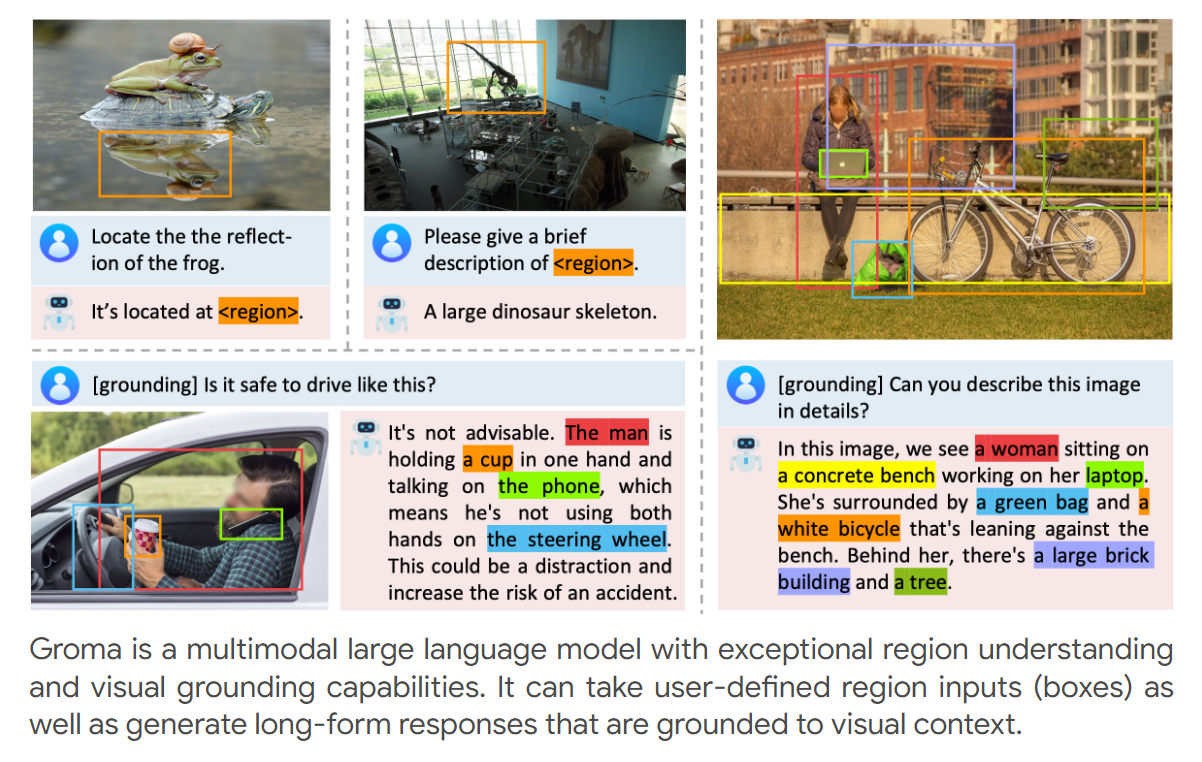
Source: github.io
Furthermore, to improve Groma's ability to engage in visually grounded conversations, the team curated a dataset of 30k visually grounded conversations for instruction finetuning. This marks the first grounded chat dataset constructed with both visual and textual prompts, leveraging the powerful GPT-4V for data generation.
In contrast to other MLLMs that depend on the language model or external module for localization, Groma consistently shows superior performances in standard referring and grounding benchmarks. This highlights the benefits of embedding localization into image tokenization.
- Coforge Revenue Rises 54% as AI Engineering and Deal Bookings Gain Momentum
- Tech Mahindra Partners With SpaceXSI to Bring AI Into Software Engineering
- Infosys AI Revenue Rises 29% in Q2, FY27 Growth Guidance Cut
- LTM Launches BlueVerse Industrial AI Lab in Chennai
- Chariot Launches Speech Recognition Model for 10 Indian Languages
- Meta Expects Up To $145 Billion In Capex As AI Investments Expand