
Space is becoming the next frontier for agentic AI. Instead of just orbiting cameras, satellites are now becoming coordinated, decision-making systems.
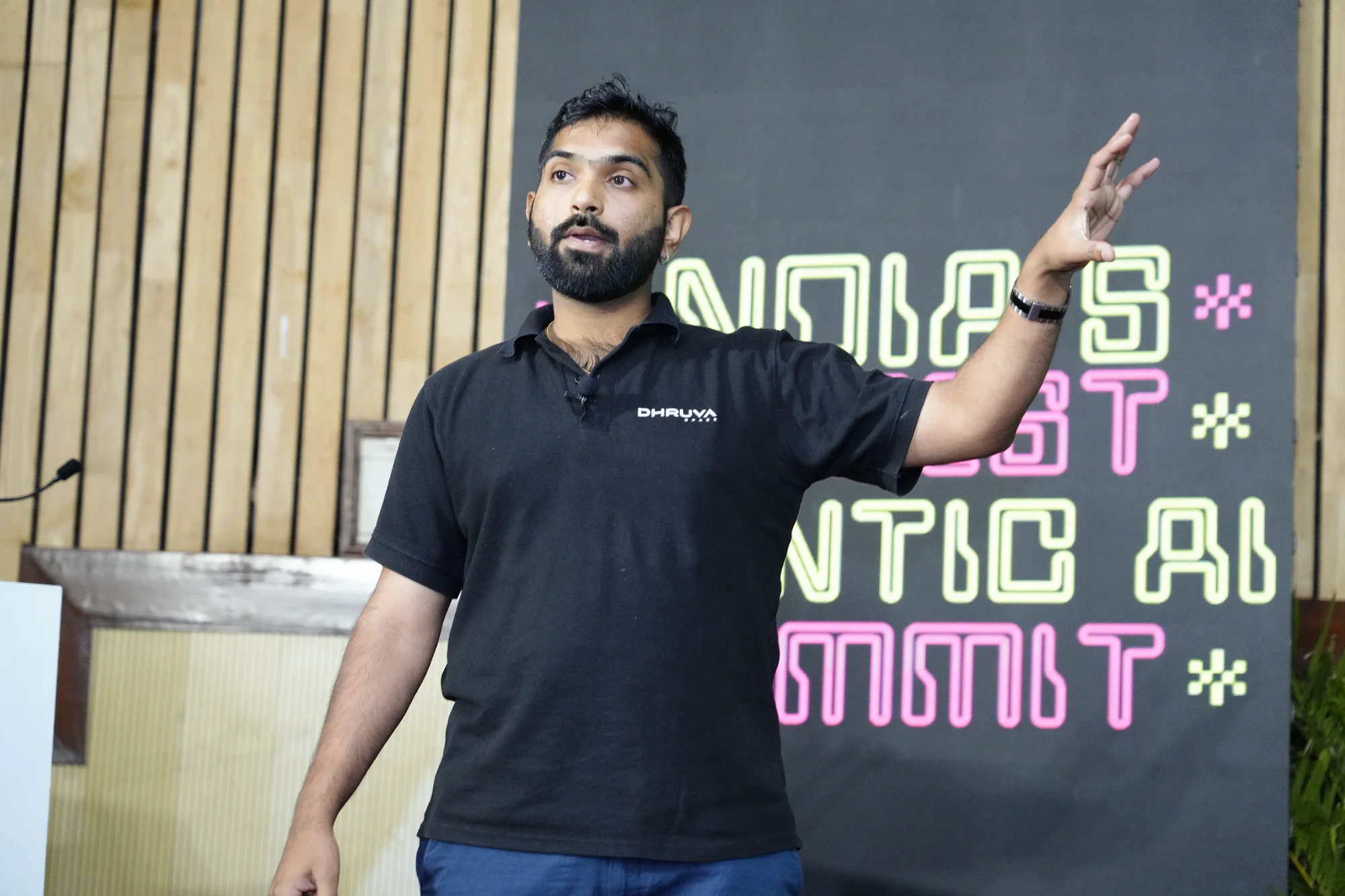
Speaking at MLDS, India’s biggest agentic AI conference organised by AIM, Radha Krishna Kavuluru, Associate Director at Dhruva Space & former Scientist at ISRO, walked through how this transformation is unfolding. His core message was that building satellites is no longer the hardest problem—making sense of what they capture is.
Satellites generate enormous volumes of data, but their real value lies in how quickly and accurately that data can be translated into decisions.
Across industries such as agriculture, satellites already influence outcomes in subtle ways. Insurance providers, for instance, rely on satellite-derived insights to estimate crop yields and assess risk.
“Banks and NBFCs… see whether a region has the capability to get the estimated yield… and based on that, they take insights on whether the premium has to be high or lower,” he explains.
Yet, while commercial use cases are growing, defence remains the most demanding and best-funded use case for satellite intelligence.
The Three Pillars of Space Data
Kavuluru outlines three primary types of satellite data that drive modern intelligence systems.
Optical imagery, familiar from platforms like Google Maps, provides highly detailed visuals but depends on sunlight and clear skies.
Synthetic Aperture Radar (SAR) offers a different advantage. It works through clouds and at night, producing black-and-white imagery that is less intuitive but far more reliable in adverse conditions.
Then there is radio frequency (RF) data. “If you’re talking on your phones… these signals… go to space,” he says. Specialised satellites can detect and geolocate these emissions, effectively mapping communication activity on Earth.
Each data type fills gaps left by the others. Together, they create a multi-layered view of reality.
Tip-and-Cue: How Satellites Work Together
To scan large areas, satellite systems rely on what Kavuluru describes as a ‘tip-and-cue’ architecture.
Wide-area satellites first scan large regions, identifying anomalies. “Tip is basically scanning the bigger size AOI (Area of Interest),” he says. Once potential targets are detected, higher-resolution satellites are tasked to zoom in. “You detect, and then you go for a high-resolution scan.”
This layered approach balances speed and precision. Wide swath scans may cover hundreds of kilometres but lack detail. Narrow scans provide clarity but over smaller areas.
What used to be a manual process is now automated. “Today… we get an Intel report, and everything is automated. The satellites give data, and we are already getting insights.”
The Rise of AI Agents in Orbit
At the heart of this system are AI agents coordinating tasks across satellites, sensors, and ground infrastructure.
These agents decide which satellites to task, optimise coverage, and even compensate for gaps. If one data source falls short, another takes over. “If SAR is not able to cover some amount of data, it offloads it to RF satellites,” Kavuluru explains.
Even ground operations are part of the equation. Satellites must downlink data to Earth through ground stations, a process constrained by time, location, and bandwidth. “This is an optimisation problem,” he notes, describing how systems dynamically assign antennas and schedule downloads.
Cloud providers are entering this layer as well. Ground stations are now accessible via services like Amazon Web Services, allowing companies to “pay per minute and control the entire antenna.”
From Pixels to Decisions
Once data reaches Earth, machine learning models take over.
In maritime scenarios, identifying ships is relatively straightforward. “Ships in water are easily detectable,” Kavuluru says, noting that even basic convolutional neural networks can perform well.
On land, however, the complexity rises. Military assets are often camouflaged, constantly evolving, and lack standardised training data. Instead of relying purely on object recognition, modern systems interpret contextual understanding.
A new road, unusual construction, or the sudden appearance of large vehicles can signal activity. “The entire context is there,” he says. “It is able to give us some kind of inference that there may be some activity going on.”
Building a Living Knowledge Graph
Detection is only the first step. Correlation comes next.
Once a vessel is identified, systems compare it against historical databases, analysing its shape, movement, origin, and even wave patterns to estimate speed and class.
Over time, this feeds into what Kavuluru describes as a structured intelligence system akin to a knowledge graph. “We are maintaining a hierarchy… central command, regiments, units… all this knowledge is maintained, and you keep tracking it.”
This evolving database enables what defence agencies call a “complete war picture”, which is a dynamic map of assets, movements, and capabilities.
The Next Frontier: Intelligence in Space
The most significant shift, however, is still ahead.
Today, most data processing still happens on the ground. But that is beginning to change. Satellites are beginning to communicate directly with each other via inter-satellite links, sharing data and distributing tasks in real time.
“There are so many onboard agents that are also coming into play,” Kavuluru says. These agents can process data in orbit, decide what matters, and transmit only insights instead of raw imagery.
In some cases, this is already happening. Certain satellite constellations now deliver actionable intelligence without ever sending full images to Earth.
A New Kind of Space Infrastructure
The broader implication is clear. Space infrastructure is becoming intelligent, autonomous, and collaborative.
What once required teams of analysts and hours of processing is now handled by distributed AI systems operating across orbit and ground.
As Kavuluru summarises, satellites are now participants in a larger, agent-driven system that observes, interprets, and acts.

Your reaction
Discussion
What's your take on this story?
No comments yet — be the first to share your view.