
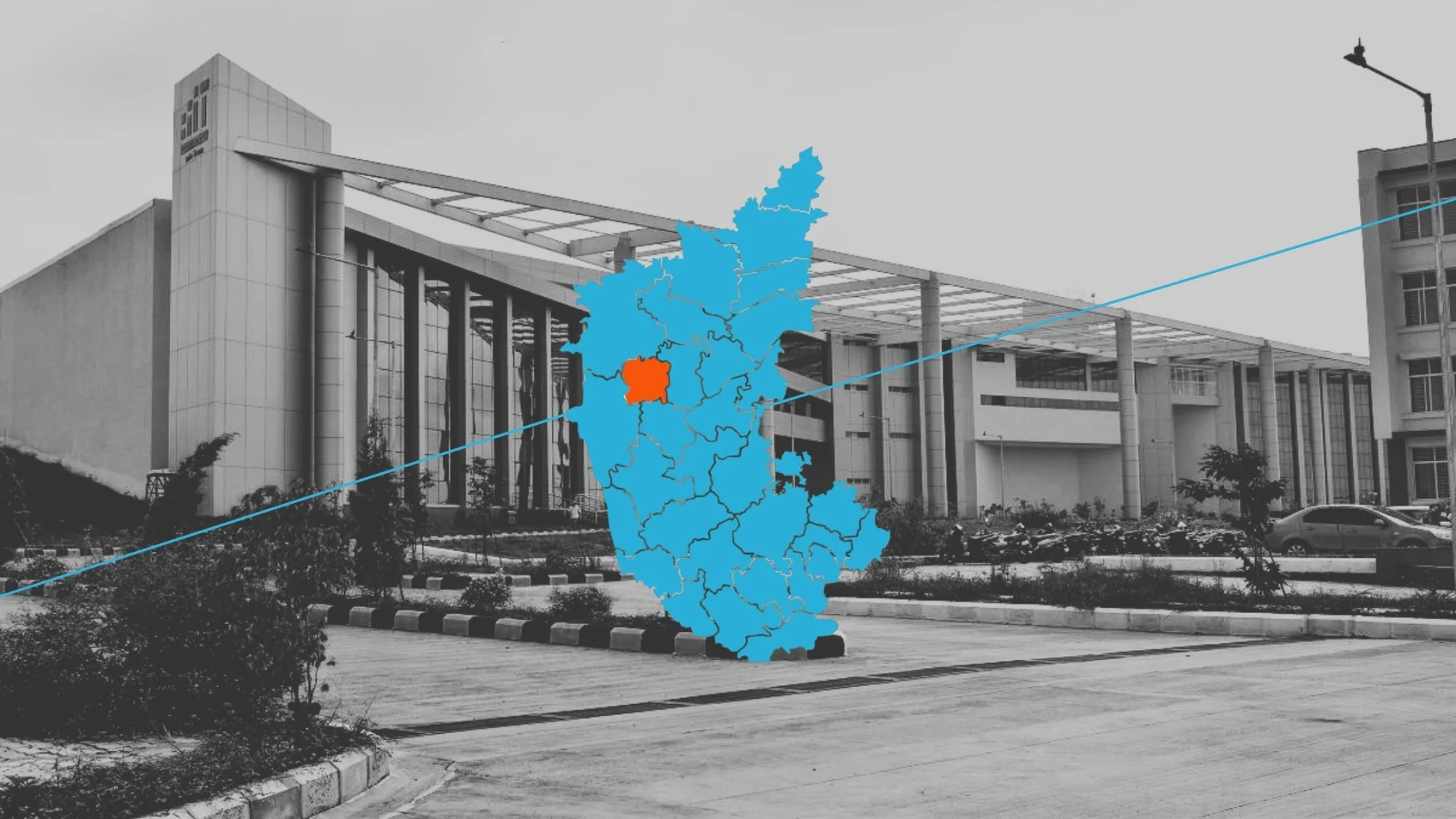
Karnataka is marching on a clear goal of moving advanced technology beyond Bengaluru into tier-2 regions. The new quantum computing facility in Dharwad is its latest bet on democratising emerging technologies.
The Indian Institute of Information Technology Dharwad (IIIT Dharwad) is setting up a Centre of Excellence (CoE) on AI and Quantum Computing with support from the Karnataka government, the Department of Science and Technology, and the IT/BT department.
The institute expects the facility to be operational within three to four months, subject to component procurement timelines. Professor S R Mahadeva Prasanna, Director of IIIT Dharwad, tells AIM that the project is backed by state funding, which covers capital expenditure and five years of operational costs.
The initiative is not limited to a single campus. While the CoE will be housed at IIIT Dharwad, it is being built as a shared effort across institutions in the region. “It’s a joint initiative of IIIT Raichur faculty and IIIT Dharwad faculty as a core team,” Prof Prasanna clarifies, adding that faculty and students from Raichur will regularly visit and work at the facility. This positions the centre as a regional node rather than just a standalone project.
The centre will host a 25-qubit quantum computer, provided by Bengaluru-based startup QpiAI, and a GPU cluster, which is being procured through discussion between NVIDIA and the state. These will be integrated later to support hybrid computing use cases.
“There is a large student base available in these tier-2 and tier-3 cities,” he says. The ambition of the university is to “equip them in terms of a set of courses that they can study and have hands-on experience so that they become ready to take up career opportunities.”
Beyond Bengaluru
The Karnataka government has positioned this as a broader shift. Instead of concentrating resources in the capital, it is extending infrastructure to other regions.
In its latest version of the state quantum roadmap, 2026–2035, the government outlined a hub-and-spoke model in which Bengaluru would remain the anchor for advanced research, while cities such as Dharwad, Mysuru, Kalaburagi, and Mangaluru serve as connected regional hubs.
This shift could also change how students approach higher education and career pathways in emerging technologies. “Everybody need not come to Bangalore,” Prof Prasanna says, outlining a model where students can access advanced infrastructure closer to home. The goal is to develop local learning ecosystems.
The roadmap proposes Regional Quantum Innovation Zones across tier-2 and tier-3 cities, backed by equitable funding and statewide skilling programmes. It also includes cloud-based access to quantum systems, allowing students, researchers, and startups to use advanced infrastructure without being physically located in Bengaluru. The state plans to build a connected ecosystem where smaller cities contribute to application development, workforce training, and experimentation, while remaining linked to larger research hubs.
At the heart of the tier-2 push is a simple observation about talent distribution. “There is no dearth for talent,” the IIIT Dharwad director says, pointing instead to a gap in access.
The CoE, in that sense, is designed less as an infrastructure upgrade and more as an attempt to bridge that exposure gap for students and educators outside Bengaluru. With a distributed model, the state wants to ensure that access to quantum infrastructure, training, and industry collaboration is not limited to a single city.
The centre will function as a national facility. It will complement work at the Indian Institute of Science (IISc) in Bengaluru, which focuses on fundamental research. IIIT Dharwad will focus on applications, training, and industry integrations.
Not Just a Lab
The centre has also structured a training pipeline. The institute has planned for awareness workshops, elective courses, minor programmes, and postgraduate degrees in quantum computing and AI. “We are going to offer elective courses for the higher semesters,” Prof Prasanna shares.
To support inflows, the institute is putting in place basic systems beyond just computing infrastructure. It will create accommodation facilities and roll out schemes for students and faculty. The idea is to allow short-term stays for training, research, and exposure.
The outreach will extend across Karnataka. Within six months of launch, the institute plans to train hundreds of educators and expose thousands of students. “We want to try giving exposure to about 250–300 academic leaders, about 500 faculty members and a thousand students,” he says.
Moreover, the centre will allow startups to access the quantum system while developing solutions, and will also refer students and faculty interested in pursuing advanced studies, research, or teaching in quantum computing.
The CoE is also targeting working professionals. “[We’ll impart] skill development for working professionals [to give] minimum required knowledge so that they start using these quantum computers,” he says.
Industry Meets Campus
The Karnataka government is also linking the centre with industry. Departments are facilitating collaborations across sectors, including automotive, healthcare, and biosciences. This focus on applications is deliberate.
Rather than treating quantum computing as a purely theoretical field, the centre aims to explore practical use cases. “For the majority of the applications, like banking and other things, how do we quantum enable them?” Prof Prasanna states the mission goal, framing the work as an extension of existing digital systems rather than a replacement.
This approach is expected to create a pipeline for jobs and research, and also align academic work with industry needs. “We also get our faculty challenging research problems to work on,” he adds.
Industry engagement is already beginning to take shape through these connections. “Mercedes-Benz came and wanted to explore,” he says, adding that the government has directed the institute to work on use cases in healthcare, biotechnology, and life sciences.
The integration of GPUs with the quantum system is also meant to serve a more analytical purpose. “That gives us a very good test bed to analyse which case I prefer, GPU or quantum,” Prof Prasanna explains. The centre will evaluate where each computing model performs best, especially as hybrid architectures gain traction.
Looking ahead, the institute is also exploring additional infrastructure to support scale and is in the early stages of discussions to set up a green data centre. The director notes that it will initially be GPU-based and may later evolve into a hybrid system combining classical and quantum computing.
A Model for Other Cities
The Dharwad project is being framed as a template. The state may replicate it in other tier-2 and tier-3 cities such as Mysuru and Mangaluru.
Prof Prasanna stresses that this experiment creates a contrast with already existing hubs like IISc. “They have 80% fundamental, we will have 80% applied,” he says. The idea is to balance deep research with large-scale training and industry-facing work.
The model also aims to reduce pressure on existing research hubs. “It will reduce the burden on industrial science in terms of applied [science],” he adds. For now, the focus remains on execution.
While the agreement for the quantum system is signed and installation is underway, the facility’s timelines also depend on global supply chains. Prof Prasanna notes that there may be delays due to imported components, such as cryogenic systems, amid geopolitical conditions. Despite this, the institute expects the system to be ready within a few months.
If timelines hold, Dharwad may soon host one of the country’s few academic quantum systems. More importantly, it may test whether advanced tech ecosystems can grow outside traditional hubs.

Your reaction
Discussion
What's your take on this story?
No comments yet — be the first to share your view.