
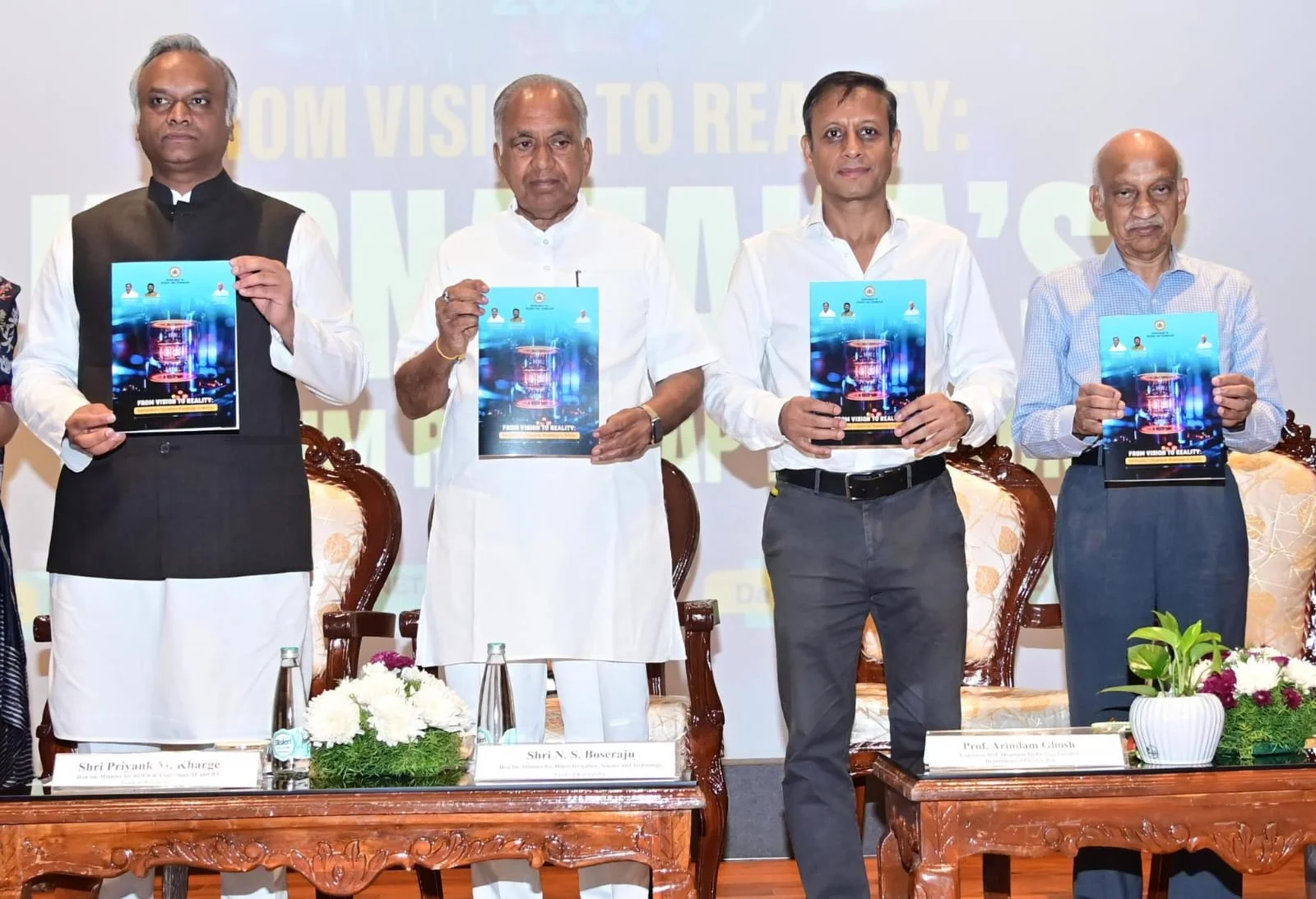
Karnataka now wants to position itself as the lead state-level actor on quantum in India, with an ambitious goal of securing 20% of the global quantum market by 2035. The state’s Department of Science and Technology has released an updated quantum roadmap that aims to establish two new research bodies and substantially increase the state’s financial commitment in the emerging sector.
The first is the Institute for Quantum Algorithms, Modelling and Software (IQAMS). It will serve as the state’s hub for quantum software innovation, focusing on algorithm development, modelling, and application engineering.
The second is the Quantum Materials Innovation Network (QMINT). It will develop and benchmark quantum materials, targeting topological insulators, 2D materials, and spintronics.
Their creation signals a shift toward dedicated institutional anchors for specific technology layers. The hardware baseline has advanced significantly with the introduction of this roadmap.
"We are the first state in India to develop a Quantum Ecosystem Roadmap. Karnataka is already leading in this technology, and we are proud to introduce this extensive mapping initiative," Science and Technology Minister NS Boseraju announced.
The 2025 plan began at 8 qubits and aimed to reach 1,000 within four years. By contrast, the 2026 roadmap starts at 100 physical qubits and sets a target of a 1,000-qubit system by 2030. This milestone is widely regarded as the threshold for ‘utility-scale’ quantum computing, at which quantum processors move beyond small, experimental devices (typically in the 100–200 qubit range) and begin to tackle problems in chemistry, physics, and optimisation that are difficult for classical computers.
By contrast, the 2025 document was written before any indigenous full-stack quantum computer existed in India. That baseline shifted once the Bengaluru-based startup QpiAI operated India’s first full-stack 25-qubit superconducting quantum computer, built under the National Quantum Mission that was launched in 2023 with a budget outlay of ₹6,003 crore.
The update is Karnataka’s second formal quantum policy statement, released nine months after the original plan debuted at the Quantum India Bengaluru (QIB) Summit last year.
Along with the plan, the state has appointed IISc professor Arindam Ghosh (Co-chair of QIB) as Chairman of the Karnataka Quantum Task Force, a specialised body that would oversee the implementation of the quantum policies.
Q-City Gets a Name and Location
The 2026 roadmap names and locates the central quantum hub for the first time.
Karnataka’s Quantum City (Q-City) will come up at Hesaraghatta, near Bengaluru. It will operate on four platforms: services, research and development, entrepreneurship and intellectual property, and manufacturing and export.
International partnerships are also explicitly mentioned. The document lists University College London, the University of Waterloo, and the University of Cambridge as formal partners. It also names the Geneva Science and Diplomacy Anticipator and the Open Quantum Institute for strategic engagement.
Bengaluru will also anchor its central network in a hub-and-spoke model. Regional nodes in Mysuru, Dharwad, Kalaburagi, and Mangaluru will take on complementary roles. A cloud-based quantum-as-a-service platform will connect startups, researchers, and students across cities to quantum infrastructure.
The model draws on approaches used in Switzerland’s quantum network and the Netherlands’ Quantum Delta.
The Four Pillars
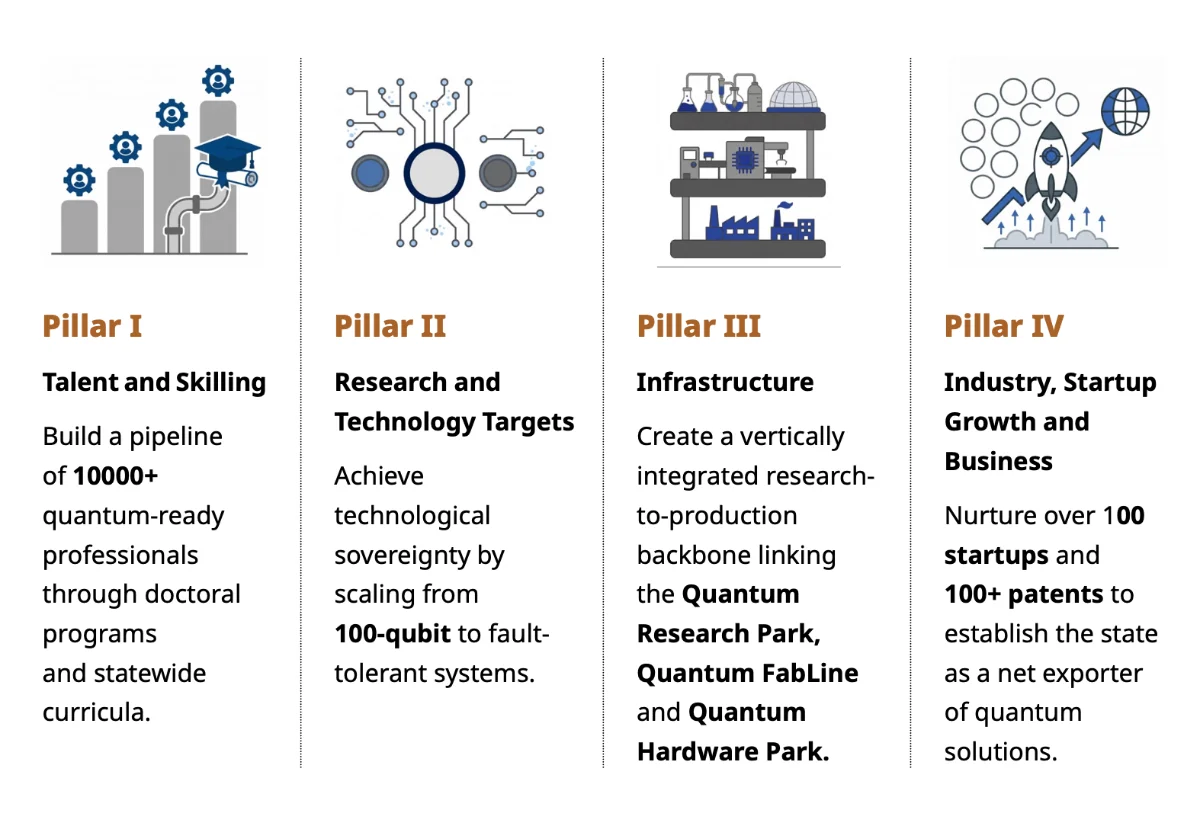
The roadmap outlines four pillars for growth, from labs to commercialisation. Talent and skilling, research and technology targets, infrastructure, and industry and startup growth. Global partnerships no longer stand as a separate pillar.
Several elements from the original plan no longer appear in the updated document. The Nipuna Skilling Programme to upskill youth in emerging technologies and Karnataka’s ELEVATE programme for early-stage startups were previously named as delivery mechanisms, which do not appear in the current plan.
The International Quantum Advisory Board, a Phase 1 deliverable in 2025, is not mentioned either. The target of becoming the “Quantum capital of Asia,” a stated Phase 4 goal last year, is also absent.
The talent and startup targets hold steady. The state plans to support at least 150 PhD scholars per year. It aims to build a pipeline of over 10,000 quantum-ready professionals by 2035. The startup target remains over 100 companies, backed by a goal of over 100 patents.
The roadmap spans four phases through 2035.
Phase one covers foundation and governance, phase two establishes Q-City and launches quantum computing services, phase three targets manufacturing, aiming for over 5,000 quantum-related jobs, and phase four covers years six to ten, and targets over 100 quantum companies as well as over 10,000 high-value jobs. Additionally, entry into international supply chains is also a goal in the fourth phase.
The setup also marks a shift in how quantum infrastructure is moving from a handful of closed labs to accessible, modular testbeds being deployed in India. This lowers the cost barrier to experimentation and allows domestic players to iterate on hardware locally instead of relying on overseas facilities.
Karnataka vs Andhra Pradesh
The Karnataka Quantum Mission now has an allocated fund of ₹1,000 crore, up from the original commitment of ₹58 crore to the Quantum Research Park at the Indian Institute of Science (IISc). The mission aims to build a quantum sector worth more than $20 billion by 2035. This would cover hardware, software, services, intellectual property, and high-value jobs.
Meanwhile, Andhra Pradesh recently inaugurated India’s first open-access quantum characterisation facility at Amaravati’s Quantum Valley, signalling a push to build indigenous quantum infrastructure.
The facility, QU-414, is designed as a shared national resource for testing, validating, and scaling quantum hardware. Built by QBit Force and operated by Qubitech, it’s part of a broader “quantum testbed” ecosystem spanning SRM University and Medha Towers.
It plans to host a 133-qubit quantum computer in partnership with IBM, TCS, and L&T, and develop 100 quantum algorithms by 2028.
Moreover, the Andhra Pradesh government also unveiled its most indigenous quantum computer in Amaravati, built by Qbit Force. L Venkata Subramaniam, the former India Quantum Leader for IBM, incubated Qbit Force for this mission and achieved this moat with his team within 4 months, since the incubation of Qbit Force in December 2025.
Unlike traditional closed labs, these systems are open-access, allowing researchers, startups, and students to directly work on quantum hardware.
Validation and testing are areas that many industry experts identify as still underdeveloped within the ecosystem. In India, several design teams continue to depend on international laboratories for advanced validation. Comparatively, in more mature ecosystems such as Taiwan and the United States, validation infrastructure was established much earlier.
Strengthening this gap could involve developing shared national validation labs and automated testing platforms that support both startups and large enterprises.
With Karnataka unveiling India’s first comprehensive quantum roadmap, its puts the state at the forefront of the emerging tech innovation.

Your reaction
Discussion
What's your take on this story?
No comments yet — be the first to share your view.