Key takeaways
- Meta-learning aims to help machine learning models acquire new skills in dynamic environments with limited training data.
- Model Agnostic Meta-Learning (MAML) is a prominent algorithm that enables quick adaptation to new tasks through efficient parameter optimisation.
- MAML facilitates faster learning by adjusting model parameters to be nearer to optimal values for specific tasks.
- Challenges like unlabeled data hinder the effectiveness of meta-learning, necessitating strategies such as rapid learning.
Meta-learning was introduced to make machine learning models to learn new skills and adapt to the ever changing environments in the presence of finite training precedents. The main objective of this approach is to find model agnostic solutions.
One highly successful meta-learning algorithm has been Model Agnostic Meta-Learning (MAML). This algorithm, with deep neural networks as the underlying model, has been highly influential, with significant follow on work, such as first order variants, probabilistic extensions and augmentation with generative modelling.
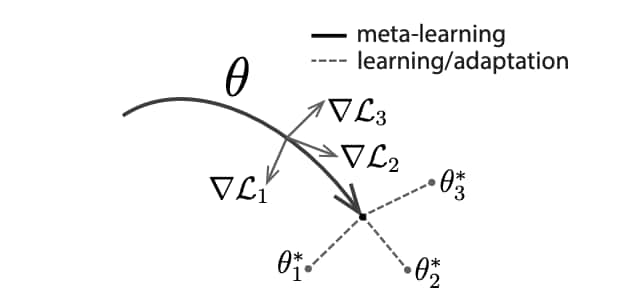 The above figure illustrates training of a simple model and a task-agnostic algorithm, Model-Agnostic Meta-Learning (MAML). The training of the model’s parameters is done in such a way so that a small number of gradient updates will lead to faster learning on a new task.
Model Agnostic Meta-Learning optimizes for a set of parameters such that when a gradient step is taken for a specific task say i, the parameters are close to the optimal parameters θ*(i) for task i.
Model agnostic meta-learning or for any machine learning model eventually runs into issues like unlabeled data. The model will be starved on data and is forced to learn on less data. In this scenario, two approaches are widely considered:
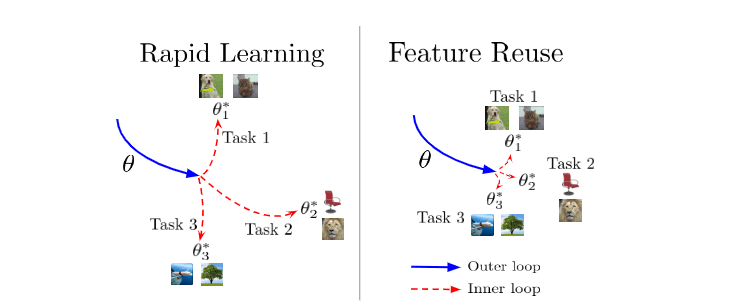 Rapid learning is the use of large, efficient changes in the representations. Whereas, feature reuse involves meta initialization with existing high quality features.
In rapid learning, large representational and parameter changes occur during adaptation to each new task as a result of favorable weight conditioning from the meta-initialization. In feature reuse, the meta-initialization already contains highly useful features that can mostly be reused as is for new tasks, so little task-specific adaptation occurs.
As can be seen in the above figure, in Rapid Learning, outer loop training leads to a parameter setting that is well-conditioned for fast learning, and inner loop updates result in significant task specialization. In Feature Reuse, the outer loop leads to parameter values corresponding to reusable features, from which the parameters do not move significantly in the inner loop.
To know whether MAML systems benefit more from rapid learning or feature reuse, researchers from MIT, Google and Cornell University have collaborated to evaluate.
They have performed two sets of experiments:
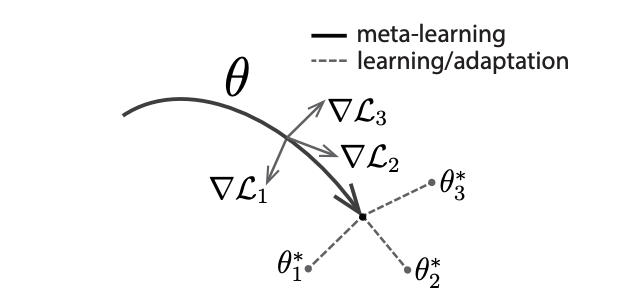 The above figure illustrates training of a simple model and a task-agnostic algorithm, Model-Agnostic Meta-Learning (MAML). The training of the model’s parameters is done in such a way so that a small number of gradient updates will lead to faster learning on a new task.
Model Agnostic Meta-Learning optimizes for a set of parameters such that when a gradient step is taken for a specific task say i, the parameters are close to the optimal parameters θ*(i) for task i.
Model agnostic meta-learning or for any machine learning model eventually runs into issues like unlabeled data. The model will be starved on data and is forced to learn on less data. In this scenario, two approaches are widely considered:
- Rapid learning and
- Feature Reuse
Evaluating Rapid Learning And Feature Reuse
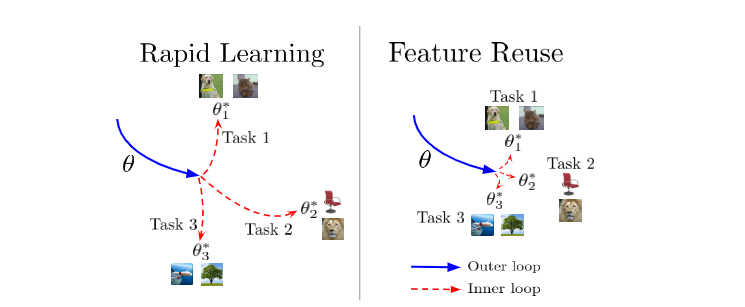 Rapid learning is the use of large, efficient changes in the representations. Whereas, feature reuse involves meta initialization with existing high quality features.
In rapid learning, large representational and parameter changes occur during adaptation to each new task as a result of favorable weight conditioning from the meta-initialization. In feature reuse, the meta-initialization already contains highly useful features that can mostly be reused as is for new tasks, so little task-specific adaptation occurs.
As can be seen in the above figure, in Rapid Learning, outer loop training leads to a parameter setting that is well-conditioned for fast learning, and inner loop updates result in significant task specialization. In Feature Reuse, the outer loop leads to parameter values corresponding to reusable features, from which the parameters do not move significantly in the inner loop.
To know whether MAML systems benefit more from rapid learning or feature reuse, researchers from MIT, Google and Cornell University have collaborated to evaluate.
They have performed two sets of experiments:
- We evaluate few-shot learning performance when freezing parameters after MAML training, without test time inner loop adaptation.
- We use representational similarity tools to directly analyze how much the network features and representations change through the inner loop.
Key Takeaways
- Researchers find that feature reuse is the dominant component in MAML’s efficacy
- Introduce ANIL(almost no inner loop) algorithm a simplification of MAML that has identical performance on standard image classification and reinforcement learning benchmarks
- Results show that lower layers of a network is sufficient for few-shot classification at test time instead of final layer
Spotted an error? Tell our editors. Read our editorial standards and corrections.