
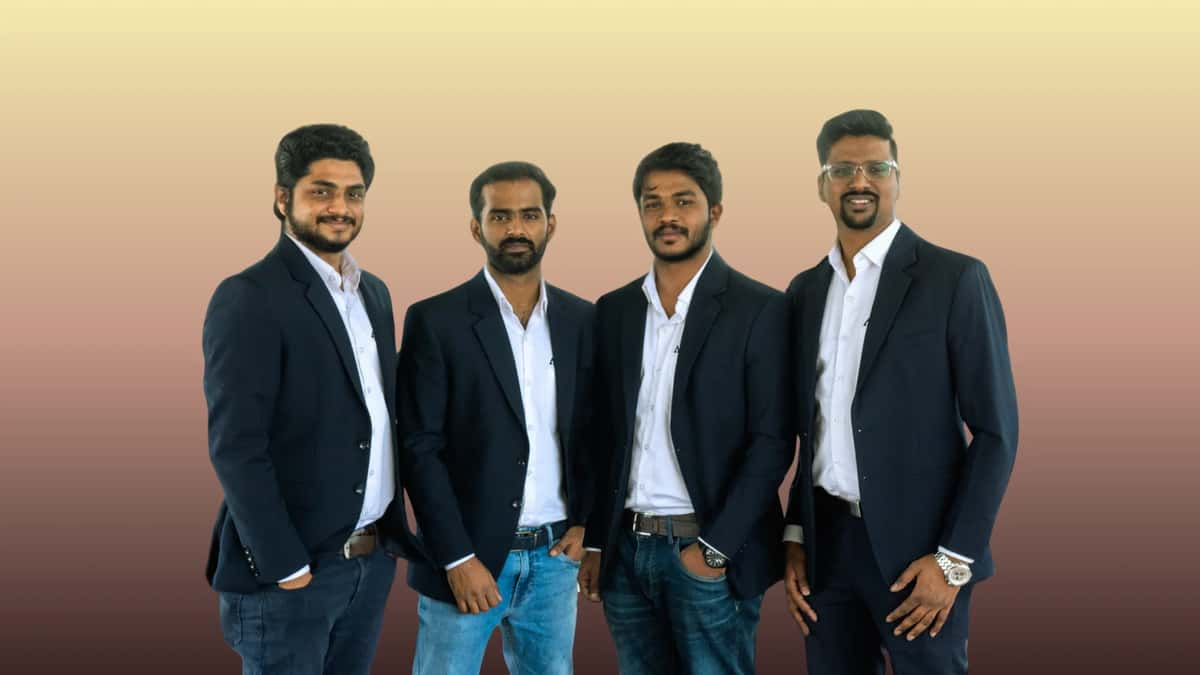

Before building autonomous mobile robots navigating factory aisles, Raghu Venkatesh was obsessed with the brain-computer interface akin to Elon Musk’s Neuralink. He built a working neural interface prototype, a brain-controlled device that used electrodes to read electrical signals and translate them into movement in a virtual world.
However, the prototype proved commercially premature, and he started looking elsewhere. Then, the pandemic happened.
When India stepped up to produce and distribute COVID-19 vaccines, Venkatesh didn’t just see a logistical win, but a possibility that India could be at the centre of global supply chains.
"India wants to capture 10–15% of global produce trade," he tells AIM. "The only way that is possible is when you use best practices."
Along with Ribin Mathew (CEO), Ebin Sunny (COO), and Raj Mohan (CTO), he founded ANSCER Robotics in 2020. The idea was to use warehouse robots to streamline the movement of material from the warehouse to the machine floor, the tracking of requests, and inventory management.
Building the Hardware, Then Rethinking It
When the team built their first robot, they hit an immediate supply chain wall. Chip shortages in 2021 left them waiting 56 weeks for a single IC, even after landing their first customer. The response from ANSCER's CTO became their north star: "We can never allow an ecosystem to control us."
The team reverse-engineered their dependency by building what they now call a modular hardware stack, sourcing industrially certified, globally available components from manufacturers in each category, and assembling them like a recipe, using aerospace-grade wiring. No soldering. Only plug-and-play.
Venkatesh also highlights capital constraints limiting scale, customer trust barriers, workforce resistance to repetitive jobs, fragmented factory processes, and regulatory uncertainties impacting component sourcing and compliance as one of the early challenges.
The next challenge was human. The workers interacting with the robots, machine operators, and material handlers often had limited English proficiency and were unfamiliar with complex software systems. ANSCER had to rethink user experience entirely, designing an intuitive, icon-based, and binary decision interface that could be learned in under 20 minutes, enabling seamless human-robot collaboration even in low-literacy, high-noise factory environments.
Invisible Inefficiency
The deeper problem ANSCER is solving, however, isn't really about robots at all. Venkatesh describes a factory floor where moving materials involves mismatched walkie-talkies, supervisors managing blinking signals, and rarely checked Kanban cards requiring workers to report back.
ANSCER's software layer connects to ERP and warehouse management systems in real time, collapses the approval chain from email threads to instant automated verification, and tracks where congestion builds up on the factory floor. One early customer saw hoarded material drop from 30% to under 5%.
Their end-of-shift reconciliation, a daily overhead burden, disappeared.
Market Awareness
The company currently operates under two revenue models: a capital-expenditure purchase for companies with an upfront budget and a robots-as-a-service model.
The company last raised $2 million in a seed round in February last year from Info Edge Ventures to expand its autonomous mobile robot offerings. Prior to that, it was funded by angels and family.
Venkatesh candidly says that, until the raise, ANSCER was EBITDA-positive. "We are a data-positive company," the co-founder and CBO asserts. Capital is now being deployed toward expansion, not operations.
ANSCER Robotics competes with Botsync, Addverb, GreyOrange, and Milvus, but the company says it differentiates itself by integrating modular hardware, autonomy in unstructured factories, functional safety, intuitive UX, and ERP-linked software.
One of its clients, who requested to stay anonymous, said that “the level of detail and accountability ANSCER has demonstrated…We really appreciate the perseverance the deployment engineers have shown during the site deployment phases.”
The US office, now officially open with a partner covering 19 states, is its first such overseas expansion. The West Asian and European markets are next.
Currently, its clientele spans Schneider Electric, Samsung, Tata, Mahindra Logistics, and Trelleborg Engineering Systems, to name a few.
Building the Ecosystem, Not Just the Product
ANSCER supports seven universities across India, including PES University in Bengaluru, with robotics labs where faculty and students learn to build real industrial applications.
A parallel initiative, the BEST Robotics Lab, funded by the Bajaj Foundation, one of its clients, has trained more than 700 people in industrial automation and robotics deployment.
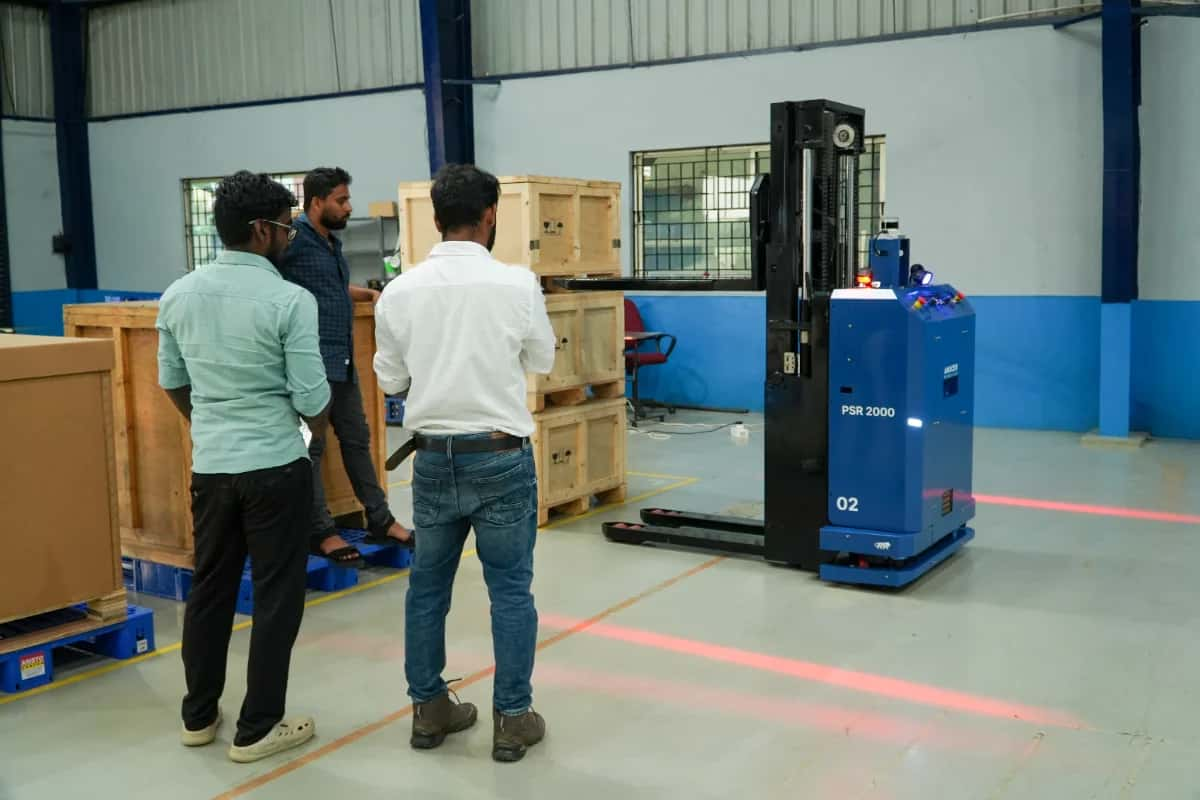
At its Bengaluru facility, with around 60 employees on-site, ANSCER can manufacture more than 1,000 robots per year on a three-shift operation. That number is growing. So is the product portfolio: two core product lines—a pallet series and a trolley series—built on a modular base platform that accepts interchangeable top modules depending on the customer's application. Another one of its facilities in Bengaluru is set up for design needs.
The company has also demonstrated multi-robot coordination systems, robotic arm integration for CNC (Computer Numerical Control) machine tending, and a research platform that IIT Madras used to build an assistive-care robot capable of responding to voice commands and pointing gestures.
Ancer’s innovations come at a critical time for the booming Indian logistics market, with e-commerce and quick commerce needing reliable and fast fulfilment. The Indian warehousing market is also experiencing rapid growth, with the industry growing at a compound annual growth rate of 22% and expected to reach $1.2 billion by 2030.
The Bengaluru-based startup is not inventing the robot, but overhauling the entire system, hardware, software, workflow, and training, to equip their human counterparts with more efficient management skills.
ANSCER, in his telling, is attempting the same manoeuvre in industrial automation: not inventing the robot, but designing the entire system, hardware, software, workflow, training, around the human beings who have to live with it every day.
Whether that argument lands in every boardroom is another matter. But for a company that started in the darkest months of a global pandemic, watching India do something historically improbable, and asking what infrastructure that moment required, ANSCER Robotics seems to have timed things right.
- From Humanoid Robots to Telecom Trials, 12 Major Announcements at NVIDIA GTC Berlin 2026
- Anyone Can Make a Robot Move, Few Can Make It Stop
- After ISRO’s PSLV Failure, TakeMe2Space Looks to SpaceX for Reliable Launch
- Why AI Agents are the Next Frontier in Quantum Security
- Physical AI Squeezes Labour Market, And Low-Skilled Immigrant Jobs May Be First to Fall
- Rocket Math Isn’t Mathing: Why India’s Space Launches are Expensive