Key takeaways
- Leverage AI tools like Farmer.Chat to significantly reduce agricultural extension service costs for farmers.
- Utilize GPT-4 for comprehensive agricultural support, including crop advice and disease identification.
- Promote technology-enabled communication to enhance farmer training and knowledge sharing.
- Ensure accessibility by providing services in multiple languages, enhancing usability for diverse farming communities.
- Support partnerships between organizations like OpenAI and Digital Green to boost agricultural productivity.
OpenAI said that AI tools like ChatGPT today are being used around the world to help farmers in India and Kenya increase crop yields in partnership with Digital Green.
Founded initially as a project within Microsoft Research India's Technology for Emerging Markets in 2006 by Rikin Gandhi and his colleagues, Digital Green became an independent NGO in 2008.
The organisation focuses on training farmers to produce and share short videos that document their challenges, solutions, and success stories, aiming to facilitate a technology-enabled means of behavior change communication.
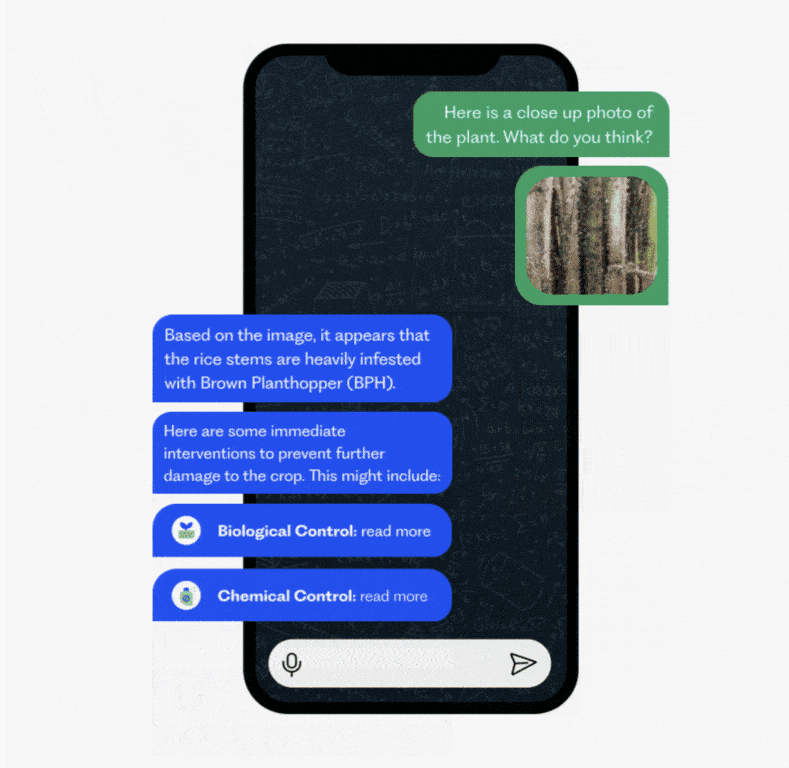
Digital Green recently introduced Farmer.Chat using GPT-4, covering a wide range of agricultural topics including crop advice, disease identification, weather forecasts, and market information. According to OpenAI, early estimates suggest that by leveraging generative AI, Farmer.Chat can bring down the cost of traditional extension services 100x, from $35 per farmer to $0.35 cents per farmer.
One key driver of this productivity increase is that Farmer.Chat is accessible across a wide range of languages, including Hindi, Swahili, and regional languages, using an agile tech stack that integrates with local language translation datasets and services in each country.
Similarly, Jugalbandi, is another AI chatbot powered by OpenAI’s GPT models through Microsoft’s Azure OpenAI Service, which assists farmers and villagers in rural India to access information about various government schemes beneficial to them.
The chatbot, accessible via WhatsApp, retrieves relevant program details typically documented in English and delivers them in the user’s native language from among 10 of the 22 official Indian languages
Meanwhile, Wadhwani AI, a non-profit institute dedicated to developing AI solutions for social good, is exploring the use of generative AI to power Kissan (farmer) call centers. Alpan Raval, the chief scientist for AI/ML at Wadhwani AI, said that they are building a Kissan call center support system using generative AI to assist farmers with their queries.
Their approach involves augmenting human experts’ knowledge by utilising models that provide automated responses based on a knowledge base created from current government reports and documents, with a speech interface enabling conversational AI interactions.
KissanAI is another AI startup that has developed a proprietary AI chatbot that assists farmers with various agricultural tasks such as irrigation, pest control, and crop cultivation.Last year, it released Dhenu, the world's first agriculture-specific LLM. Dhenu is designed to provide multilingual support, initially available in Hindi and English, making it accessible to a broad range of farmers across India.
Spotted an error? Tell our editors. Read our editorial standards and corrections.