
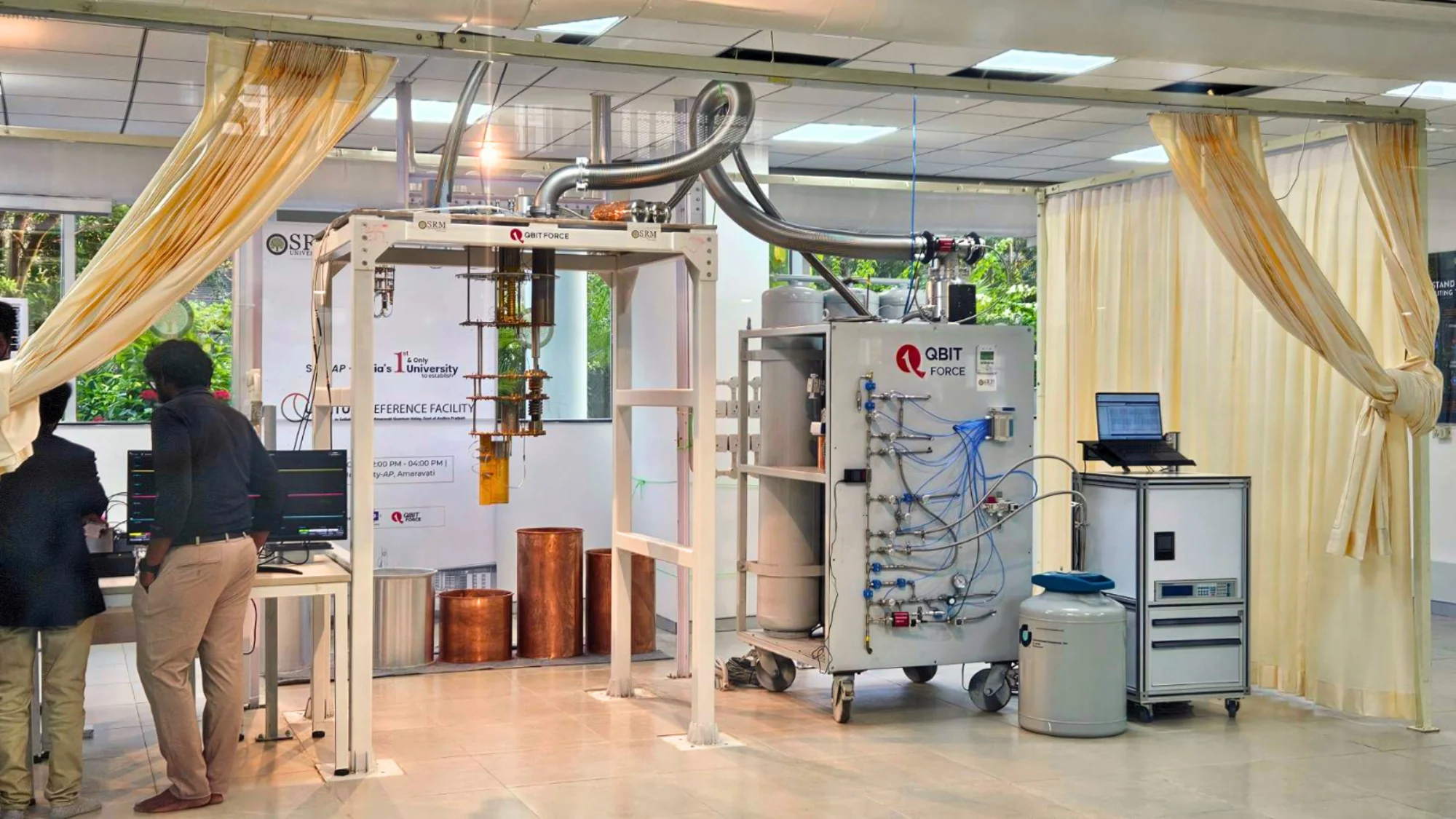
On April 14, Andhra Pradesh launched a quantum computer, along with a reference and testing facility in Amaravati. The initiative is a part of the push to build indigenous quantum systems in India, but unlike traditional quantum computers, the project is chasing higher qubit counts.
The implications are profound. Higher qubits can enable quantum error correction, tuning the technology towards commercially relevant applications. But beyond that, it is about creating a system that enables quantum hardware to be tested, validated, and improved.

“It is about the launch of these quantum reference facilities. These are testing and prototyping facilities, you can consider them as a testbed for India,” Sridhar C, Mission Director for Andhra Pradesh State Quantum Mission (APSQM), tells AIM.
The systems have been built as part of a national effort. Multiple institutions contributed components. These include TIFR, IISc, DRDO, IIT Bombay, IIT Delhi, and IUAC, with the integration led by the recently incubated Amaravati-based startup Qbit Force.
The current system includes a two-qubit processor provided by IISc Bengaluru, a three-qubit processor by TIFR Mumbai and a five-qubit readout resonator designed and developed by Qbit Force.
The reference facility, designed as an open-access environment, enables researchers, startups, and companies to test quantum hardware. It also allows them to access and study the components themselves, under real operating conditions.
While the design has scaling potential up to around 100 qubits, that is not the main objective.
https://youtu.be/Br-YZ-8W_S8?si=ove3Ec02Y3QLZdyh
The Computer and Facility
Instead of only building computers, the project focuses on the infrastructure layer behind them. Most global quantum testing systems operate as closed environments. Users can test inputs, but cannot access internal architecture.
“No one puts together a computer like this. They hide it in a room and then come out with a black box and stop you from ever opening it,” L Venkata Subramaniam, CEO of Qbit Force and former IBM India Quantum Lead, describes in an interaction.
In contrast, the Andhra facility, located at SRM University in Amaravati, allows physical access and hands-on testing. Users can evaluate processors, cryogenic systems, RF components, and interconnects in one place. The goal is not computation alone but system-level understanding.
“The system will be used to test one component at a time as each component needs to be characterised individually,” says Prudhvi Pinnaka, Co-founder and CEO of Qubitech, the startup handling the operations of the referencing facility. “However, multiple components can be installed and tested.”


He also adds that the facility will be open to partners this summer after completing certification paperwork. To ensure consistency, as different users bring in different components to test on the same system, standards will be defined for each component, and each component will be tested individually against those standards to assess its performance.
The system also functions as a training ground. It allows students and engineers to work directly with hardware instead of simulations. “It helps everyone,” Subramaniam says. “We have queries from abroad also.”
The open model widens access. The facility plans structured entry through scheduled slots, guided sessions, and programmes for academia and industry.
Why Openness Matters for India
Globally, access to quantum hardware remains restricted. While a few facilities exist in some countries for such validation functions, they all operate in silos. Facilities in the US operate under export controls, limiting access for foreign researchers. The UK and China prioritise domestic users, and Japan’s flagship centres follow similar models, restricting access to India.
Only the Netherlands offers limited neutral access, but at high cost (operating on a ‘pay-for-access’ model) and with long waiting periods of about 6–12 months.
Sridhar expresses that the Amaravati facility is “open to all—Indian and international researchers, startups, and enterprises alike.” It is doubling down on transparency.
“IBM, for example, is giving a machine to us, which is kept in a box. You don’t open it. It is all installed with AMD, and we don’t know what goes inside,” he says. “This is the first time we are having it open-access so that people can come see what is going on inside,” Sridhar adds.
However, demand in India is expected to dominate near-term usage. The facility may eventually align with national security frameworks as global restrictions tighten, he explains, citing the evolving geopolitical landscape around quantum.
The European Union has invested more than €11 billion to attain technological sovereignty in quantum. Meanwhile, China is planning a 12,000 km quantum network, leveraging the technology in communications.
The Amaravati facility is not meant to stand alone. It serves as a prototype for a broader network of quantum testbeds across India. “A robust quantum research ecosystem would require approximately 50 such facilities across the country,” Sridhar asserts.
The long-term vision, as expressed by the Andhra Pradesh government, includes creating a national reference architecture. This would allow consistent benchmarking and replication across institutions.

Your reaction
Discussion
What's your take on this story?
No comments yet — be the first to share your view.