
Key takeaways
- GCCs in India's BFSI sector leverage AI and automation to transform financial services delivery.
- Real-time analytics enhance portfolio analysis and risk engineering in commercial insurance.
- BFSI GCCs employ 20-25% of total talent in India's GCC ecosystem, underscoring their importance.
- Bengaluru is the leading hub for BFSI GCCs, followed by Delhi/NCR, Hyderabad, and Chennai.
- Anaptyss invests heavily in AI-led innovation and digital services through its integrated centre of excellence.
Global capability centres (GCCs) in India’s banking and financial services are now largely powered by advanced technologies like AI-ML, data analytics, and automation, redefining how financial services are delivered.
A key catalyst in this transformation is the adoption of real-time analytics, especially within the commercial insurance space. This is enabling sharper portfolio analysis, more effective risk engineering, and improved catastrophe modelling.
Alongside this, there’s a rising focus on user experience (UX), as today’s customers expect digital solutions that are not only efficient but also intuitive and user-friendly.
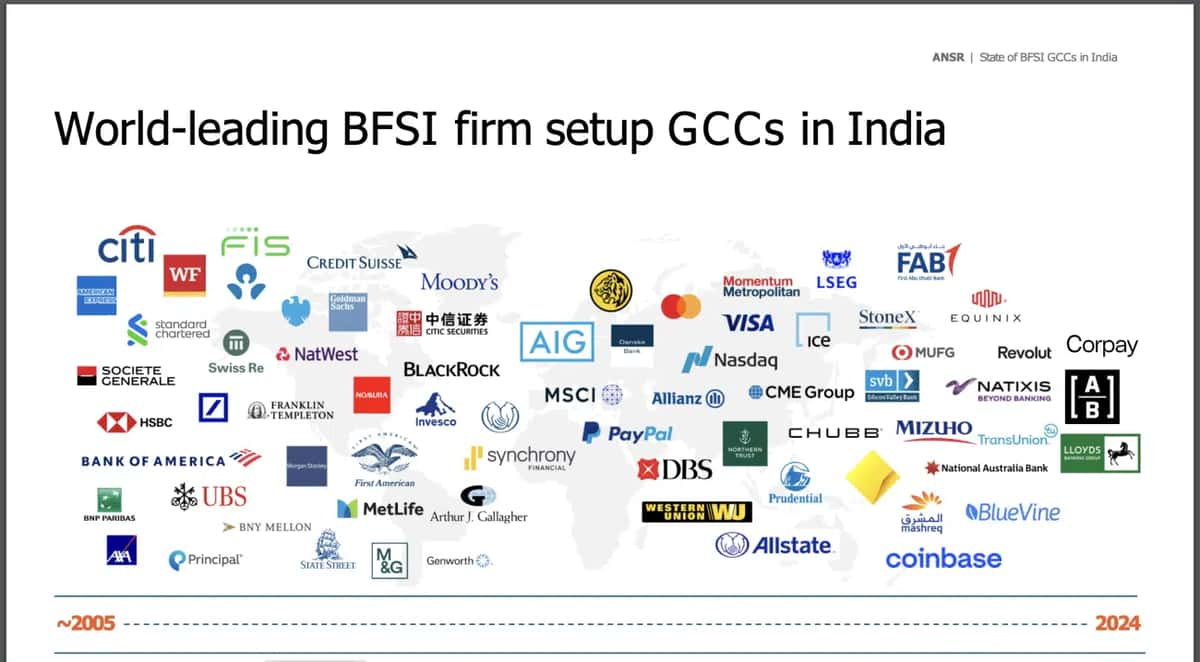
According to ANSR’s ‘State of BFSI GCCs in India’ report, more than 90 BFSI enterprises operate approximately 185 GCCs across India, with many organisations maintaining multiple centres. Bengaluru stands out as the leading hub, followed by Delhi/NCR, Hyderabad, and Chennai.
India’s BFSI GCC ecosystem continues to thrive, employing nearly 20–25% of the total talent working in GCCs across all industries, highlighting its growing significance in the global financial services landscape.
Deep Tech with Anaptyss
In an interview with AIM, Anuj Khurana, CEO and co-founder of Anaptyss Inc, highlighted the company’s strong focus on AI-led innovation. “A major focus area for Anaptyss has been its substantial investment in an integrated centre of excellence (CoE) for AI-led digital services,” he said.
This centre brings together tech architects, industry leaders, and advanced AI/ML technologies to create digital solutions that address real business challenges.
Anaptyss, a digitally enabled managed services company, has already developed several impactful solutions. One of its key products, ALFA, is an AI-powered system for anti-money laundering (AML) transaction monitoring that offers “over 75–80% accuracy in detecting false alerts”.
The company also created a machine learning tool that allows for 40% faster validation of third-party credit risk models. In short, “GCCs are enabling insurers to reimagine their operations,” Shrinivas Ramanujan, chief operating officer at Opteamix, told AIM.
“With AI, blockchain, and predictive analytics, these centres are becoming essential for digital transformation and customer engagement.”
Need for Deep-Tech Talent
The push for deep-tech talent is clearly strategic. BFSI GCCs are actively hiring AI engineers, data scientists, technology architects, and natural language processing (NLP) experts.
Khurana mentioned that there’s also strong demand for talent in areas such as model risk management, credit risk, fraud analytics, and cryptocurrency. The critical skills these centres are looking for include programming languages like Python and R, risk management frameworks, AI and ML proficiency, and descriptive analytics.
To support this, Anaptyss is conducting focused hiring campaigns and partnering with top business schools and institutions such as the ICAI. The goal is to attract, retain, and grow talent capable of driving digital innovation.
Echoing the same, Guru Thiagarajan, head of Deutsche Bank’s India tech centre, previously told AIM how deep tech is helping his teams boost productivity.
“The focus is on productivity—helping research analysts and bankers sift through vast amounts of data, summarise reports, and prepare for client meetings faster,” he said. “With generative AI and large language models, we can help our teams handle data-heavy tasks in a fraction of the time.”
India at the Centre of Transformation
India has become central to this shift. “Today, our delivery sites in Gurugram and Noida have dedicated technology infrastructure and facilities to support year-round R&D projects focused on developing AI-based solutions,” Khurana added.
The company has earmarked an annual budget to boost its innovation capability, and over 10% of its leadership roles are deeply involved in innovation programs.
Additionally, Anaptyss is leveraging emerging technologies, including data analytics, robotic process automation, AI, GenAI, agentic AI, machine learning, and natural language processing to develop proprietary digital solutions.
Additionally, the company’s ecosystem of ‘Digital Entrepreneurs in Residence’ allows Anaptyss to prototype and implement industry-specific and tailored digital solutions based on its deep-tech capabilities and in-depth understanding of the banking and financial services domains.
Over 60% of the company’s program managers, technology architects, and data analysts are involved in developing AI-enabled digital solutions.
Rise of Neo Banks
Alongside this, the rise of neo banks—digital-first banking platforms—has accelerated the demand for agile, AI-powered solutions.
Suman Sastry U, vice president at Everest Group, told AIM that these fintech players, like Freo, Jupiter, and Fi, are meeting the expectations of millennials and Gen Z users who want fast, flexible financial services. AI is central to their operations, powering everything from KYC compliance and credit assessment to fraud detection and customer support.
This disruption is also reshaping GCCs. Traditionally geared towards international markets, many GCCs are now turning their attention inward, serving Indian fintechs and banks.
In many cases, neo banks have adopted a collaborative model by partnering with traditional banks, serving as their digital banking front ends. He further mentioned that partnerships such as Niyo-SBM India and Jupiter-Federal Bank demonstrate how this approach is expanding reach, enhancing customer experiences, and driving faster digital adoption.
Spotted an error? Tell our editors. Read our editorial standards and corrections.