
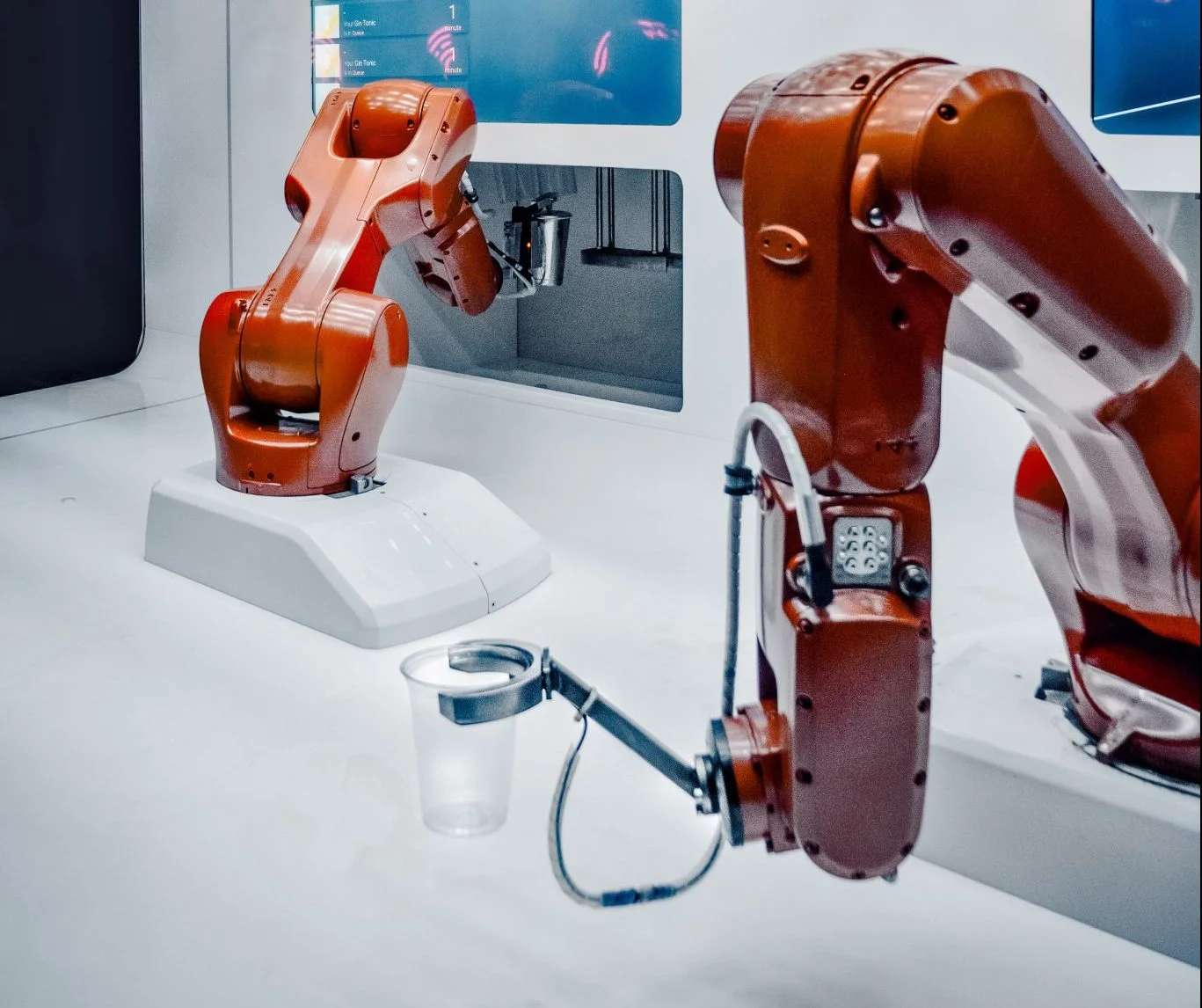

As GCCs are making a shift from designing for isolated plants or short-term output gains, they are increasingly building systems for scale, standardisation, and repeatability. Robotics solutions developed and validated in India are becoming global templates, deployed across multiple factories and geographies.
In this GCC-led model, collaborative robots, autonomous mobile robots, and AI-enabled systems operate as interconnected ecosystems. The focus is on intelligent, adaptive operations that can be replicated across global networks with speed and consistency.
However, GCCs operate under stringent international standards for overall equipment effectiveness, safety, ESG compliance, and energy efficiency.
In a conversation with AIM, Sougandh KM, Business Director of South Asia, Teradyne Robotics, says, “Robotics—especially collaborative robots—helps meet these benchmarks by delivering predictable performance, improved accuracy, and measurable gains across every parameter. This standards-driven environment accelerates both experimentation and deployment.”
As wages rise and skill availability varies, GCCs are using robotics to elevate human roles rather than replace them, he adds.
For example, Manish Mamtani, CIO at Compass Group India, previously told AIM that the leading B2B food and support services company has deployed 25 to 30 cleaning robots across client sites over the past year, with plans to scale the fleet to nearly 250 robots. These machines handle repetitive, time-bound tasks, ensuring operational continuity even when manpower availability fluctuates.
Collaborative robots are designed to be easy to use, enabling faster upskilling and smoother transitions into higher-value roles such as robot programming, system supervision, and automation orchestration. The result is a workforce that is increasingly technical, adaptable, and future-ready.
One of the defining strengths of GCCs is their ability to scale proven solutions globally. Automation workflows developed in India—whether in welding, inspection, quality control, or intralogistics—can be rolled out across dozens of facilities worldwide. This significantly multiplies the return on investment and positions India as a central node in global automation strategy.
What This Means for India’s Talent Ecosystem
India’s robotics market size reached $1.98 billion in 2025, according to the latest comprehensive industry analysis by IMARC Group.
Ironically, while the country has historically struggled to become an original market for robotics, GCCs have emerged as its most receptive customers.
“Right now, all our customers are outside India,” Gokul NA, Founder of Design, Product and Brand, CynLr, reveals. “Mostly GCCs.”
He explains that one of CynLr’s customers is the world’s third-largest semiconductor equipment manufacturer, while another engagement is focused on long-term deployment extending to 2028.
These clients are looking for universal, general-purpose robotics platforms, especially for assembly tasks where human labour remains difficult to replace.
At the same time, as GCC workforces shift more towards AI engineers, product managers and cybersecurity specialists, employee expectations have become more sophisticated. They demand personalisation in workplace systems—but not at the expense of privacy.
“How can you anonymise my data but still give me a personalised experience?” Mamtani says, describing a common concern raised by clients.
The solution lies in behavioural intelligence rather than identity-based profiling. Systems learn from usage patterns, such as how people interact with spaces, when they engage with services and what choices they make, without collecting sensitive personal data.
“Every product has multiple parts coming together,” Gokul says. “That’s where human labour is still irreplaceable—and where a sentient, general-purpose robot is needed.”
As robotics adoption expands through GCCs, India’s talent landscape is also evolving. Demand is rapidly shifting away from repetitive operational roles towards robotics engineers, AI vision specialists, automation architects, and data-driven manufacturing experts.
“Robotics is no longer a shop-floor decision—it’s a strategic capability. GCCs aren’t just adopting automation; they’re redefining how global automation is built and scaled. The real question now is how quickly we can build the talent to take this worldwide,” Sougandh explains.
In many ways, GCCs are beginning to define how robotics itself will be designed, deployed, and scaled globally, from India.
Talent: The Hardest Problem in India
While global awareness of the physical intelligence gap is growing, India continues to face structural challenges in supporting deep tech industries.
“We don’t have the machinery to support this,” Gokul admits. “The VC system is tuned to consumer tech and finance, not infrastructure-building businesses like deep tech.”
Investor expectations for rapid commercialisation are often misaligned with industries such as robotics, semiconductors, or material science, where progress is slow, capital-intensive, and foundational.
Talent shortages present an even bigger hurdle. CynLr currently employs around 80 people, with an average employee age of just 22–23.
“It’s basically a talent factory,” Gokul said. “We run almost year-long training programmes. Universities are failing at this—and more importantly, we have to make people unlearn.”
He points out that India’s engineering education system tends to produce tool-trained graduates rather than concept-trained engineers.
“The ability to notice a problem is not trained,” he says. “In reality, the robot doesn’t announce what’s wrong. You need to understand the system.”
Despite receiving around 17,000 applications annually, CynLr hires only about a dozen candidates. Even premier institutions aren’t exempt from the challenge.
“I just concluded hiring at IIT Madras with zero,” he says.
Looking ahead, Gokul envisions a radical shift in how manufacturing itself is organised, decentralised, agile “universal micro-factories” replacing rigid production lines.
However, he remains realistic about timelines.
For India, the bigger challenge is cultural and structural—moving from replication to invention.
“We’re very good at incremental innovation and cost optimisation,” he says. “But foundational technology building is still missing.”
He hopes that as the current AI hype cycle matures—and inevitable bubbles burst—the real gaps in physical intelligence will become impossible to ignore.
“When the forest burns, fresh seedlings grow,” Gokul says.
- The Hardest Part of Industrial AI Isn’t Adoption—It’s On-Site Deployment
- Why FDEs Are Emerging as a Critical GCC Role
- AI Is Forcing India's GCCs to Move Beyond Cost Arbitrage
- How India’s Nano Retail GCCs Built a 3x AI Lead Over Walmart and Target
- Chennai’s GCC Boom Is Getting Bigger. But is There Room for Smaller Occupiers?
- India's 60 Lakh Tech Workforce is Growing—But Not On Par With AI Revenue Surge