

India’s global capability centre (GCC) ecosystem is expanding rapidly, set to grow from 1,700 centres in 2024 to 2,100 by 2030. While US-based GCCs continue to dominate, non-US GCCs are growing at a CAGR of 6.8%, nearly twice the growth rate of US firms.
Karnataka: The Hub of US-Based GCCs
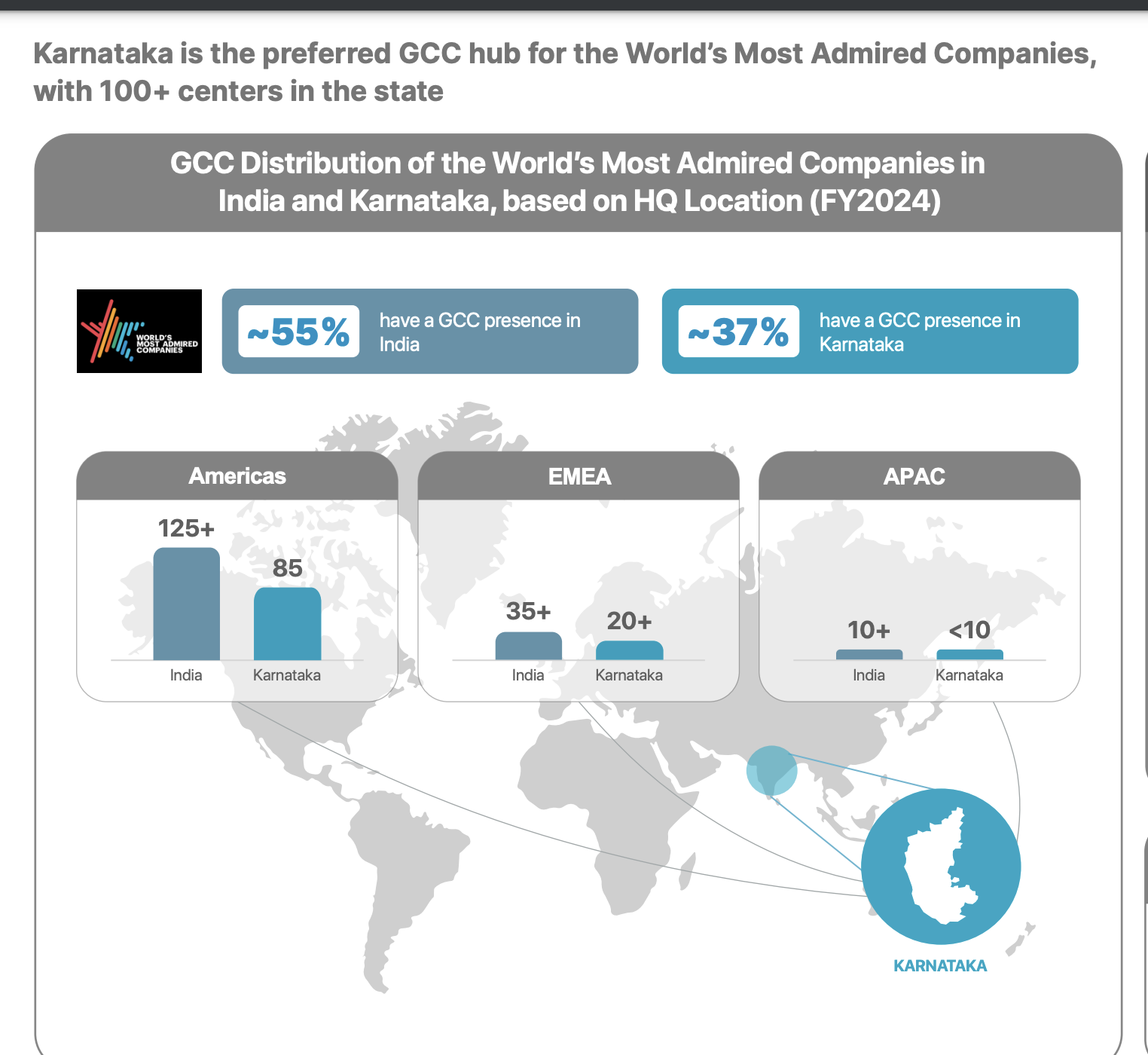
Karnataka remains the leading destination for US-headquartered GCCs in India, hosting over 50% of them. According to a Zinnov-AmCham GCC report, two-thirds of the world’s most admired US companies present in India have set up centres in Karnataka.
The key industries among them are BFSI (banking, financial services, and insurance) and software & internet.
Some of the prominent US-based GCCs in Bengaluru are Lowe’s, Kimberly-Clark, and Wells Fargo, to name a few.
Rise of Non-US GCCs in India
A growing number of non-US companies are also setting up GCCs in India. "The anticipated 15-20% surge in non-American GCCs in India over the next two years highlights the country's escalating strategic importance in the global business landscape,” said Alouk Kumar, founder and CEO at Inductus Limited.
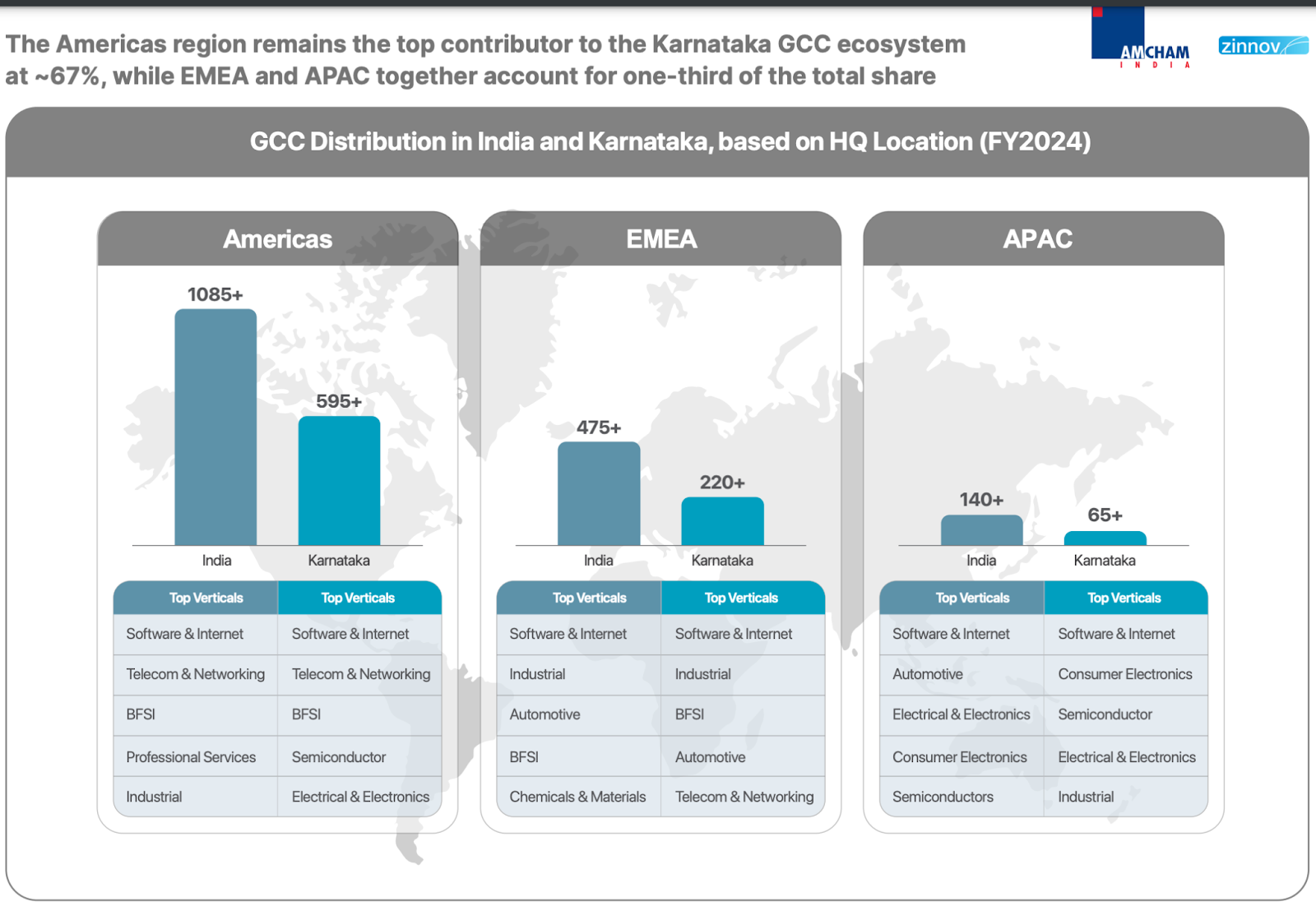
Notably, GCCs from the Asia-Pacific region have experienced a growth exceeding 65% in the past five years, with those from Europe, the Middle East, and Africa growing by around 35-40%.
This trend is driven by enterprises from Europe, the Asia-Pacific, and the Middle East diversifying their global operations beyond traditional Western hubs.
Experts predict this growth trajectory will continue over the next 2-3 years.
Kumar further highlighted that “India's cost-effective, highly skilled talent pool, robust digital infrastructure, and evolving policy framework make it an attractive destination.
“The emergence of Tier-II cities such as Ahmedabad, Kochi, Thiruvananthapuram, and Coimbatore as viable alternatives to metropolitan areas further strengthens India's position as a GCC powerhouse.”
For instance, Takeda, a Japanese biopharmaceutical giant, recently launched its innovation capability centre (ICC) in Asia in Bengaluru. The centre will use AI and digital technologies to drive research and improve healthcare.
“The launch of our Bengaluru ICC is a pivotal moment in Takeda’s digital transformation journey,” said chief data and technology officer Gabriele Ricci.
In November 2023, ZEISS, a German optics and optoelectronics leader, opened its GCC in Bengaluru. The centre will tap into India’s IT talent pool to expand ZEISS’s global R&D efforts.
Mizuho Global Services India Pvt Ltd (MGS), a subsidiary of Japan’s Mizuho Bank, has opened a new office at the World Trade Center in Perungudi, Chennai. Since its founding in 2020, MGS has expanded rapidly with offices in Mumbai and Chennai. Currently employing 350 people, the company plans to more than triple its workforce to over 1,000 in the next three years.
The Reason Behind Such Expansion
Experts believe that Europe’s reliance on India for technology operations is increasing, particularly in regions such as France, the Nordics, and the Benelux (Belgium, Netherlands, and Luxembourg).
This trend is driven by rapid modernisation, a shortage of local tech talent and the need for multilingual support across industries like manufacturing (Industry 4.0), automotive, BFSI, pharma, and retail.
“Traditionally, Europe used to have the nearshore captive centre, which gave them timing benefits,” said the senior director leading GCC in Accenture, “due to war and instability in Europe, mostly in Ukraine and Poland, many financial GCC moved to India. The war has a huge impact.”
The robust GCC ecosystem in India thrives on its skilled workforce, supportive government policies, innovative startups, and a strong network of service providers.
“Factors such as India's competitive GCC Policies mushrooming out of several states and the ability to achieve operational efficiencies at scale make it the ideal choice for global firms seeking long-term resilience in their corporate strategies, ”Kumar further mentioned.
However, what truly sets India apart in this next phase of the GCC's evolution is its ability to create value rather than just a cost arbitrage destination.
Non-American GCCs are leveraging India not just for talent and operations but for innovation—whether it’s Swiss financial firms setting up AI-powered risk analysis hubs in Bengaluru or Middle Eastern energy giants driving sustainability R&D from Hyderabad.
With India’s deep integration into global supply chains and its thriving startup ecosystem valued at over $400 billion, GCCs are increasingly tapping into co-innovation models with local firms and digital twin models with their parent companies, unlocking synergies that go far beyond basic outsourcing and ODC.
As India scales from a service delivery hub to a strategic innovation partner, the future of non-American GCCs in the country is not just about growth—it’s about leadership in global transformation.
Seeking Inspiration from US-Based GCCs
Raghavendra Vaidya, MD and CEO at Daimler Truck Innovation Center India (DTICI), highlighted the growing trend of companies setting up engineering centres in India. He noted that while "the initial push came from US-based conglomerates," in recent times, "many Western and Central European companies have been establishing their presence here."
He emphasised that the process has become highly structured: "The playbook has been perfected over the last few decades... it is almost a cookie-cutter approach if you have a real intention of doing it." Companies today can easily reference existing models and successfully establish their own centres.
A key driver behind this trend is the transformation happening in Western and Central Europe, where companies are realising that "they can’t do all of their engineering by themselves in the headquarters because there are so many problems to be solved." Observing their peers successfully setting up engineering centres in India, they recognise the value such centres bring to their parent organisations.
While IT services are relatively easy to establish, "setting up an engineering centre is difficult." However, India remains "the talent market in the world for ER&D," and the proven success of GCCs in driving innovation and value has instilled confidence among organisations looking to follow suit.

Your reaction
Discussion
What's your take on this story?
No comments yet — be the first to share your view.