

India’s GCC story isn’t new, but for years, its true significance remained largely out of sight.
Back in 1985, Texas Instruments (TI) became the first multinational to set up a wholly owned R&D center in India. Located in Bengaluru, this facility was never just a cost-saving move. It signalled the start of something much bigger.
For more than a decade, India’s GCCs were defined by scale. They hired in the thousands, ran global processes at speed, and helped multinational companies operate more efficiently. Cost advantage was the headline. Execution was the mandate.
That era is now decisively behind us.
In 2026, GCCs are redefined beyond headcounts. What matters is what they own, which decisions they influence, and the business outcomes they are accountable for.
Global companies today are operating in an environment shaped by economic uncertainty, tighter regulations, rapid advances in AI, and growing expectations around security and trust. The focus is no longer on cost arbitrage, but on where critical work can be delivered with depth, speed, and reliability.
From Scale to Strategic Weight
India today hosts more than 1,850 GCCs employing nearly 2.2 million professionals. In 2025 alone, over 100 new GCCs were established in the country—a clear sign of sustained global confidence in India as a long-term base for building capability.
But what is fundamentally changing is the nature of these centres.
“The global frontier in 2026 will be shaped by a very different kind of GCC,” Milesh J, head of strategy and operations at SAP Labs India, tells AIM. “India is no longer just executing work. It is becoming the place where products are built, decisions are made, and enterprise priorities are shaped.”
This shift is deliberate. Global firms are pushing more ownership into their India centres, across product development, AI platforms, analytics, cybersecurity, and core R&D. The objective is greater speed, stronger resilience, and tighter alignment between strategy and execution.
In many organisations, India-based GCCs are now expected to operate as true extensions of the global enterprise, rather than downstream delivery arms.
One of the clearest markers of this evolution is product ownership.
“India is becoming the world’s product headquarters,” Milesh notes. “GCCs are mastering entire product lifecycles, from strategy to delivery and continuous innovation.”
This represents a decisive break from the past. Instead of supporting discrete modules or executing pre-defined roadmaps, GCC teams are now responsible for end-to-end product decisions, design, engineering, testing, deployment, and ongoing iteration.
The drivers are practical. Global companies want faster experimentation, shorter release cycles, and greater accountability. When product decisions and engineering teams sit closer together, feedback loops tighten, and execution improves.
This model, Milesh explains, creates a flywheel effect, where integrated applications generate high-quality data, data powers AI-driven decisions, and those decisions continuously refine business processes, generating even more value over time.
Pankaj Sachdeva, VP, data science & analytics and MD, India at Pitney Bowes, tells AIM that the most successful GCCs will be those that combine deep domain knowledge with strong engineering capabilities, while staying closely aligned with broader enterprise strategies and customer needs.
As a result, talent readiness is emerging as a defining priority. GCCs are accelerating investments in specialised skills such as AI, cybersecurity, and full-stack development, while building multi-skilled teams capable of supporting global roles.
AI Moves From Showcase to Backbone
If 2024 and early 2025 were about experimenting with AI, 2026 will be about living with it.
According to the EY GCC Pulse Survey 2025, 58% of India’s GCCs are already investing in agentic AI, while another 29% are planning to scale deployments soon. GenAI adoption is even more widespread, with 83% of GCCs investing in it.
The shift is also visible in execution. Pilots have grown from 37% in 2024 to 43% in 2025, with upskilling initiatives, like GenAI training, now reaching 81% of GCCs.
Furthermore, "the trends defining GCCs in 2026 centre on placing AI at the heart of strategy to drive sustainable transformation. We are seeing an unprecedented shift as leaders embed generative AI and autonomous systems into every business process. This move is not about short-term wins or tactical tech upgrades, but a deliberate, long-term reimagining of business functions with AI as the catalyst," Gurbans Chatwal, VP, Fiserv tells AIM.
Across India’s GCC ecosystem, AI is moving beyond pilots and proofs of concept. It is increasingly embedded into everyday workflows, quietly improving speed, quality, and decision-making.
“AI is no longer a showcase technology,” Arvind Chittora, MD at Sonoco Performance Hub, explains. “It has become a workflow enabler. The real test now is whether GCCs can use AI to shape outcomes, not just deliver outputs.”
Chittora added that India-based GCCs are increasingly emerging as global centres of excellence for analytics and AI.
In many multinational firms, these teams now define standards for data architecture, model governance, and responsible AI practices.
However, this shift, as Chittora believes, comes with higher expectations. AI systems deployed at scale must be explainable, auditable, and secure, especially in regulated industries. As a result, governance is no longer an afterthought.
In this regard, Balu Chaturvedula, the SVP and country head at Walmart Global Tech, reveals how the evolution has moved rapidly from traditional models to generative AI, then to multimodal systems, and now toward AI that can operate with increasing autonomy in decision-making. His phrase “AI everywhere” captures this shift towards intelligence being embedded across systems and workflows.
Chaturvedula points to a second trend he calls “autonomous everywhere”, driven by the rise of physical AI. “Physical AI is rampant right now,” he said, pointing to Walmart’s significant investments in automation.
Taking an example, he explains, “Walmart has made humongous investments in physical AI. We have taken a significant leap in automating our entire data centre and certain formats.”
He emphasises that this was not a recent move but a long-term transformation. “This journey is not now; it’s been a journey for five years. It’s a very capital-intensive journey, but we thought that’s the only way we can change the way we serve our customers, and we are much ahead in that journey.”
On the same note, Jaspreet Bindra, co-founder of AI&Beyond, adds, “But physical AI isn’t just about humanoids—it’s already on the streets.”
He states that autonomous vehicles are the first mass adoption wave, led by Waymo, which is now delivering over 2.5 lakh paid rides every week.
In 2026, Waymo plans to expand into more than 20 new cities, with London as its first international market and active testing underway in Tokyo. “The message is clear—physical AI isn’t an emerging trend. It’s already operational, commercial, and embedded in daily life,” he believes.
Trust Becomes a Strategic Advantage
As Indian GCCs take on greater responsibility for decision-making systems, trust has moved to the centre of the conversation.
“Trust has become a strategic edge,” says Milesh. “Cyber resilience, data sovereignty, and responsible AI are now board-mandated priorities.”
Security, compliance, and ethics no longer support functions sitting outside product teams. They are being built directly into development cycles, with close collaboration between technology, legal, and risk teams.
SAP Labs India, for instance, is emerging as a strategic anchor for ethical AI and cybersecurity, guided by SAP’s AI ethics policy aligned with the UNESCO’s Recommendation on the Ethics of AI. This alignment positions India not just as a builder of AI systems, but as a steward of responsible and trustworthy innovation.
Across the ecosystem, leaders agree on one principle: speed cannot come at the cost of integrity.
“Every technology introduces exposure and vulnerability,” Chaturvedula cautions.
Without strong threat detection, secure system design, and properly structured access controls, the risks multiply. “If you don’t do threat detection properly, if you don’t do underlying security properly, if data isn’t structured with the right authentication and authorisation controls, we will be in a very big trouble spot,” he adds.
Talent Density Over Headcount
As GCC mandates deepen, the way they think about talent is also changing.
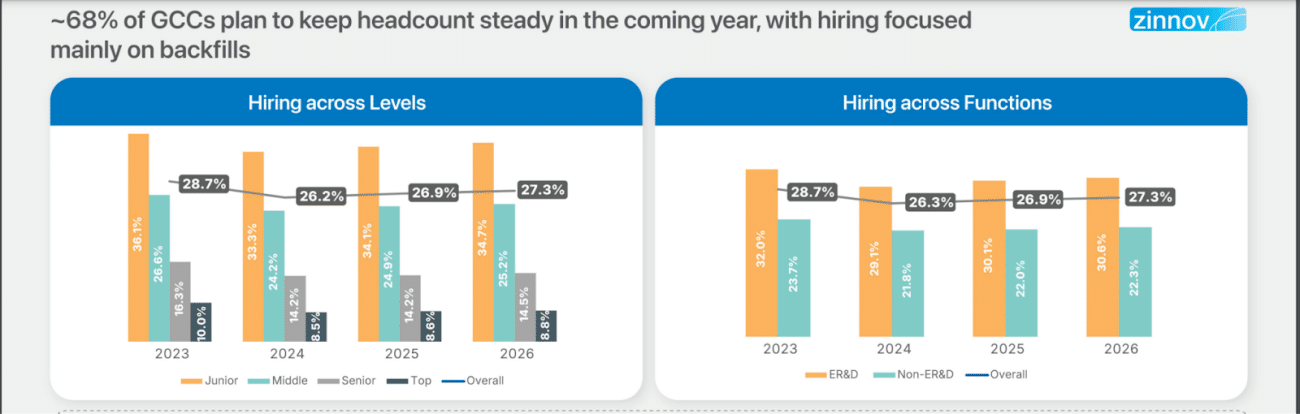
For years, growth was measured by headcount. That metric is losing relevance.
“Elite GCCs are prioritising depth and speed over headcount,” Milesh adds. “Roles are becoming more fluid, combining engineering, design, and AI ethics.”
This has intensified competition for specialised talent, particularly in AI engineering, data science, cloud, and cybersecurity. Yet, compensation alone is no longer enough to attract or retain top performers.
Engineers today want ownership: the chance to work on complex problems, influence decisions, and see the impact of their work on real products and customers.
Vijai Kishan, India site lead and head of India enterprise technology at Fidelity Investments, tells AIM that this evolution is already visible. “Our teams are not just supporting global work, they are shaping it. That requires deep technical skills, strong business understanding, and a continuous focus on learning.”
To meet these expectations, GCCs are redesigning career paths, enabling cross-functional rotations, and investing heavily in upskilling. Leadership density, rather than sheer team size, is becoming the differentiator.
"A rapidly expanding STEM base, stronger industry–academia alignment, and a culture of continuous learning are enabling GCCs to design, operationalise, and govern enterprise‑grade AI and GenAI systems," Rakesh Sancheti, chief growth officer, Tredence tells AIM.
Lighter Offices, Wider Footprints
The physical footprint of GCCs is changing as well.
Hybrid work is no longer a temporary arrangement; it has become a structural reality. As a result, many GCCs are moving away from large, long-term office leases and towards more flexible spaces with shorter commitments.
This flexibility allows companies to scale teams up or down as business needs change. It also enables hiring across multiple cities while maintaining a core presence in major innovation hubs.
Offices themselves are being redesigned—not for fixed seating, but for collaboration, labs, and secure environments for sensitive work.
At the same time, the rise of nano GCCs and mid-size GCCs is driving demand for flexible and managed workspaces.
“They want to operate asset-light, scale gradually, and focus on speed-to-market,” Gaurav Vasu, founder and CEO of UnearthInsight, a leading GCC intelligence and research firm, mentions. “That’s where flex spaces give them a massive advantage—not just on cost, but on bundled services, compliance, and readiness.”
This shift has accelerated the expansion of GCCs into tier-2 and tier-3 cities.
To reduce risk and tap broader talent pools, companies are setting up smaller satellite centres in cities such as Coimbatore, Ahmedabad, Indore, Lucknow, Mysuru, and Mangaluru.
These locations offer lower operational costs, strong talent availability, and higher employee retention.
Recent reports suggest demand for GCCs in tier-2 cities could grow by 30-40% in the coming years, with some centres achieving up to a 35% reduction in operating costs and a significant boost in profitability.
GCCs as Ecosystem Connectors
Beyond real estate and talent, GCCs are taking on a new role—becoming connectors within the innovation ecosystem.
Partnerships with universities, startups, and local innovation hubs are becoming more common. These collaborations support long-term capability building through joint research programmes, skill development initiatives, and early access to emerging technologies.
“GCCs are increasingly acting as bridges,” Anuj Khurana, co-founder and CEO of Anaptyss, says during an interaction. “They bring together academia, startups, and enterprise teams to create sustained innovation.”
This ecosystem-led approach reflects a more mature view of capability building—one that looks beyond immediate delivery needs to long-term resilience.
Perhaps the most important change underway is how success is measured.
“By 2026, GCCs will be judged by the value they create,” Khurana explains. “Not cost savings, but product quality, speed to market, risk reduction, and customer impact.”
Decision-making authority is gradually moving closer to India-based centres. With that authority comes accountability. GCC leaders are increasingly expected to co-own outcomes alongside global business teams.
Chittora captures this shift succinctly. “The real differentiator will not be capability, but authority. GCCs that can challenge assumptions, surface uncomfortable truths, and co-own outcomes will shape the enterprise. Others will remain service factories.”
The Next Chapter
India’s GCC ecosystem is entering its most consequential phase yet.
The foundations—scale, talent, and operational excellence—are already in place. What will define the next decade is how effectively GCCs convert these strengths into influence, ownership, and trust.
Those centres that invest early in AI at scale, leadership depth, governance, and real product ownership will evolve into global nerve centres—places where enterprise strategy is shaped, not just executed.

Your reaction
Discussion
What's your take on this story?
No comments yet — be the first to share your view.