Key takeaways
- Intel's Horse Ridge cryogenic controller achieves high-fidelity results at room temperature, overcoming a major limitation in quantum computing.
- Quantum chips traditionally require freezing temperatures to maintain qubits, posing significant scalability challenges.
- The team demonstrated frequency multiplexing on two qubits using a single cable, simplifying wiring and advancing quantum control chip integration.
- Horse Ridge employs specially designed transistors to facilitate microwave control signals, enhancing qubit performance and scalability.
- The design of Horse Ridge allows for efficient qubit operation and potentially addresses real-world problem-solving capabilities.
Intel and QuTech (a collaboration between the Delft University of Technology and the Netherlands Organisation for Applied Scientific Research) recently achieved a breakthrough in quantum scalability.
In the current form, quantum computers chips have to be kept at freezing temperatures to maintain the fragile qubits on the processor. Qubits typically operate at about -273 Celsius. Such temperatures are difficult to achieve. Until now, this was a significant bottleneck. The research published jointly by the organisations showed Intel’s cryogenic controller, Horse Ridge, can accomplish the same high-fidelity results even at room temperature.
Additionally, the team also demonstrated frequency multiplexing on two qubits using a single cable. This simplifies the wiring challenge, paving the way for fully integrated quantum control chips with the quantum processor.
Intel Horse Ridge
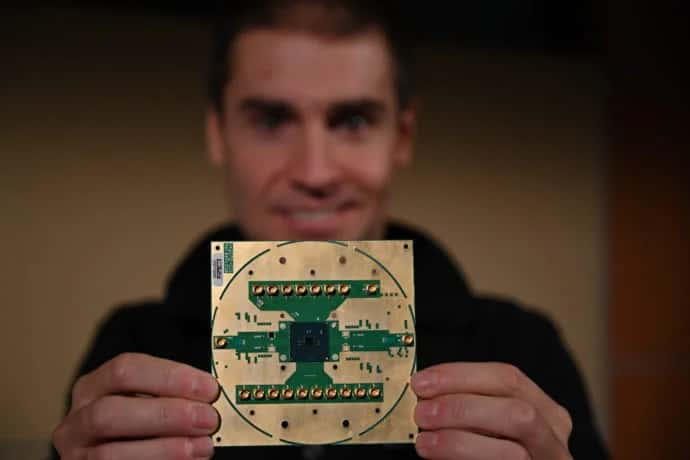
Intel unveiled its cryogenic chip Horse Ridge first in 2019. It uses specially designed transistors that send microwave control signals to Intel’s quantum computing chips. Horse Ridge uses a highly integrated system-on-chip (SoC) to simplify complex control electronics required to operate a quantum system. It helps in faster setup, improves qubit performance, and scales efficiently to higher qubit counts to solve real-world problems.
Horse Ridge is designed to act as a radio frequency processor and programmed with instructions that correspond to basic qubit operations. It translates instructions into electromagnetic microwave pulses that can manipulate the qubit states. Named after one of the coldest regions in Oregon, Horse Ridge was designed to operate at cryogenic temperatures (~4K), a temperature so cold that the atoms almost stop moving.
Cryogenic control chip, Horse Ridge, was developed to overcome a key ‘interconnect or wiring bottleneck’ often associated with quantum computing. This challenge lies between the quantum chip stored in low, cryogenic temperature in a dilution refrigerator and the control electronics (that control the qubits on the quantum chips) operated at room temperature connected through wires. As the number of qubits on the quantum chips increases, the number of wires leading to the control electronics outside of the refrigerator also increases. It is not a sustainable solution considering companies are steadily increasing qubits in the chips.
Getting these control electronics to operate at cryogenic temperature is the key to overcome the wiring bottleneck, which Horse Ridge could achieve. Intel introduced the second generation of the chip in 2020. It brought the key control functions for the quantum computer operation into the refrigerator as close as possible to the qubits. This helped in reducing the complexity of wiring.
Intel’s breakthrough
The latest research shows a commercial CMOS-based cryo-controller that achieves coherent control of a two-qubit processor at the same fidelity as that of control electronics placed at room temperature. It is an important milestone and helps solve the scalability problem by leveraging multiplexing. It reduced the number of cables/wires required for qubit control. The Intel and QuTech team ran a two-qubit algorithm called Deutsch-Jozsa. Deutsch-Jozsa is a deterministic quantum algorithm.
The results were verified by randomised benchmarking that validated Horse Ridge’s capability to present a highly integrated and scalable solution for quantum control electronics. The technology can be directly applied to multi-qubit algorithms and noisy intermediate-scale quantum devices.
Next up, the team hopes to fully integrate the controller chip and qubits by fabricating them in silicon to enable better quantum scalability.
Wrapping up
The new research cements Intel’s position in the evolving quantum computing ecosystem. While much of the R&D in quantum computing has been around qubits themselves, Intel has taken an innovative approach by improving the interconnects and control electronics.
Researchers are increasingly turning towards building quantum computers with techniques used to develop most modern-day electronics. This approach offers huge advantages in terms of scalability and practicality.
Spotted an error? Tell our editors. Read our editorial standards and corrections.