
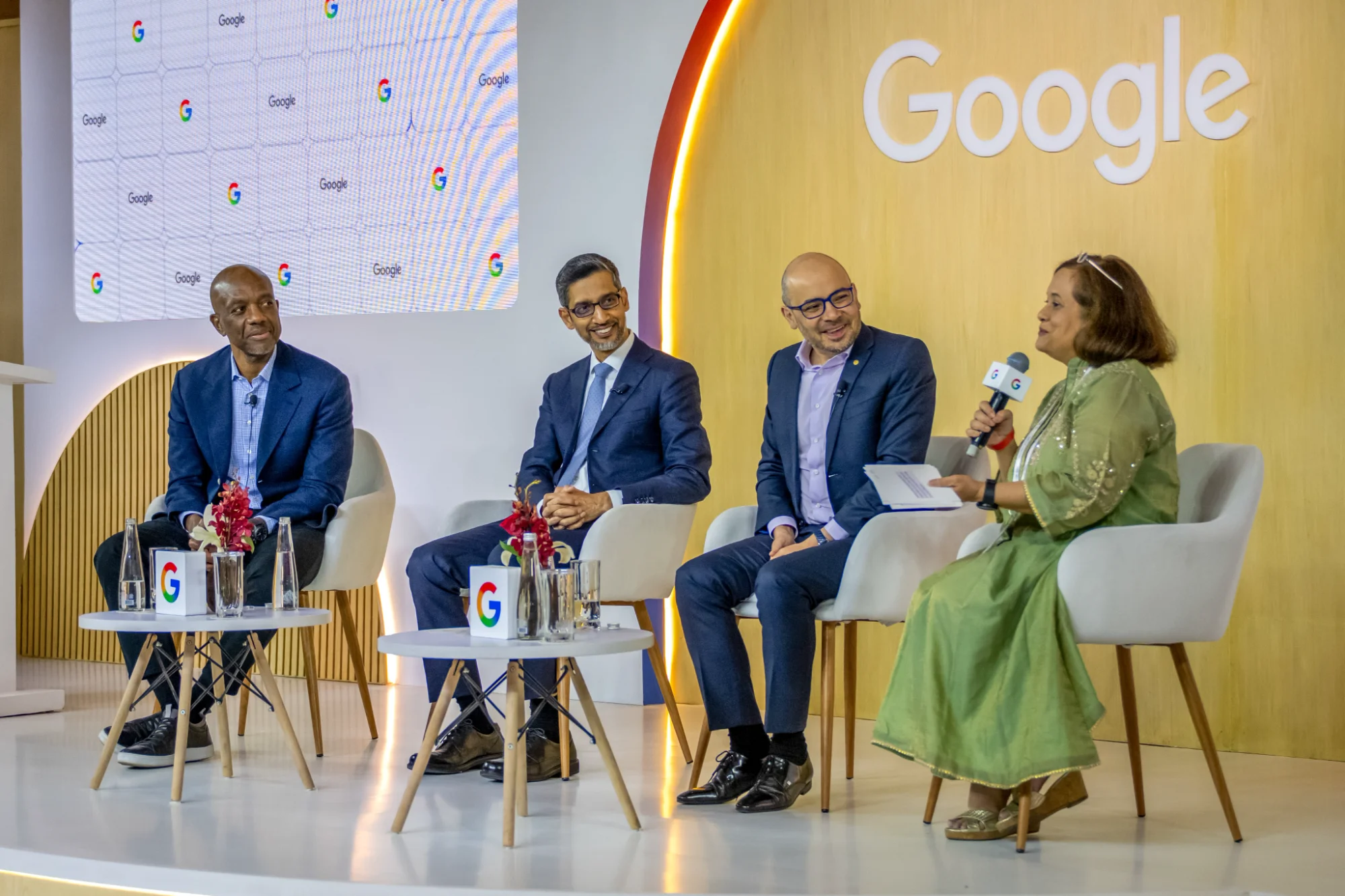
In the wake of the India AI Impact Summit, Google CEO Sundar Pichai returned to familiar ground.
“Whenever I return to India, I’m struck by the extraordinary pace of progress,” he says, recalling his childhood in Chennai and the country’s digital growth over the past decade.
Joined by Google DeepMind CEO Demis Hassabis, Pichai presents a full-stack AI strategy for India, spanning infrastructure, products, skilling, science and public services, alongside $60 million in new global grants.
He describes India as one of the largest platforms for popular AI tools and a country positioned to deploy AI at scale. “For countries like India, AI presents a chance to leapfrog age-old gaps and create new opportunities,” he says. “Whether it’s making diseases more detectable and treatable.”
Pichai even met Prime Minister Narendra Modi to discuss how Google is helping to infuse AI across India to improve healthcare, expand access to information in all languages, and support startups and agriculture.
$15 Billion Vizag AI Hub and New Subsea Connectivity
Infrastructure is central to Google’s India strategy.
Last year, Google announced a $15 billion AI hub in Visakhapatnam. The project is slated to include gigawatt-scale compute capacity and a new international subsea cable gateway.
“When finished, it will bring jobs and the benefits of cutting-edge AI to people and businesses across India,” Pichai says.
Building on this, Google announced the India-America Connect initiative, which will deliver new subsea cable routes connecting the US, India and locations across the Southern Hemisphere, strengthening AI connectivity.
Skilling and Workforce Programmes
Google says it has trained more than 100 million people globally in digital skills and is expanding its AI-focused training efforts.
The company will launch an AI professional certificate programme in partnership with governments, education institutions and employers. In India, it is partnering with Wadhwani AI to offer the programme to students and early-career professionals.
“We are also partnering with 10,000 Atal Tinkering Labs to bring GenAI assistance to over 10,000 schools and 11 million students,” Pichai says.
Google Cloud is also expanding its collaboration with Karmayogi Bharat under Mission Karmayogi. The iGOT Karmayogi platform, supported by Google Cloud infrastructure, serves more than 20 million public servants across over 800 districts.
The partnership will digitise training repositories into searchable knowledge assets and support content in more than 18 Indian languages.
Google DeepMind x Indian Government
Google.org will launch two $30 million programmes to expand the use of AI in public services and scientific research. One of them, the Global AI for Government Innovation Impact Challenge, will support partnerships that use AI to improve public services.
The other, the AI for Science Impact Challenge, will provide funding to researchers using AI in scientific work.
Google DeepMind will also work with Indian government bodies and institutions under its National Partnerships for AI initiative. The partnership will provide access to its AI models for science and support innovation hubs with generative AI tools.
Besides, the search giant also announced the Google Center for Climate Technology in collaboration with the Office of the Principal Scientific Advisor to the Indian government to support AI-based climate research and adoption.
Google cites new data showing that 74% of public servants globally are using AI, but only 18% believe their governments are using it effectively.
Hassabis also points to the scientific impact of AI systems such as AlphaFold.
“Over three million researchers around the world make use of it now. Actually, over two lakh in India,” he says. “And I think it’s just the beginning of the impact that AI is going to have on the sciences and medicine.”
He urges India to double down on its strengths, referring to agriculture and climate research as potential areas of focus. He also mentions creative industries, including Bollywood, as sectors that could adopt the latest AI models, such as its generative AI model Veo 3.
Product Updates
Google introduced a live speech-to-speech translation model that supports real-time conversations in more than 70 languages, including 10 Indic languages such as Bengali, Hindi, Tamil and Telugu.
The company says it will improve the model behind Search Live so users can ask questions about what they see in their own language, including Hindi, Indonesian, Japanese, Korean and Brazilian Portuguese. Google Lens also asks follow-up questions when images are unclear to provide better results.
Moreover, the Gemini app now includes self-study tools and JEE Main practice tests. According to Google, India is among the top three countries globally for both Gemini and AI Mode usage.
A Full-Stack Commitment
Pichai suggests that, in India, where SMEs form a large share of the economy, AI could act as a multiplier.
“Think about the kinds of superpowers this technology gives to SMEs,” he adds.
Unlike earlier waves of technology, he says, AI tools could be directly accessible to small businesses, enabling productivity gains without requiring large capital investments.
“Google has a full-stack commitment to India,” Pichai says in closing. “I’ve never been more excited about the future we are building here.”
What is AGI and How Close are We?
Hassabis says he sets a high bar for artificial general intelligence. “AGI… is a system that exhibits all the cognitive capabilities that humans have.”
The human brain, he explains, remains the only proof that general intelligence is possible. Current systems are impressive but not yet general. “In my opinion, we still have a way to go, at least another five or 10 years.”
According to him, AI can be a powerful tool for scientists, experts and young entrepreneurs. However, he also notes the risks, including safety concerns, job changes and equitable distribution of AI-related benefits.
“If we do it the right way, the potential is there,” he concludes.

Your reaction
Discussion
What's your take on this story?
No comments yet — be the first to share your view.