Salesforce Battles SaaSpocalypse Fears as AI Spending Spooks Wall Street
By Pallavi Chakravorty ·
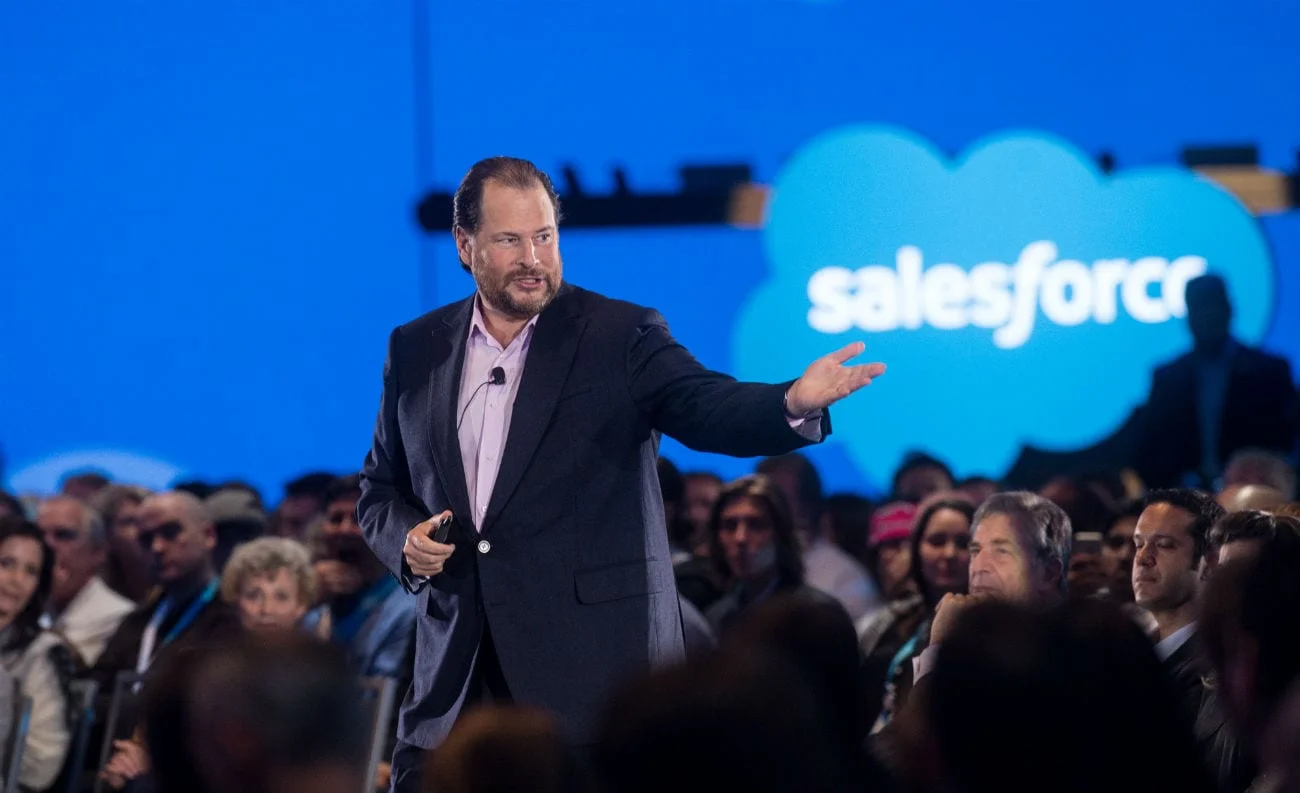
Salesforce delivered solid quarterly results, but it wasn't enough to calm investors. While it projected confidence, the market reaction made one thing clear: the debate over whether AI will supercharge or destabilise the company is far from settled.
The company’s shares fell as much as 5% in extended trading on Wednesday, closing 3.26% lower on the NYSE at $185.42 apiece. The stock has already fallen more than 24% in 2026.
The selloff reflects a broader reckoning across the SaaS sector—investors are questioning whether traditional enterprise software companies can survive the AI revolution, even when the numbers don't show cracks yet.
The enterprise software major posted quarterly operational revenue of $10.7 billion, up 13% year-on-year. Its full-year revenue was $41.5 billion, a 10% YoY increase, aided in part by its $8 billion acquisition of data management firm Informatica last May. Net profit reached $7.46 billion.
Looking ahead, Salesforce forecasts revenue of $45.8–46.2 billion for the coming year—growth of roughly 10–11 per cent—and reported remaining performance obligations (RPO) of more than $72 billion, signalling substantial contracted revenue yet to be recognised. It also lifted its 2030 revenue target to $63 billion.
Yet the optimism had limits. The company’s outlook fell slightly short of Wall Street expectations of $46.06 billion.
Analysts point to cautious corporate budgets amid global economic uncertainty. Companies are prioritising essential software and cost-saving tools, while scrutinising large digital transformation projects. At the same time, Salesforce has been aggressively pushing its own AI initiatives, rolling out Einstein AI features and acquiring AI capabilities. But investors aren't convinced the company can transition from its legacy business model to an AI-first approach without cannibalising its own revenue.
Biting Its Own Tail
Hari Balaji, Partner, Technology Consulting, Generative AI, AI-led Transformation, EY believes the market’s “SaaSpocalypse” fear is understandable. “If AI agents let one person do the work of ten, then seat-based pricing looks vulnerable, and some user interfaces will see less time-on-screen. But it’s too simplistic to jump from that to ‘enterprise SaaS is obsolete’,” he tells AIM.
Large enterprises don’t buy SaaS for screens; they buy it as an operating backbone—systems of record, approvals, audit trails, compliance, and integrations. In an agentic world, those needs quadruple.
“Governance doesn’t disappear, it becomes more important,” he says, adding, “What shifts is the business model. Per-seat pricing will likely give way to hybrid structures—consumption, agent actions, and outcome-linked pricing. The shift will be commercial, not structural.”
A similar shift is unfolding for Indian IT services. “AI may compress effort in certain repetitive workstreams, but it will also create demand for integration, modernisation, governance layers, AgentOps, and operating-model redesign. The bubble risk is real, but the extinction narrative is not,” Balaji explains.
The broader concern is structural. SaaS firms, long valued for predictable, per-seat subscription revenue, now face the prospect of AI agents automating work in ways that could reduce the need for traditional licences. The narrative has been dramatised as the “SaaSpocalypse”.
Market jitters intensified in January after Anthropic launched AI plugins that investors feared could erode the dominance of established software vendors, wiping hundreds of billions off software and related stocks in a single trading session.
Salesforce leadership has pushed back forcefully.
Srini Tallapragada, President and Chief Engineering and Customer Success Officer, dismissed the “SaaSpocalypse” framing as simplistic, arguing that enterprise systems are deeply embedded. “Mission-critical software is not easily replaced; customers rely on trusted platforms to manage complexity at scale," he tells AIM.
What ultimately matters is customer value. “As long as we continue to deliver value, we’ll be good,” he reassures.
Feigning Confidence
But the company can’t wish the concerns away. During the earnings call, CEO Marc Benioff mentioned the term multiple times.
“You’ve heard about the SaaSpocalypse? And it isn’t our first. We’ve had a few of them,” he said, later adding, “If there is a SaaSpocalypse, it may be eaten by the SaaSquatch because there are a lot of companies using a lot of SaaS because it just got better with agents.”
To reinforce that message, Salesforce rolled out a suite of shareholder-friendly measures post the Q4 results. It increased its quarterly dividend by nearly 6% to $0.44 per share and authorised a new $50 billion share buyback programme—moves designed to signal financial strength and long-term confidence.
The company also reshaped its earnings call format, blending traditional analyst Q&A with product demonstrations and executive commentary—part investor briefing, part marketing showcase.
A key announcement was a new metric for its AI offerings: agentic work units (AWU). Rather than counting raw AI “tokens”, Salesforce wants to measure completed, verifiable actions such as updating a customer record that demonstrate tangible enterprise value. The aim is to shift the conversation from generative novelty to measurable productivity.
Strategically, Salesforce outlined a future in which SaaS platforms remain at the centre of enterprise technology stacks, with AI model providers operating beneath them as largely interchangeable engines. In this vision, customer relationships, data integration and workflow ownership give companies like Salesforce the upper hand.
The challenge, however, is existential over the long term. Salesforce must prove it can transition to an AI-driven model without cannibalising its core subscription revenues, and do so before newer AI-native rivals gain scale.
For now, the fundamentals remain solid. But Wall Street appears to be pricing in a worst-case scenario, demanding proof that Salesforce can turn AI from a threat into its next growth engine.