
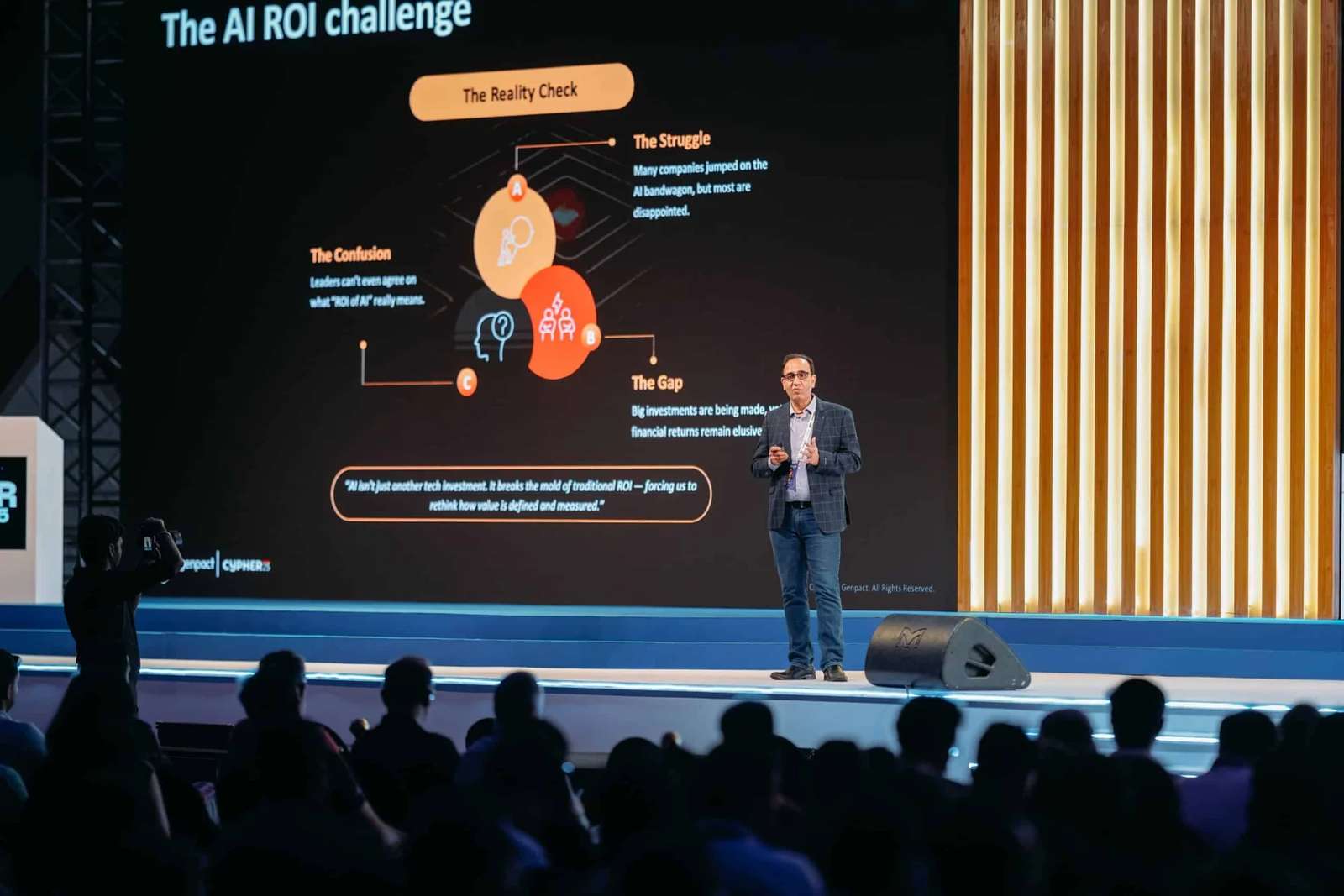

For decades, businesses measured technology success through traditional return on investment (ROI) models. These worked when costs and outputs were predictable. In the age of AI, where models evolve and markets shift constantly, that approach falls short.
At Cypher 2025, India’s biggest AI conference organised by AIM in Bengaluru, Vikas Behrani, vice president of AI practice and innovation lab at Genpact, urged organisations to rethink ROI. He said AI’s value is fluid, intangible, and always changing. “You have to keep looking at it, innovate, and at the same time recalculate what AI value will mean in the next few years.”
Beyond the Obvious Gains
Behrani noted that AI returns extend beyond cost savings, automation, or revenue growth. The bigger impact lies in what he called invisible ROI—customer delight, brand reputation, talent attraction, agility, and knowledge retention. These are hard to measure but build long-term advantage.
He also flagged hidden costs. “More often than not, invisible costs are two to three times your direct costs,” he said. Legal reviews, compliance checks, employee training, and integration with legacy systems quietly drain budgets.
Treat ROI as a Journey
Behrani stressed that ROI should be seen as a continuous process.
In the pre-implementation stage, businesses must define the problem, set success metrics, ensure data quality, and test pilots. During rollout, they should train employees, work with domain experts, monitor performance, and plan for maintenance. Post-implementation, AI should be managed like a portfolio investment, with expectations reset and ROI reassessed regularly.
From Cost to Value
For Behrani, the shift is about mindset. “You have to move from cost reduction to value creation. From short-term gains to long-term impact. From single solutions to portfolio solutions.”
He concluded with a clear message. “The bottom line is not just a cost case anymore, but a strategic value equation. Those who master AI ROI measurement will define the future of value in this AI era.”
- Anthropic Makes $2.08 in Revenue for Every $1 Spent on Compute — Here’s the Full IPO Story
- OpenAI Says AGI is Here. But Not Everyone is Buying It
- Why Oracle is Bringing Post-Quantum Security to Java
- What Really Happens When You Turn Your Selfie Into a 1980s AI Pic?
- AI Agents Are Making Data Security A Bigger Enterprise Problem
- OpenAI is Getting Nervous About Reinforcement Learning