
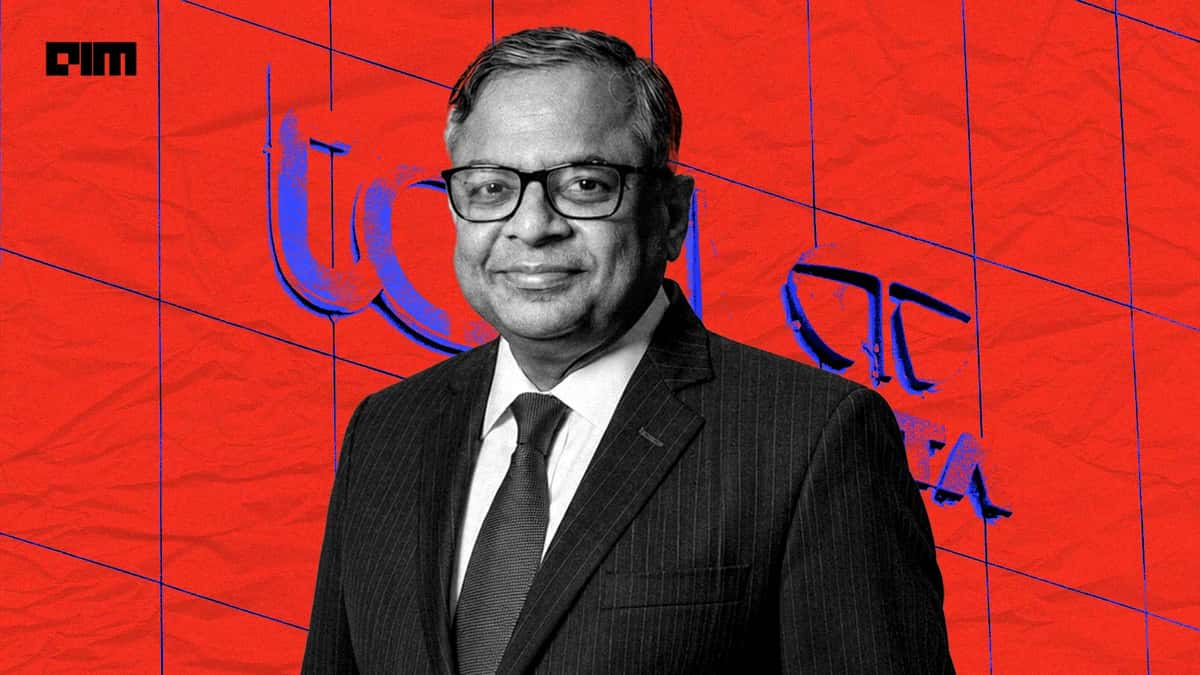
TCS lost more market value in a few hours on Wednesday than most Nifty companies are worth in total. The reason: its chairman just quit.
On August 12, N Chandrasekaran told the Tata Sons board he will not seek reappointment when his term ends on February 20, 2027. Nine years at the helm, over. The announcement landed six days before Tata Sons’ August 18 AGM, a meeting that was already shaping up to be tense.
For the second time in a decade, India’s largest business house has no clear line of succession at the top.
The market didn’t wait for clarity. It just sold.
Why TCS took the biggest hit
TCS fell over 4% intraday on Wednesday. At one point the drop touched 5%. Tata Motors Passenger Vehicles was down 3.3%. Titan and Tata Steel both slipped more than 2%. Tens of thousands of crores gone, in hours, across the group.
TCS isn’t just another Tata company. It's the cash engine. Tata Sons owns 71.7% of it, and dividends from the IT major have funded much of the group's expansion into steel, autos, aviation and retail for years. When the parent wobbles, TCS is where investors feel it first.
Chandrasekaran ran TCS from 2009 before moving up to Tata Sons in 2017. That path made him, in the market’s head, almost interchangeable with the company itself. His exit reopens a question nobody has a clean answer to yet: who chairs Tata Sons next, and who ends up chairing TCS’s board as a result.
The timing makes it worse. TCS is already dealing with one of its toughest stretches in years, as generative AI eats into traditional IT services pricing and growth slows against global peers. Jefferies had already cut its TCS price target to ₹1,800 on AI-linked risk before any of this happened. A leadership vacuum at the parent, stacked on top, just gave investors one more reason to sell first and ask questions later.
Phil Fersht, CEO and Chief Analyst at HFS Research, called it plainly on LinkedIn: this is not an orderly succession. “Tata is changing its leader just as some of the biggest bets in its history across AI, semiconductors, electronics, aviation and automotive are entering their hardest phase, while TCS itself is wrestling with the biggest structural disruption the IT services industry has ever faced,” he wrote.
His read is that the market isn’t pricing the loss of one chairman. It’s pricing uncertainty over who makes capital allocation calls across a roughly $277 billion group. Chandrasekaran, in his framing, had become the “chief integrator” holding technology, capital and operations together.
Take that away, and the market wants proof the next person can do the same job.
The Succession Plan
Chandrasekaran’s own path, TCS CEO to Tata Sons chairman, gave current TCS CEO K Krithivasan something rare: a group chairman who had actually run his company before. That advantage disappears with this exit.
If T V Narendran, the Tata Steel CEO seen as an internal frontrunner, becomes chairman, Fersht argues the group’s centre of gravity could shift from technology toward manufacturing and other capital-heavy businesses, even as TCS tries to defend its spot as the group's biggest dividend payer.
Not everyone thinks TCS itself is exposed. Gaurav Vasu, Founder and CEO of UnearthInsight, says the direct hit should be limited because TCS already has a mature leadership bench.
He points out that Chandrasekaran had handed off customer relationships to his brother, former COO N Ganapathy Subramaniam, well before this transition. Still, Vasu doesn’t rule out senior exits at TCS down the line, and he draws a comparison to the churn that followed C P Gurnani’s departure from Tech Mahindra.
Pareekh Jain, CEO and Lead Analyst at Pareekh Consulting, made the same comparison in a separate LinkedIn post: whoever takes over at Tata Sons will likely trigger some reshuffle at TCS too.
Two analysts, one precedent, same warning: succession at the top rarely stays at the top.
What hasn’t changed, and what has
TCS’s actual numbers haven’t been cracked. Double digit revenue growth, healthy margins, a solid order book for the June quarter. Nothing there says panic.
What changed is the risk premium. Investors are now pricing in an extended, very public leadership transition at the company’s largest shareholder, right as AI reshapes pricing and delivery across the entire IT services industry.
TCS’s leadership bench will be watched as closely as Tata Sons’ own search. The group’s newer, capital-hungry bets in semiconductors, aviation and electronics need a chairman with enough authority to keep funding them without internal friction.
And the market, having already wiped out billions within hours of the news, will keep parsing every signal between now and August 18, and well beyond it, until a name is actually announced.
TCS also has a much bigger AI infrastructure bet sitting in the background. Through HyperVault, its AI data centre business with TPG, the company plans to build 1 GW of AI-ready capacity in India, with the partners planning to invest up to ₹18,000 crore.
More importantly, OpenAI has signed on as HyperVault’s first customer, starting with 100 MW and with an option to scale to 1 GW. TCS says it has since secured customer commitments, finalised land parcels and progressed partnership agreements.
The project is already well beyond a PowerPoint announcement, so Chandrasekaran’s exit is unlikely to derail it. But it does put another big capital-allocation decision in front of his successor.
- Are Boutique AI Firms India’s Next Big Thing?
- Indian IT’s New Workforces Come with a Margin Challenge
- ‘Owning of the IP Itself is Meaningless,’ Says Mphasis’ Ravi Vasantraj
- Infosys’s $5.2 Billion Deal Wins Fail to Lift FY27 Outlook
- Tech Mahindra’s Q2 Revenue Modest, But AI-led Deflation Remains Higher
- Wipro’s Deal Slump Puts Its AI Growth Story to the Test