
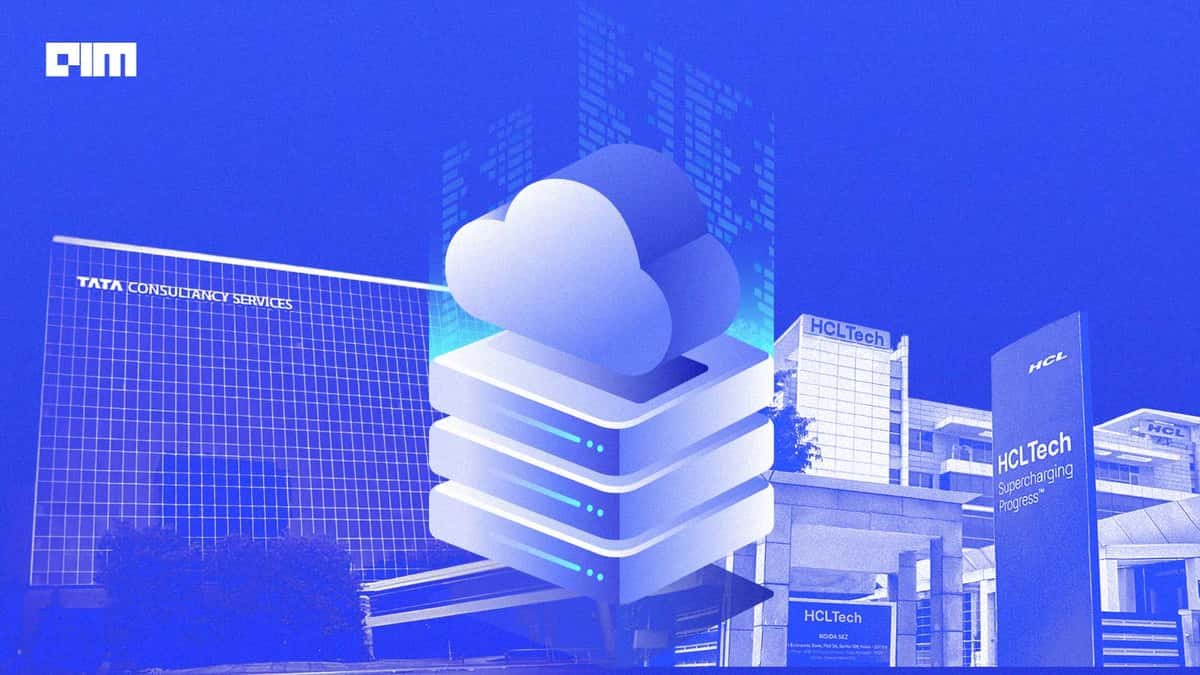
Indian IT no longer want to just build software on top of someone else's servers. They want to own some of the servers too.
Last year, TCS secured $1 billion investment from TPG for its HyperVault business to support its gigawatt-scale AI-ready data centre buildout. It has even secured land in Pune and Andhra Pradesh. Then, in July this year, HCLTech's board announced a ₹3,500 crore ($368 million) investment to build up to 50 megawatts of AI data centre capacity.
However, Infosys seems bent on taking a different approach. On the IT company’s data centre plans, Infosys Chief Executive Officer Salil Parekh, during the recent earnings call, said the company had reviewed it with its management team and board, and had decided against making any move into that business at this stage.
It is a rare, explicit divergence between peers that have historically moved in lockstep on most strategic questions like pricing, hiring, even messaging around AI.
What TCS, HCLTech are Actually Building
TCS moved first and biggest.
Last year, the company announced plans to invest up to $6–7 billion to build 1 gigawatt of data centre capacity in India over five to seven years, at a cost of roughly $1 billion per 150 MW. It then brought in private equity major TPG as a partner: the two will jointly put in $2 billion of equity into a venture called HyperVault AI Data Centre, with TCS holding 51%, while aiming to raise a further $4.5–5 billion in debt.
TCS chief K Krithivasan has framed this as part of a broader "full-stack" ambition that spans everything from chip design and infrastructure to models, platforms, and AI agents, positioning the company as an AI-first operator rather than only a services vendor.
HCLTech's move, though smaller in absolute rupee terms so far, follows a similar logic. Riding on the tailwinds of India’s sovereign data and workload requirements, CEO C Vijayakumar told analystsb during the Q1 earnings call that the bigger opportunity for the company is not to rent AI capacity but to own it.
In an interaction with AIM, Sriram Hariharan, Corporate Vice President and Global Head - Strategy and Corporate Development at HCLTech, says the trigger that tipped the company’s data centre strategy was the observation that revenue intensity of a data centre rises sharply once AI enters the picture.
A traditional colocation facility might generate roughly one unit of revenue per square foot or megawatt, but hosting it as a full-stack AI offering can push that multiple up to 10–15x, along with a higher return on the capital deployed.
He ties this to a shift in client expectations too.
"If you compare it to the earlier three-tier web architecture, it was a lot easier to have multiple vendors come together to deliver these services. You could still pinpoint a specific vendor for ownership of a particular component or tower,” says Hariharan. “But with AI, there's a bit of a black box, so the expectation today is to have one player that can provide the full stack and take full ownership. That's why, from our side too, this is a much higher revenue-intensity business than traditional physical colo infrastructure."
HCLTech has also already begun executing. It has plans to establish its first AI data centre at the upcoming Odisha Sovereign AI Park in partnership with foundational AI startup Sarvam AI and the Odisha government. The project will involve a planned capital outlay of ₹14,257 crore, including financial assistance from the state government.
Why Infosys is Staying Out
Infosys's reasoning, as laid out by Parekh, centres on capital allocation rather than rejecting AI infrastructure altogether.
The company continues to spend heavily on AI, but through an asset-light, partnership-driven route: a tie-up with Anthropic to combine Claude models with its Topaz AI platform, an expanded partnership with ExxonMobil on immersion-cooling systems to make data centres more energy-efficient, and its own Topaz Fabric platform that lets clients run workloads across closed, open-weight, or on-premise models while keeping data sovereignty intact.
Industry watchers see this as a coherent, if more conservative, strategy rather than a missed opportunity.
Gaurav Vasu, Founder and CEO of research firm UnearthInsight, says the economics of AI infrastructure are fundamentally different from the economics of IT services. Any AI infrastructure buildout would need to be based on gaining sovereignity. That’s why TCS and HCLTech can strike the iron while its hot.
“The rationale for TCS and HCLTech is somewhat different because both have a relatively larger India domestic business, where owning or investing in data centre infrastructure can complement local demand and sovereign cloud requirements,” says Vasu.
Aparna Kumar, Founder of IT advisory firm Nexora Tech Solutions and a former CIO at SBI and HSBC, offers a more sceptical reading. She points out that a modern data centre is no longer purely an infrastructure play: environmental compliance, water and power availability, and the sheer scale of upfront capital now dominate the calculus.
Running the numbers over a three-to-five-year horizon, she says that a large services company would need a minimum of $5–10 billion just to get started at a meaningful scale.
“On one side, they (IT services firms) are trying to reduce manpower because of AI and data centres have not been their core job for decades,” she says, explaining that AI infrastructure spending competes directly with the profit and revenue pressures.
She adds that some companies may find the cost-benefit math simply doesn't clear the bar, and end up redirecting that capital toward AI skilling or supporting India's sovereign cloud build-out instead.
Moreover, large global enterprises will keep relying on hyperscalers such as Google, Microsoft, and Amazon for core AI and data centre needs rather than shifting that spend to Indian IT vendors. That’s where Infosys’ logic wins.
“For Infosys, avoiding capital-intensive infrastructure investments is a pragmatic allocation decision. Its strengths lie in building AI solutions, integrating enterprise systems and executing large-scale transformations, not in competing with hyperscalers on infrastructure,” Vasu remarks.
The Market's Verdict
Investors though aren’t cheering. When TCS first announced its data centre ambitions, brokerage BOBCaps called the plan "negatively surprising," estimating the business could generate returns in the teens, far below TCS's core business.
HCLTech, notably, has also warned that AI-driven productivity gains could create a 2–3% revenue deflation headwind even as it pursues this new growth vector—a reminder that the data centre bet is as much a hedge against AI cannibalising services revenue as it is a pure growth play.
The pivot is also unfolding against a national push for compute sovereignty.
India's government-backed IndiaAI Mission, a roughly ₹10,372 crore programme, has already deployed close to 62,000 subsidised GPUs and is targeting 100,000 by the end of 2026. A
Real estate consultant Colliers projects India's total data centre capacity could more than triple to around 4.5 GW by 2030, with global hyperscalers like AWS and dedicated data centre operators like STT pouring in billions of dollars.
That is the market TCS and HCLTech are choosing to enter directly, and that Infosys, for now, is choosing to serve, rather than own.
- Tech Mahindra’s Q2 Revenue Modest, But AI-led Deflation Remains Higher
- Wipro’s Deal Slump Puts Its AI Growth Story to the Test
- The Unintended Winner of US Green Card Pause: India’s Offshore AI Hubs
- HCLTech Shows Indian IT Can Win AI Deals—But at the Cost of Core Business
- Indian IT's Q2 Will Test the Economics of AI
- Can Mid-Market Deals Save HCLTech From the Great AI Tech Squeeze?