
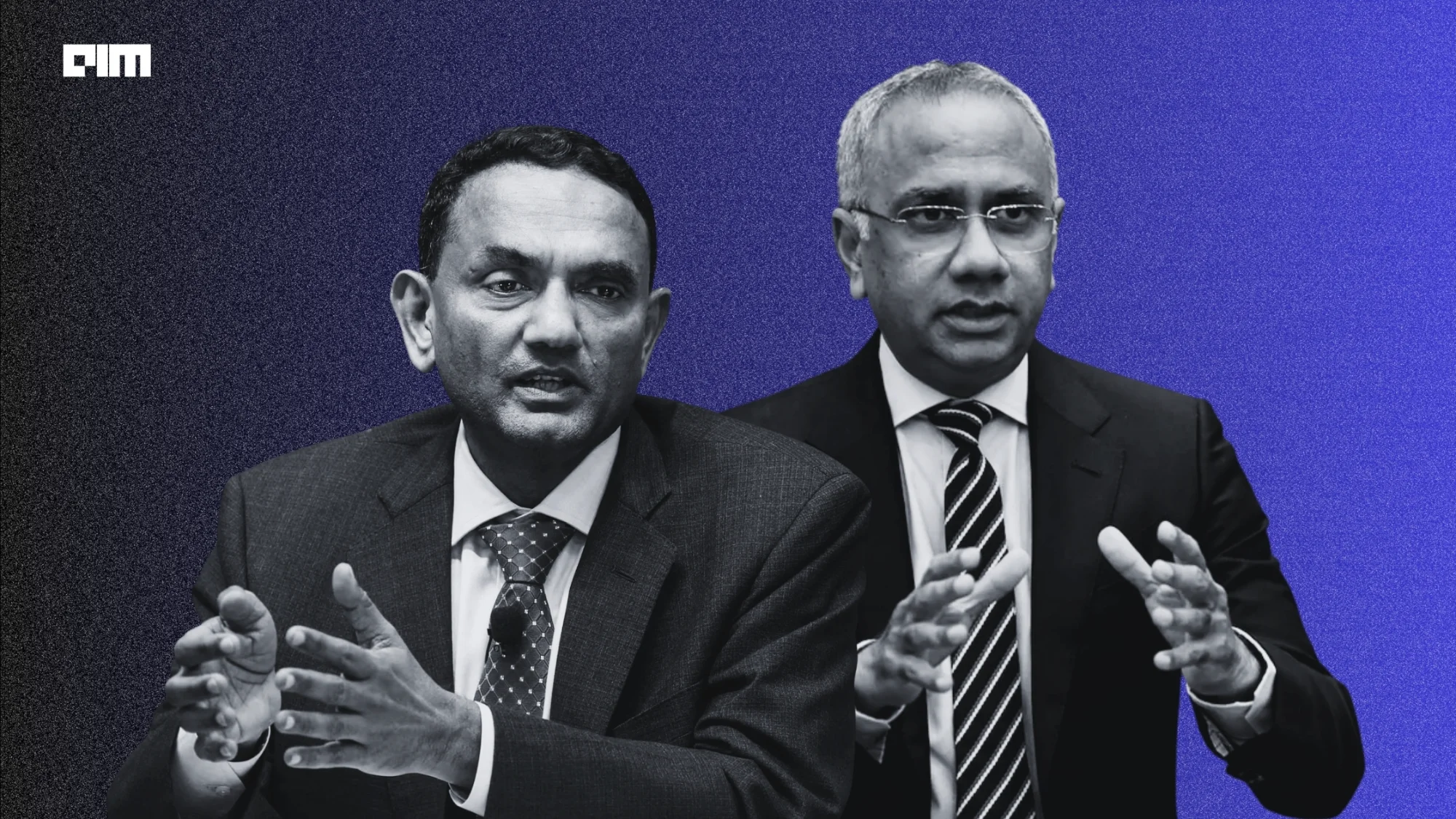
The AI race inside India’s IT industry is beginning to look less like a technology upgrade and more like a strategic realignment. Over the past few weeks, the country’s two largest technology services firms have stitched together alliances with different corners of the global AI ecosystem.
TCS has aligned with OpenAI and AMD. Infosys has partnered with Anthropic and Intel.
TCS is betting on infrastructure and compute supply. TCS will leverage AMD’s Helios platform—which provides open-standard architecture for AI training and inference—to co-develop a sovereign rack-scale architecture to support 200 MW of AI infrastructure capacity. With OpenAI, it will build AI-optimised data centres in India with 100 MW compute capacity, and scale it up to 1 GW.
Meanwhile, Infosys is betting on enterprise orchestration and workflow automation. It partnered with Anthropic to develop advanced enterprise AI solutions, integrating Claude Code with Infosys Topaz AI suite of services. With Intel, it will utilise the chips company’s compute platforms to design, develop, optimise, and benchmark AI workloads through the Topaz Fabric agentic services suite.
While these collaborations are fuelling enterprise AI ambitions, they also reflect a much larger shift underway in Indian IT.
“For many years, these companies operated largely as implementers,” Sanchit Vir Gogia, Founder of Greyhound Research, tells AIM. “They integrated software platforms, managed infrastructure, and delivered large-scale application services.”
The AI economy is rearranging that structure. “The real leverage in this new landscape sits around three things: Who has access to the most capable models, who can secure reliable compute capacity, and who can translate those capabilities into systems enterprises actually trust,” he explains.
If you believe Narmadeshwar Mishra, Founding Director at Brilliant Academy Of Learning, this is actually a “global AI Cold War playing out through the IT giants,” he posted on LinkedIn.
https://www.youtube.com/watch?v=Nt_APe2298U
What Does TCS Want?
TCS appears to be leaning toward the supply side of that equation.
Its partnership with OpenAI gives the company proximity to one of the most influential AI model ecosystems shaping generative AI adoption globally. It will leverage that to advance AI infrastructure through a new data centre initiative called HyperVault.
“When a services firm begins linking its strategy to physical compute capacity at that scale, the signal is clear,” Gogia says. “The company is attempting to move closer to the supply layer of the AI economy rather than remaining downstream as a services implementer.”
The partnership with AMD reinforces that direction. As TCS CEO K Krithivasan said, the AMD tie-up “advances our ambition to become the world’s largest AI-led technology services company”
AMD’s Instinct GPUs and EPYC processors are increasingly positioned as the building blocks of dense AI clusters designed for training and inference workloads.
The conversation, Gogia argues, is not simply about chip performance. “It is about designing infrastructure environments capable of running very large training and inference workloads while still fitting within hybrid enterprise environments and sovereign data frameworks that many governments now favour.”
The sovereign element is important.
Governments and enterprises are beginning to demand AI systems that operate within domestic infrastructure boundaries. Data residency, regulatory oversight, and national security concerns are all feeding into that shift. India, too, announced a tax holiday until 2047 to foreign cloud service providers utilising data centres in India.
If TCS successfully builds large-scale AI infrastructure inside India, it could position the company closer to the physical backbone of the AI economy rather than only delivering services on top of it.
Infosys Has a Different Game
Instead of focusing on large compute infrastructure, Infosys is building AI systems designed for enterprise operations.
Its partnership with Anthropic integrates Claude models into Infosys’s Topaz AI platform. The goal is to create agent-based AI systems capable of automating complex enterprise workflows. The first deployments focus on industries such as telecommunications, finance, and manufacturing—sectors peripheral to the AI race.
“Banks, telecom operators, and manufacturers are rarely interested in chasing the newest model headline,” Gogia says. “Their first question is usually much simpler: Can the system be trusted to operate safely inside a regulated environment?”
The collaboration with Intel supports that enterprise orientation. Infosys is leveraging Intel’s broad AI portfolio rather than building new data centers, unifying Intel’s “high-performance, energy-efficient” compute (Xeon, Gaudi, etc.) with Infosys Topaz Fabric.
Rather than building massive training clusters, the partnership focuses on infrastructure architectures that deliver predictable performance and manageable operating costs across cloud, on-premises, and edge environments.
Many enterprise buyers care deeply about those trade-offs. Their AI systems need to run continuously inside operational processes that cannot tolerate instability or unpredictable costs.
In practical terms, Infosys is trying to occupy the orchestration layer of enterprise AI where models, data, and workflows converge.
Some analysts argue that these alliances represent the beginning of a new AI stack emerging within the Indian IT services industry. Service providers are expanding their role beyond implementation, building orchestration frameworks, automation architectures, and industry-specific accelerators designed to automate enterprise functions.
The Revenue Question
The ultimate test of these partnerships will not be technology announcements. It will be revenue. “This should have happened sooner. If they [TCS and Infosys] had moved faster on AI, the stock charts might look very different today,” Anurag Thakur, Associate at consumer internet company Info Edge India, posted on LinkedIn.
“Now, the real test begins. Partnerships are easy. Revenue impact is not. Let’s see if these moves reflect in the next quarter,” he added.
Infosys’s approach aligns naturally with industries where governance and reliability dominate technology decisions. Banks, telecom companies, healthcare organisations, and manufacturers often move cautiously when adopting new technologies. Systems that demonstrate strong governance controls and predictable performance tend to move into production faster.
TCS is pursuing a different trajectory with large-scale compute infrastructure ambitions. If HyperVault successfully delivers large amounts of compute capacity, it could enable massive engagements involving infrastructure development, AI platforms, and operational services.
But infrastructure strategies are not formed in siloes. Large data center projects depend on power availability, regulatory approvals, and long-term utilisation levels.
But beyond these individual partnerships, a deeper transformation is underway inside the Indian IT industry. Many companies are now exploring new pricing structures tied to automation-driven productivity gains and platform-based delivery models.
“What people are missing is [that] this isn’t about tech flexing. This is about infrastructure control. Whichever side wins decides what AI processes your loan, answers your customer service calls, runs your company's operations, and powers your apps,” Sahil Kumar, Full Stack Engineer at event services company Blend, posted on LinkedIn.
“The AI that wins India doesn't just win revenue; it wins trust, data, and the template for every other developing market.”

Your reaction
Discussion
What's your take on this story?
No comments yet — be the first to share your view.