
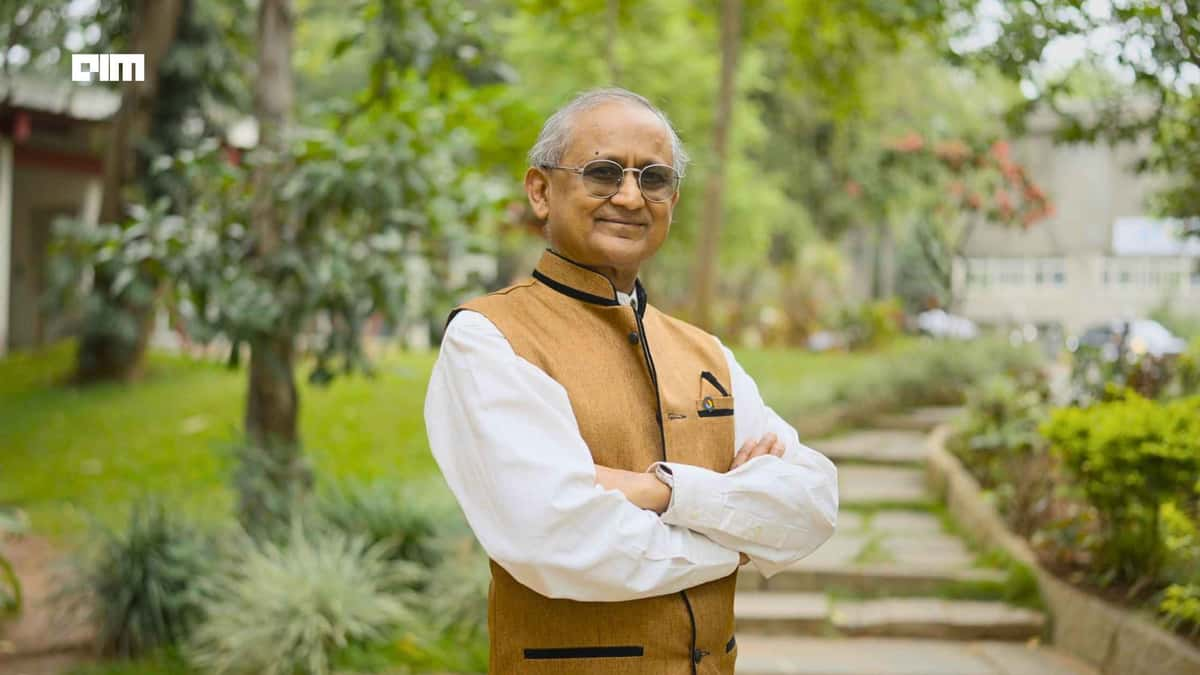

At the India AI Impact Summit in February, Amit Sheth, the founding director of IAIRO, India's newest AI research institution, asked a room of 100 people a simple question. If he were to build something akin to DeepSeek in India, would he be able to assemble 200–250 world-class researchers that the Chinese lab pulled together?
Only three hands went up. Two, by his own admission, belonged to people who clearly did not know what they were talking about. He was not sure about the third either.
That sentiment follows the numbers. According to research by the Hoover Institution and Stanford University, 71% of Chinese AI researchers trained abroad go back home. For India, that number is the other way round, with 73% of high-skilled researchers not returning after an international move, per IISER.
Research Volume Isn’t the Problem
Sheth has watched this gap widen upfront.
At AAAI, NeurIPS, and EMNLP conferences, he recounts that for every 20 papers from China and six or seven from the US, there was only one from India. China did not get here by accident. Sheth recalls visiting Tsinghua University in Beijing and finding facilities that beat anything he had seen at a US campus, funded by a scholar programme that handed returning professors million-dollar labs and serious pay.
India’s equivalent, schemes like the PM Professorship Programme by Anusandhan National Research Foundation (ANRF), started only recently and the money behind them is, in his words, comparatively tiny.
This tracks with what Tech Mahindra’s Chief Innovation Officer Nikhil Malhotra said days earlier: India has been measuring the wrong things, counting GPUs and models instead of counting contributions the rest of the world actually cites. India sits second globally on AI paper volume, right behind China.
On citation influence, the number that shows whether anyone builds on your work, it drops to fourth, behind the UK, China, and the US.
Volume was never the problem. Nobody stuck around to make the volume count.
Enter ‘Small AI’
Sheth’s pitch is that India should stop trying to out-GPU the US and China, and instead go compact. Neuro-symbolic models, trained on one company's own data, deployed air-gapped on a solar plant or a semiconductor fab, not a trillion-parameter model trying to know everything about everything.
“We create new kinds of models that are very compact,” he tells AIM. These models are trained only on the data for the problem being solved. IAIRO’s Sandwich platform is meant to co-build these with startups at what he claims is a fraction of the $7 million and eight-person team a typical AI-native startup needs.
It is a reasonable bet on paper. It also conveniently sidesteps the question of whether you can build a serious Small AI ecosystem without first solving the talent exodus that produced the citation gap in the first place.
On the Upside
Give credit where it is due. Sheth co-chaired the ANRF's AI mission proposal panel with CEO Shivkumar Kalyanaraman, and the process he describes sounds promising. Around 500 proposals. Three to five detailed reviews each. Finalists called in for video presentations, live Q&A, and roughly 40 minutes of deliberation per team.
Sheth says it matched the rigour of National Science Foundation panels he ran in the US for years, and came without any favouritism.
The catch, as always, is money. ANRF can currently fund about 1% of proposals. Sheth wants that to improve to 5–10%. Government funding participation with the Credit Guarantee Scheme has moved up from 69% to 85%. Progress, technically. Just not the kind that moves fast enough for a country wanting to compete on frontier tech.
The Rush to Monetise Research
This is where Sheth stops being careful. He says Indian corporates treat organisations like IAIRO, ones with an explicit national mandate, the way they would treat a vendor delivering on a quarterly SOW.
Even in drug discovery and drug repurposing, categories where the payoff structure is inherently long and lumpy, he cannot get companies to invest the time to understand what is on the table.
He already has a working prototype built with IIT Madras researchers on cancer molecule discovery. Published. Covered in Indian newspapers. Still no takers rushing to fund the next step. And then there are funding holdups.
Compare that to Indian pharma companies acquiring foreign tech at billion-dollar valuations for capability that, Sheth argues, could have been built domestically at a fraction of the cost. The willingness to pay exists. It is just aimed outward.
The biggest example for India is Skyroot’s Vikram 1, the first privately built Indian rocket to reach orbit, built by engineers who came out of deep research training rather than a product-first startup track. Sheth’s takeaway: invest in the underlying science first, and the breakthroughs follow.
- The AI Slowdown Narrative Doesn’t Reflect Enterprise Reality
- India’s Enterprises are Scaling AI. Is the Infrastructure Ready?
- Industry Wants Faster Approvals and Cheaper Power in India’s Data Centre Policy
- Inside Jio Platforms: Its Tech Bets, Loss-Making Subsidiaries and Hidden Risks
- India’s GCCs to Add 1.4 Million Jobs, Drive 170 Million Sq. Ft. Office Demand by 2031
- AI Can Be Cyborg or Centaur. But Can Enterprises Monetise It?