
In an episode of the tech dystopian series Black Mirror, the consciousnesses of the protagonists, upon their deaths, are uploaded to the cloud, allowing them to forever relive their youth. This was the show’s idea of a simulated version of heaven—widely considered the only true happy ending in the entire series.
However, a recently resurfaced patent from Meta paints a rather hellish picture. It describes how AI systems can simulate a deceased user’s social media activity and make them “work” again.
This has intensified the global debate around what researchers are calling “AI resurrection” and the risk of turning digital remains into economic assets.
The Fine Print
The patent, first filed in 2023 and led by Meta CTO Andrew Bosworth, outlines technology that could allow AI to analyse a user’s past posts, messages, and interactions to generate responses or mimic their communication style after death. While Meta has said it has no immediate plans to build such a product, the patent has sparked scrutiny because of what it represents: the possibility of posthumous simulation embedded directly into platform infrastructure.
Researchers studying what they term “AI resurrections” say this marks a potential turning point.
In a recent paper titled Artificially Alive: An Exploration of AI Resurrections and Spectral Labor Modes in a Postmortal Society, Tom Divon and Christian Pentzold from the Hebrew University of Jerusalem and Leipzig University, respectively, examined more than 50 real-world cases across the US, Europe, the Middle East, and East Asia where generative AI was used to recreate deceased individuals’ voices, likeness, or personalities.
Unlike bespoke memorial projects created by families or museums, the researchers argue that Meta’s proposal differs in scale. Instead of optional, standalone tools, it imagines AI resurrection woven directly into social media systems used by billions.
They describe this as “spectral labour”—the idea that the dead could effectively be made to “work” again through the extraction and reanimation of their data, likeness, and emotional expression. At platform scale, this could transform posthumous presence into a continuous source of engagement, content generation, and economic value.
The paper categorises AI resurrection practices into three emerging modes: spectacularisation, where famous figures are digitally re-staged for entertainment; sociopoliticisation, where victims of violence are reanimated for advocacy or testimony; and mundanisation, the fastest-growing category, where ordinary users create chatbots or synthetic personas to “talk” with deceased loved ones.
The researchers argue that current legal systems are poorly equipped to address this phenomenon.
Traditionally, digital remains are treated either as inheritable property or as privacy interests to be protected. Generative AI, however, converts static data into interactive agents capable of producing new speech, relationships, and potentially revenue.
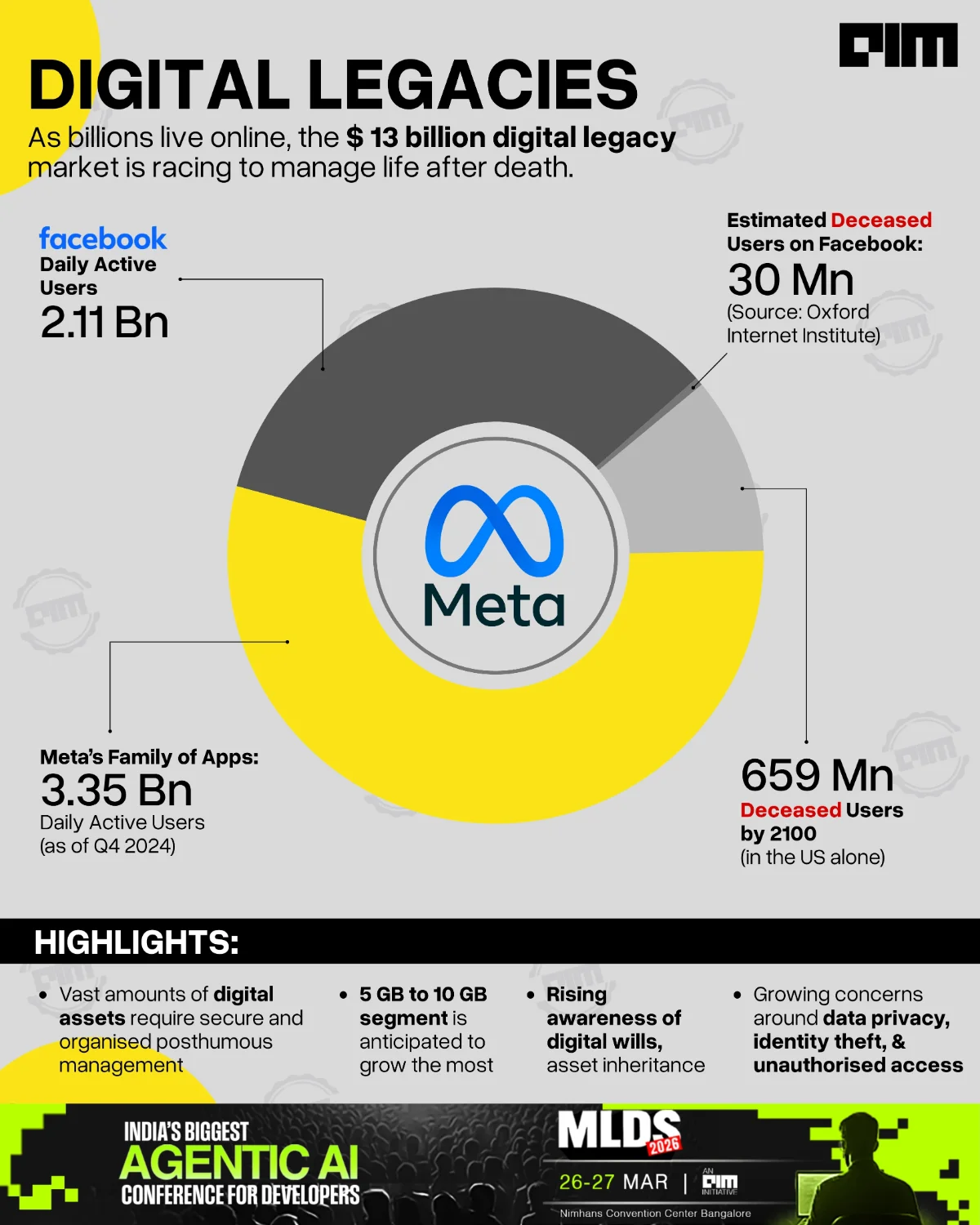
According to Grand View Research, the global digital legacy market was valued at $12.93 billion in 2024 and is expected to grow at a CAGR of 15.6% between 2025 and 2030. The growth is driven by rising awareness around digital wills, asset inheritance, and safeguarding online identities.
The India Question
India has 491 million social media users as of January 2025, according to DataReportal, representing 33.7% of the population and making it the second-largest social media market globally after China.
Pranesh Prakash, a technology policy expert, notes that India does not recognise patents on software per se under Section 3(k) of the Indian Patents Act, raising uncertainty over how such a filing would be treated domestically. While the patent may hold in other jurisdictions, its enforceability in India could face structural limitations under the current intellectual property law.
Prakash also drew a sharper ethical line. “No AI should be allowed to pretend to be a human,” he tells AIM, arguing that systems designed to simulate deceased individuals risk crossing a fundamental boundary between representation and impersonation.
His position underscores a broader concern among digital rights advocates: AI resurrection may not simply preserve memory, but manufacture synthetic continuity, blurring the line between tribute and deception.
In India, the regulatory landscape is beginning to confront this question. Malcolm Gomes, Chief Operating Officer at Privy by IDfy, an enterprise grade suite of products designed for Digital Personal Data Protection (DPDP) Act compliance points to Section 14 of the Act, which recognises a Data Principal’s right to nominate an individual to exercise their rights in the event of death or incapacity.
“Any system that continues operating an account post death must align with the user’s explicit instructions during their lifetime and enable the nominated representative to exercise applicable rights in accordance with law,” Gomes explains.
He emphasises that consent cannot be assumed from routine platform usage. “Consent for such a feature must be specific, informed, and purpose-bound. It cannot be implied from general platform use. Platforms must also consider the privacy interests of third parties whose data may be embedded in the account.”
Deepak Bhavsar, Co-founder and Director - Compliance at managed security services provider Infopercept, echoes similar concerns, warning that AI-powered memorialisation can quickly cross ethical lines.
“AI that mimics someone's voice, personality, or conversational style may seem like preservation, but it can quickly veer into simulation without permission,” he says. “The guiding principle should be unambiguous: the person's digital identity is their primary property, and any posthumous control must strictly adhere to their recorded preferences.”
Beyond individual consent, the broader question is whether platforms should be allowed to generate social and economic value from users after their death, particularly if explicit pre-death authorisation was never provided.
Researchers of the paper argue that without robust “pre-death consent” mechanisms, akin to a digital do-not-resuscitate order, inaction could quietly function as implicit agreement. In such a scenario, silence may be interpreted as permission for AI resurrection after death.
The future of digital afterlife may depend on how clearly the living are allowed to define their boundaries before becoming data.
Meta did not respond to AIM’s queries at the time of publication.

Your reaction
Discussion
What's your take on this story?
No comments yet — be the first to share your view.