
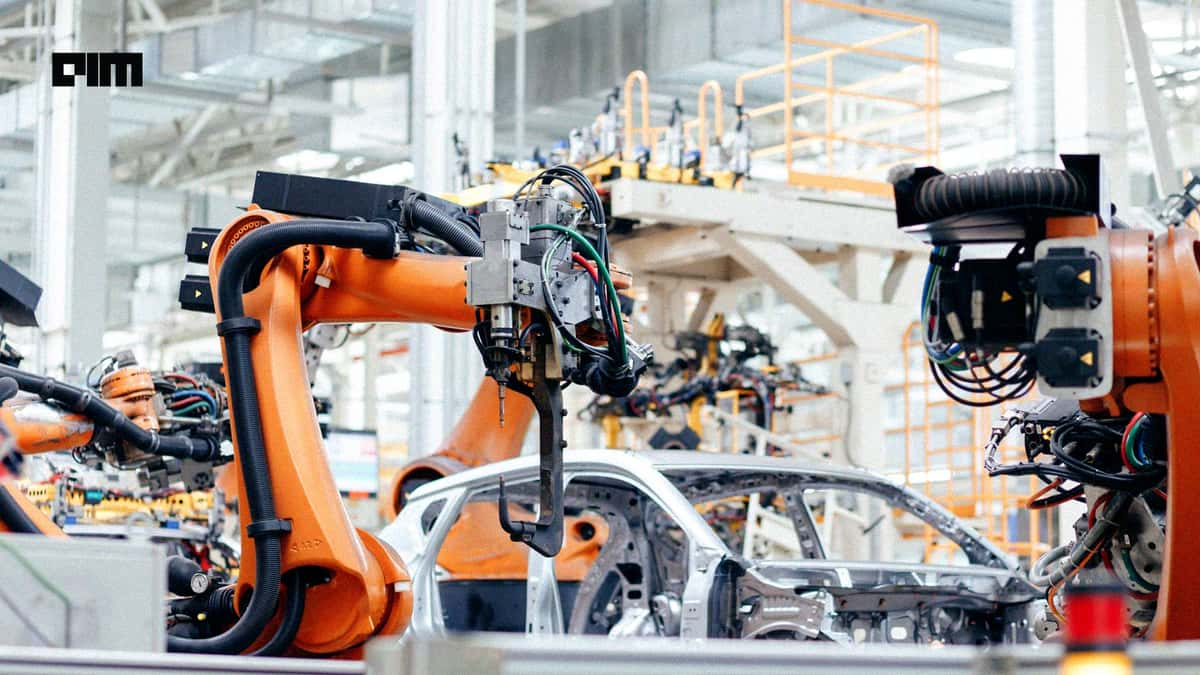

On automotive factory floors around the world, intelligence is entering the assembly line in various ways. Predictive maintenance flags unreliable equipment, digital twins bypass supply chain bottlenecks, and computer vision systems inspect painted surfaces.
Indian automakers are also following suit.
Among them is Tata AutoComp Systems, which operates 61 manufacturing facilities across India, North America, Latin America, Europe, and China, and employs over 20,000 people. It supplies components to original equipment manufacturers across passenger vehicles, commercial vehicles, two- and three-wheelers, and tractors. The company generated nearly ₹13,100 crore in revenue in FY25.
The Pune-headquartered company, founded in 1995, has been building what it calls a Digital Factory programme, an effort to layer artificial intelligence and connected systems across its production operations. The scope is broad: quality inspection, equipment maintenance, workforce training, and supply chain management.
The starting point was the inspection line.
"Quality control was the natural starting point. Traditional human inspection could statistically sample less than 5% of parts; AI-driven computer vision now scans 100% of parts in real time on a moving line. The implications for zero-defect manufacturing are profound," Arvind Goel, Vice Chairman at Tata AutoComp Systems Ltd tells AIM.
Manufacturers have been moving towards full-coverage inspection, standardising data models across facilities so that inspection results can be centralised and cross-plant patterns identified. A defect spotted at one plant can be compared against similar processes elsewhere to detect systemic equipment or supplier issues.
At Tata AutoComp, that data feeds into dashboards that surface quality deviations within a shift, rather than after it.
"Previously, operators manually checked parts for surface defects—a tiring, sampling-based process prone to misses. Today, AI-powered digital inspection systems evaluate every part on a moving line in real time, making instant OK/Not OK decisions before defective components advance downstream," Goel said.
Maintenance, Supply Chain, and Training
The second area of focus is equipment maintenance, where the company has moved away from calendar-based servicing towards a model driven by sensor data. Industrial IoT devices now feed machine readings into AI models that attempt to forecast failures before they occur.
"On machine maintenance, the shift is equally dramatic—from calendar-based servicing regardless of actual machine condition to AI-driven prediction of failure days in advance, enabling maintenance during planned windows rather than emergency shutdowns," Goel said.
The business case for this approach is well-established across manufacturing. According to Deloitte, predictive maintenance can reduce maintenance costs by 25–30% and eliminate 70% of unplanned breakdowns. For an automotive parts plant, where a line stoppage cascades into scrapped batches and schedule disruptions across a supply chain, the stakes are considerable.
Tata AutoComp frames the objective in direct terms: reducing severe equipment failures and associated maintenance costs, with maintenance windows shifted from emergency to planned slots.
Beyond the production floor, the company has been applying AI to supply chain management. It is deploying AI-powered control towers—systems that bring real-time visibility to demand forecasting and inventory management to reduce both overproduction and stockouts.
On workforce training, the company has introduced virtual reality-based learning programmes for shopfloor operators, citing a reduction in training time of up to 30% without disrupting live production. The approach is part of a broader attempt to build a digital skills base across a workforce that has historically worked in manual assembly roles.
The Technology Foundation
Tata AutoComp says its AI strategy is built on a centralised data platform rather than standalone tools. The company has built a unified data and AI layer that stores AI-ready data, constructs data products, and operationalises use cases across functions. Alongside this, it has been deploying Manufacturing Execution Systems for part traceability, Energy Management Systems, and AI-guided video analytics for plant safety.
The company is also building an "AI Playground"—a facility that gives internal business teams direct exposure to AI tools applied to automotive use cases—and employee digital assistants to give staff a single interface for accessing information.
"Integration across enterprise systems, shop-floor OT layers, and cloud-based AI platforms is a deliberate architectural priority, not an afterthought," Goel said.
Barriers
The company identifies three obstacles that have consistently slowed AI deployment.
The first is legacy infrastructure. Many machines on older plant floors were not built with connectivity in mind, making it necessary to retrofit sensors and data ports before any AI model can operate on them. The second is what the company calls the "digital quotient" deficit—the gap between what AI systems require of frontline workers and what those workers currently know.
"Frontline operators are being asked to work in fundamentally new ways. Strong digital training programmes and structured change management plans are non-negotiable—ultimately, these operators must become advocates, not resistors, of the AI transformation," Goel said.
The third barrier is capital. Computer vision hardware, data infrastructure, and robotics require substantial upfront investment, and in a thin-margin industry, securing that approval requires a tightly defined business case.
A study by Tata Consultancy Services and Amazon Web Services, which surveyed 216 senior manufacturing leaders across North America and Europe, found that while 75% of respondents expected AI to become one of the top three contributors to their operating margins by 2026, only 21% reported full AI readiness. The gap between intent and infrastructure is a recurring theme across the sector.
What Happens to Workers
The question of how AI changes the composition of a factory workforce is one that Tata AutoComp addresses directly, describing the outcome as role redesign rather than headcount reduction.
The company points to the emergence of new internal designations—business technology leads and digital technology leads—that sit within business units and bridge the gap between production teams and digital systems. On the floor itself, the company cites the example of a machine operator transitioning into a robot operator, responsible for programming, supervising, and troubleshooting AI-guided machinery.
"The manual task changes; the operator's value deepens. We are making deliberate investments in reskilling and cross-skilling programmes to transition traditional assembly roles into technology-centric functions—robotics maintenance, data analytics, connected systems management," Goel said.
Tata AutoComp also points to adjacent opportunities created by the broader transition in the automotive sector, noting that cross-skilling opens pathways into EV battery supply chains and localised logistics.
Across India, 54% of manufacturing companies have now implemented AI and analytics technologies, per a PwC India report, and the pressure to do so is growing. India's smart factory market is valued at $7.7 billion in 2025 and is projected to reach $17 billion by 2032, growing at 12% annually, according to P&S Intelligence.
For large-scale suppliers such as Tata AutoComp, the question is less whether to invest than how quickly the operational and cultural infrastructure can be built to support it.
"AI amplifies human capability," Goel said. "The workforce of a Digital Factory is more empowered, not diminished."
- The AI Slowdown Narrative Doesn’t Reflect Enterprise Reality
- India’s Enterprises are Scaling AI. Is the Infrastructure Ready?
- Industry Wants Faster Approvals and Cheaper Power in India’s Data Centre Policy
- Inside Jio Platforms: Its Tech Bets, Loss-Making Subsidiaries and Hidden Risks
- India’s GCCs to Add 1.4 Million Jobs, Drive 170 Million Sq. Ft. Office Demand by 2031
- AI Can Be Cyborg or Centaur. But Can Enterprises Monetise It?