
Walking down the street near the Gateway of India in Mumbai, one will find the Old Yacht Club. The Victorian facade of the 150-year-old club today serves as the headquarters of the Department of Atomic Energy. But years ago, it stood witness to when India almost became a global leader in computing hardware.
In the 1950s, long before the Tata Institute of Fundamental Research (TIFR) moved to its modern Colaba campus, the institute operated out of this very building. Within its rooms, physicists and mathematicians attempted to engineer India’s escape from colonial technological dependence by building the TIFRAC.
The story of TIFR is key to understanding how India went from attempting to manufacture its own computer to exporting low-cost IT labour.
How India arrived at this weak point is the subject of the book Computing in the Age of Decolonisation: India’s Lost Technological Revolution—the result of a five-plus-year effort by anthropologist and MIT assistant professor Dwaipayan Banerjee.
As with almost any story of modern Indian science, the man at the centre is Homi J. Bhabha. Bhabha deeply understood that true independence required more than just ending British rule.
In 1947, India won political freedom but lacked a strong economy. Facing severe foreign exchange shortages, Prime Minister Jawaharlal Nehru’s government put strict protectionist policies in place. Bhabha realised relying on foreign computers meant trading political colonisation for technological dependence.
Yet, India urgently required massive computing power. At TIFR, Bhabha needed advanced calculating machines for cosmic ray research and early nuclear energy programmes. Simultaneously, India’s chief economic planner, PC Mahalanobis, needed to crunch huge amounts of demographic and agricultural data for the five-year plans.
However, fulfilling this demand through imports was impossible as India lacked dollar reserves to purchase Western computers, and the funds were largely allocated for essential food and medicine.
Even if India could afford them, Cold War politics intervened. The USA actively blocked access to advanced computing technology through strict export control regimes, fearing that dual-use equipment might eventually benefit the Soviet bloc
The US also fundamentally opposed a newly independent nation building high-tech industries to rival Western monopolies. “The US would tell India—‘We'll give you money, but we don't want you to industrialise in the same way as we have,’” Banerjee tells AIM.
Hand-Woven Memory and the Hardware Bottleneck
Despite the constraints, Bhabha formally ordered a mission of technological independence in 1954, that India would build a computer from scratch.
He gave this task to R Narasimhan, a mathematician who had recently returned from the United States. Operating without a local electronics supply chain, workshop technicians hand-wired tens of thousands of parts to build the computer’s memory from the ground up.
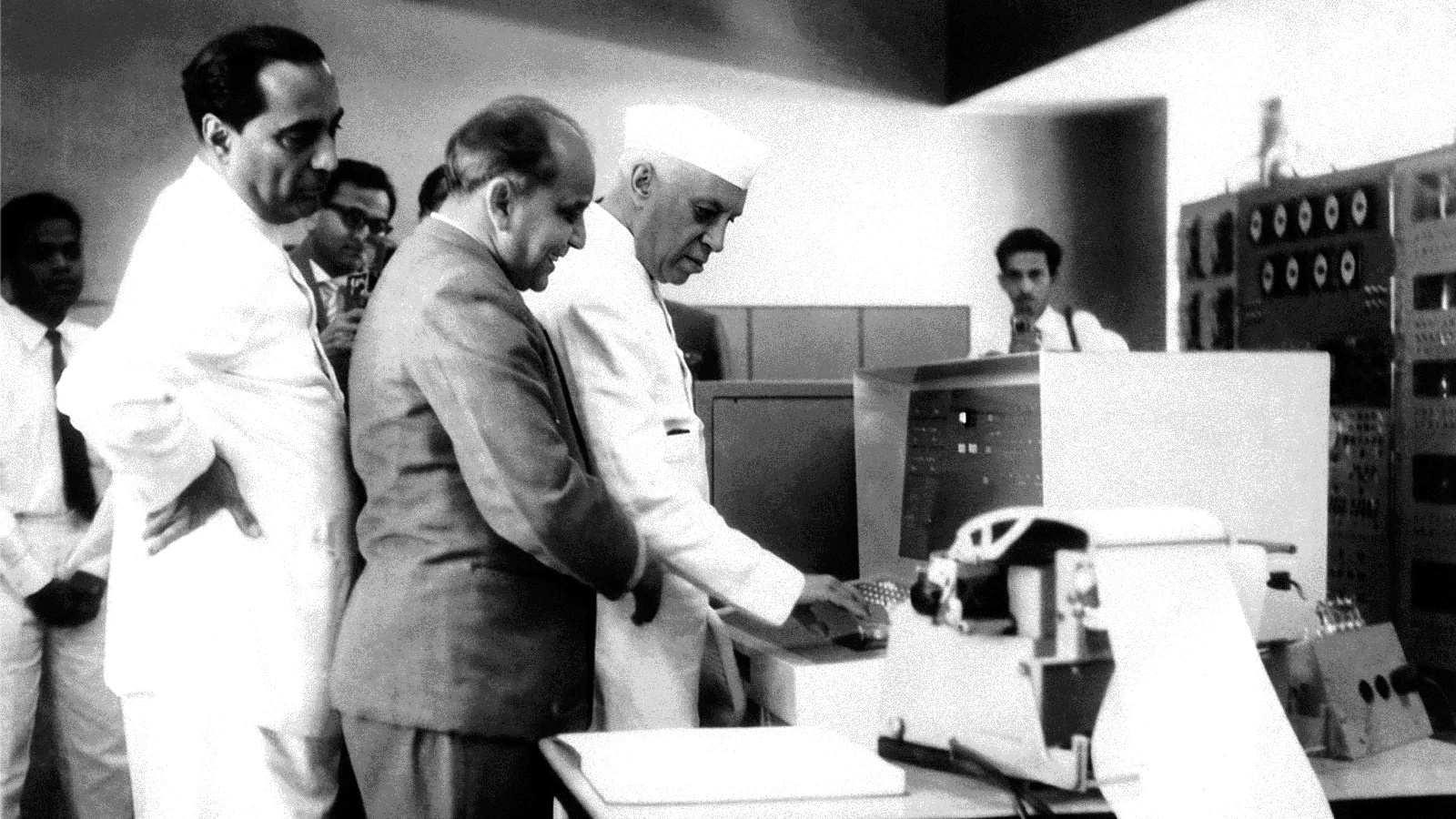
By 1960, the team successfully launched India’s first homegrown electronic digital computer, formally named TIFRAC by Nehru in 1962. It ran in two continuous daily shifts to handle the workload of Indian scientists.
What made TIFRAC truly special was how it was built, thanks to its magnetic ferrite core memory. Since they could not import memory blocks, TIFR’s unsung technicians painstakingly built the grid by hand, carefully threading thousands of tiny, doughnut-shaped magnetic rings onto a complex web of copper wires.
While magnetic ferrite core memory was hand-woven globally during this era, TIFR's true achievement lay in engineering this complex architecture from scratch under severe financial and embargo constraints. This proved that Indian engineers could build advanced technology with very little money
“It was a story of people trying to do really impressive things with their hands tied behind their backs,” says Banerjee. “The US was holding all of the knowledge secrets, actively with sanctions and other trade tools, which made it difficult for India to move ahead.”
But this success eventually hit a structural wall.
While the US and IBM relied on massive government subsidies to build manufacturing plants to scale memory production and transition to the next generation of computing, India lacked the industrial ecosystem, such as semiconductor fabrication and mass-assembly lines, to scale up
When the world shifted to new 'high-level' programming languages like FORTRAN, TIFRAC’s limited memory could not support the heavy compilers required to translate human-readable words into machine code
Ultimately, TIFRAC was forced to compete against IBM’s mass-produced products.
When IBM representative Richard Garwin evaluated TIFRAC, he praised the engineering but pushed TIFR to abandon local manufacturing for imports. While TIFR resisted, TIFRAC was losing its battle against rapid global advances in software. Without a strong manufacturing base, TIFR lacked the money and factory setup to mass-produce the parts needed for an upgrade.
The CDC 3600 Irony and the IBM Loophole
Bhabha first tried to bridge this gap by looking East, importing Soviet machines like the URAL. However, these were inadequate for the rapid scaling required.
To prevent research from stopping, TIFR imported an American CDC 3600 mainframe, purchased using United States Agency for International Development (USAID) funds. The CDC 3600 had superior memory and was equipped with a FORTRAN compiler, allowing scientists to write simple mathematical formulas instead of tedious machine-level code. Drawn to this ease of use, researchers rushed to the American machine. Unable to compile these modern languages natively, TIFRAC was eventually retired
Recognising TIFRAC’s failure as a symptom of a larger problem, Bhabha convinced the government to form the Bhabha Committee on Electronics in 1963 to write a ten-year plan for a self-sufficient manufacturing base. The report was finalised in late 1965. But in January 1966, an Air India Flight 101 crashed into Mont Blanc, tragically killing Bhabha.
Without Bhabha to push the vision forward, the state struggled. India's finances were drained by compounding crises—the 1962 Sino-Indian War, agricultural famines, a severe 1966 currency drop, and the 1971 Indo-Pakistani War. These emergencies wiped out the capital required for heavy manufacturing.
“TIFRAC was the first attempt, but first attempts can only get you so far. Then you put in more money to overcome the limitations, and that’s where things got tricky in India,” says Banerjee.
With the hardware mission stalled and Bhabha gone, a massive computing demand emerged in the government sector, and IBM seized the opportunity. Despite protectionist laws, IBM dug in through the “As-Is” programme.
Instead of modern systems, IBM shipped obsolete 1401s into Bombay. By slightly refurbishing these outdated systems locally, IBM exploited a legal loophole, convincing officials to classify the operation as ‘domestic remanufacturing’. IBM rented these obsolete machines to the government at exorbitant rupee rates, capturing over 70% of the Indian market and locking the country into old technology.
The Pivot to IT Services
The tipping point was the 1973 Foreign Exchange Regulation Act (FERA), which required foreign companies to reduce their ownership to 40%.
IBM refused, and in 1977, Minister of Industry George Fernandes issued an ultimatum: follow the rules and share technological know-how, or leave. IBM officially exited India in 1978.
The removal of IBM appeared to be a victory for national pride, but it did not bring back Bhabha’s dream of hardware independence. Instead, the exit gave rise to the modern IT services model.
Meanwhile, the state-owned Computer Maintenance Corporation (CMC) took over responsibility for over 800 critical legacy IBM systems nationwide. Their expert management of these complex systems proved to the global market that Indian engineers had elite software maintenance skills.
By the 1980s and into the 1990s, the political mood shifted entirely. As subsequent governments became more democratically accountable, politicians had to cater to shorter electoral cycles and demands for immediate economic relief.
Building a physical manufacturing base takes decades of sustained capital before turning a profit. Thus, the state abandoned the expensive struggle of building physical machines. Instead, they took the software route.
Software required very little upfront capital, bypassed the need for heavy R&D, and offered rapid foreign profits. Lacking the telecom setup for remote development, Indian firms pioneered “bodyshopping”—flying programmers directly to Western clients. Thus began India's era of cost arbitrage in providing IT services.
The IT services model perfectly matched the social comfort of the middle class. In 1988, private firms established NASSCOM, cementing outsourced software as India's primary tech focus.
Reflecting on modern IT, Banerjee believes that Bhabha would be devastated. “If he were alive right now, he would be the saddest person in the world.”
Bhabha understood that brain drain was unavoidable if the state produced top talent without building local facilities to hire them. Banerjee explains the current lack of IT infrastructure is “exactly what he was worried about,” which is why he pushed so aggressively to build domestic R&D facilities.
Today, India is pouring significant capital into its sovereign AI missions, yet significant technological and research gaps remain. Much of this can be attributed to the massive brain drain of the 1980s and 90s, a talent flight that seems nearly impossible to reverse today.

Your reaction
Discussion
What's your take on this story?
No comments yet — be the first to share your view.