
Agentic commerce is certainly picking up, but brands are struggling to manage context to pinpoint what AI understands about their offerings.
AI chatbots and browsers sent 269% more traffic to U.S. retail websites in March 2026 than they did a year earlier, according to new data released by Adobe. Yet, most brands remain largely invisible to the AI systems which are either steering consumers toward or away from their products.
Adobe’s solution is Adobe CX Enterprise, a new end-to-end system that brings together AI agents, reusable "agent skills," and a governance layer that lets brands automate their entire customer lifecycle from acquisition to loyalty without losing control of what those agents say or do in their name.
"There is a new intermediary between brands and their customers, and unlike every one that came before it, this has the ability to reason," Loni Stark, Vice President of Strategy and Product at Adobe, said in a statement.
A Platform Play, Not Just Products
The CX Enterprise platform hosts agents built natively into Adobe applications. It features an "agent skills catalogue" that packages reusable instructions into deployable workflows, and a set of developer tools built around the Model Context Protocol (MCP) standard that has rapidly gained industry traction.
This comes at a time when Adobe is also placing a high-profile bet on interoperability, expanding partnerships with Amazon Web Services, Anthropic, Google Cloud, IBM, Microsoft, NVIDIA, and OpenAI. The Adobe Marketing Agent, which surfaces customer insights and flags campaign issues, is now generally available inside Microsoft 365 Copilot, and is in beta inside Anthropic's Claude Enterprise, ChatGPT Enterprise, Google's Gemini Enterprise, and IBM watsonx Orchestrate.
"Marketers shouldn't have to choose between their organisation's AI tools and the marketing capabilities required to drive impactful outcomes," said Amit Ahuja, SVP of product for Customer Experience Orchestration at Adobe. "We are providing businesses flexibility and choice, empowering teams to make smarter, faster decisions while maintaining enterprise-scale context, trust and governance."
The 'Coworker' That Plans a Campaign
For a marketing team to increase a brand’s cross-sell performance, it needs to assemble the required audience segments, creative assets, and performance insights.
Adobe said its CX Enterprise Coworker is designed to translate a business goal into a multi-step agentic workflow. In the case of a marketing team, this will build a plan, submit it for human approval, then execute and monitor the campaign against the target.
"Adobe CX Enterprise Coworker will be the next step for businesses that are retooling marketing workflows to help teams take advantage of agentic AI technology," said Anjul Bhambhri, SVP of engineering for Customer Experience Orchestration.
The Coworker is built on open standards, MCP and Agent2Agent (A2A), and is designed to operate across Adobe applications as well as third-party AI platforms. Adobe said it would be generally available in the coming months.
Teaching AI What a Brand Actually Means
Since redefining customer experience is vital, Adobe has come up with Brand Intelligence, a "continuously learning reasoning engine" built into its GenStudio content supply chain platform. The platform is designed to learn from review cycles, approvals, rejections, and annotations, building a dynamic, machine-readable model of what a brand actually stands for.
Adobe said it has been working with Xfinity, Comcast's consumer division, on an early deployment.
"This partnership with Adobe allows us to embed brand intelligence into every step of our marketing workflows so our teams can spend less time managing work and more time crafting the standout storytelling that defines the Xfinity brand," said Jon Gieselman, Chief Growth Officer at Xfinity.
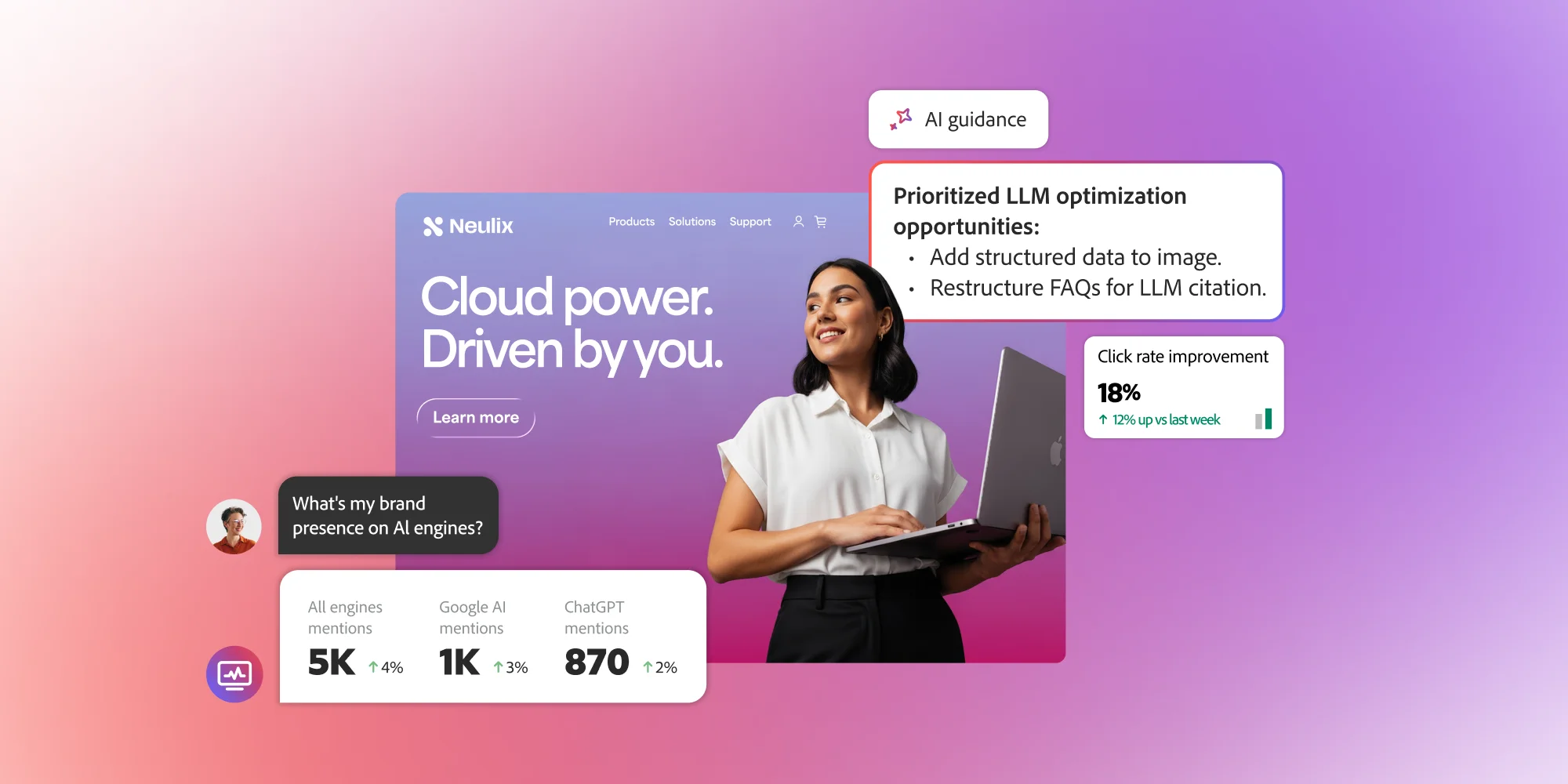
The brand visibility push extends outward as well. Adobe's LLM Optimiser tool is designed to help companies understand and improve how AI chat services describe their products, essentially applying search optimisation principles to its reasoning model.
Underpinning all of it is a major expansion of Adobe's partner and agency ecosystem.
It said major holding companies—dentsu, Havas, Omnicom, Publicis, Stagwell, and WPP—are standardising on CX Enterprise. System integrators, including Accenture, Deloitte Digital, and PwC, are packaging Adobe's agentic capabilities into vertical industry solutions. Payment integrations with Adyen, PayPal, and Stripe are designed to bring checkout into agent-powered conversational experiences.
Anil Chakravarthy, President of Adobe's Customer Experience Orchestration Business, framed the overall ambition plainly: "Adobe CX Enterprise enables businesses to scale agentic AI with a fully customizable solution that is tailored to the needs of their organisation, moving teams beyond AI experiments to tangible business outcomes."
Whether the market is ready to consolidate around a single platform for agentic marketing workflows or whether the fragmentation Adobe is trying to solve will simply reproduce itself at a higher level of complexity remains to be seen.
[The writer is in Las Vegas attending Adobe Summit 2026 at the invitation of Adobe. Editorial coverage remains independent.]

Your reaction
Discussion
What's your take on this story?
No comments yet — be the first to share your view.