
India is racing to become a global data hub. The country is aggressively encouraging tech companies to set up data centres, promising tax holidays and single-window clearances.
According to Vestian's latest report, the country's installed data centre capacity is projected to reach 1.7–2 GW by the end of 2026. But as racks of servers go up, questions about what happens when they complete their lifecycle remain largely unanswered.
Each data centre is, by design, a machine that consumes, and eventually discards, enormous quantities of hardware. The e-waste this infrastructure generates is already straining a recycling ecosystem that was never built to handle it.
A Different Kind of E-Waste
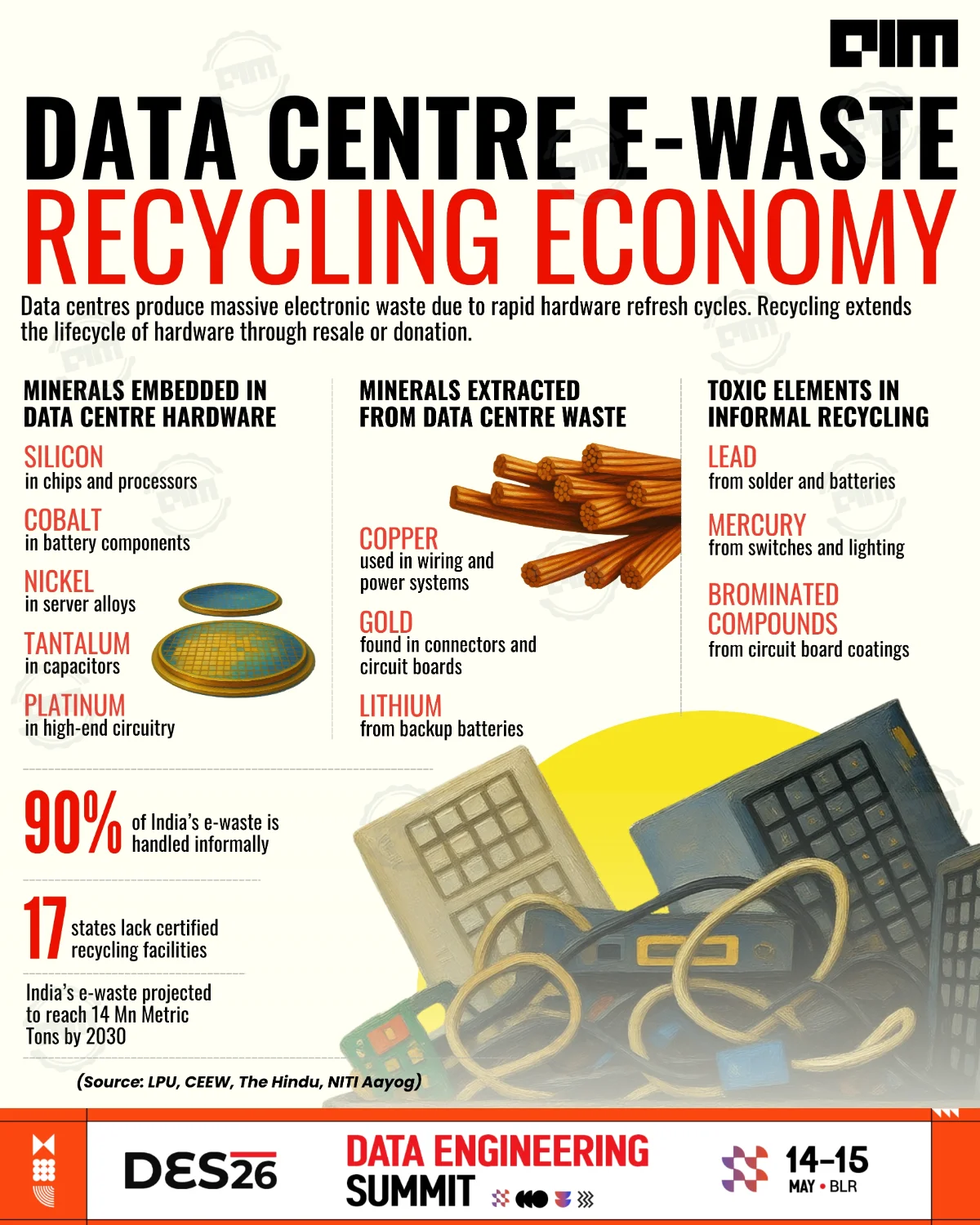
Data centre hardware is not the same as a discarded smartphone or a broken refrigerator. They generate high-density, high-value e-waste, servers, storage drives, networking equipment, power systems, cooling infrastructure, and increasingly lithium-ion batteries used for backup, containing concentrated quantities of copper, aluminium, gold, rare earth elements, and semiconductor-grade materials.
“What differentiates this waste stream is scale and uniformity. Hardware refresh cycles of 3-5 years create predictable, bulk volumes, unlike fragmented consumer waste,” Nitin Gupta, Co-founder and CEO of Attero, a deeptech recycling firm, tells AIM.
That predictability should, in theory, make planning easier. But the volumes involved are staggering.
The Council on Energy, Environment and Water (CEEW) projects that generative AI alone could generate up to 5 million metric tonnes of accumulated e-waste by 2030. Countries operating on older hardware face an additional penalty, generating up to 14% more e-waste per unit of computing output compared to those running on the latest chips.
Beyond sheer volume, this hardware presents a specific compliance challenge.
As Anwesha Sen, Assistant Programme Manager (Tech and Policy) at the Takshashila Institution, observes, "Hyperscalers and cloud providers are bound by strict ESG mandates and require a Data Destruction Certificate. End-of-life servers must be recycled through a highly secure, multi-stage process that prioritises data destruction and uses advanced refining processes to extract minerals from the hardware."
This is where India's formal recycling sector faces a critical test, and, at present, is falling short.
The Certification Gap
There’s an acute market gap in compliance and capacity.
Few Indian recyclers currently hold internationally recognised certifications such as R2 (Responsible Recycling) or e-Stewards, which hyperscalers and cloud providers typically mandate before engaging a recycling partner. This certification deficit means that even as decommissioning volumes grow, the recycling business risks shifting to overseas certified players.
This highlights a broader structural problem. About 90% of the e-waste generated in India is managed by the informal sector, according to CEEW. India already generates over 3.8 million tonnes of e-waste annually, yet the overwhelming majority still flows through unregulated channels.
Gupta says the immediate challenge is not recycling technology alone, but "infrastructure around collection, reverse logistics, warehousing, and secure channelisation." Unless traceability and collection systems improve, a large share of high-value data centre hardware will bypass formal recyclers entirely.
Behind the curtains, the informal sector is fast and accessible, but its methods are hazardous. Practices of acid leaching, open burning, and manual dismantling without protective equipment are widespread.
"Data centre waste is more complex and often more hazardous due to higher concentrations of metals, chemicals, and battery systems. When processed informally, this increases exposure to toxins such as lead, mercury, and brominated compounds,” he adds.
The Observer Research Foundation has described data centres as carrying a triple environmental threat—rising emissions, water consumption, and waste generation—whose effects are compounding rather than separate. Communities living near informal recycling hubs, rarely consulted about the data centre boom, absorb the toxic residue of hardware they will never use.
Research by Safdarjung Hospital on the Mandoli industrial area in Delhi found a troubling concentration of heavy metals in groundwater coming from informal e-waste recycling sites, exceeding both Indian and WHO standards for drinking water.
A Geopolitical Opportunity
The global e-waste economy is shaped by the lack of regulations. After China’s 2018 ban on the import of e-waste, Southeast Asian countries like Thailand, Malaysia, and Indonesia have become hubs for low-cost dismantling and recycling of e-waste.
For India’s e-waste economy to stand a chance, and to position itself as the digital infrastructure backbone of the Global South, it needs to process data centre materials within its borders.
"These servers contain significant amounts of rare earth elements and critical minerals like neodymium and tantalum. From a geopolitical standpoint, properly recycling these servers can help build a domestic secondary supply chain for critical minerals, reducing India's reliance on imports," Sen notes.
Meanwhile, private players are doing their bit.
Attero's processes, backed by 47 global patents, are designed to extract over 22 critical metals, including lithium, cobalt, nickel, and rare earths, with recovery efficiencies above 98% and purity levels exceeding 99.9%. "The data centre boom is not just an opportunity, it is a necessity for building a world-class urban mining sector in India," its co-founder notes.
There’s also the need to improve the collection infrastructure. Gupta points to the gap of digitised, direct-to-consumer and enterprise take-back models that offer doorstep pickup, transparent pricing, data security, and end-to-end traceability.
He argues that policy must address both ends of the lifecycle. “This means enforcing formal recycling pathways for bulk institutional waste, integrating informal workers into compliant systems, and treating recycling zones as regulated industrial infrastructure with strict environmental oversight”.
The Policy Deficit
India's regulatory framework has also not kept pace.
The E-Waste (Management) Rules, 2022 introduced extended producer responsibility targets and created a formal compliance architecture, but implementation remains patchy. A 2026 CPCB assessment found 17 states and union territories with no registered recycling facilities, a gap that forces e-waste from the formal system into informal networks.
There is also no uniform national framework for data centre decommissioning and recycling compliance. Gupta identifies this as the second major bottleneck.
"India needs a clear national framework for data centre decommissioning, stronger compliance monitoring, and active support from the central government for formal recycling infrastructure, digital tracking systems, and investment in advanced recovery capacity. Without that, scale will remain uneven," he says.
Sen commends the Extended Producer Responsibility (EPR) targets under the E-Waste Management Rules as a step in the right direction, with brands and importers required to collect and recycle 80% of their previously placed electronics volume from FY28. However, there’s a significant formal capacity deficit. The investment opportunity is real, she argues, but only if accreditation and specialised infrastructure are built with urgency.
Combined with stronger enforcement and growing demand for high-purity recycled materials, data centre waste could evolve into a reliable domestic source of critical materials rather than leaking into informal channels.

Your reaction
Discussion
What's your take on this story?
No comments yet — be the first to share your view.