India's Data Centre Boom Outpaces Power Planning
By Novinston Lobo ·
On March 30, the Lok Sabha Standing Committee on Communications and Information Technology tabled its 27th report in Parliament. Buried in its findings is a warning that deserves more attention.
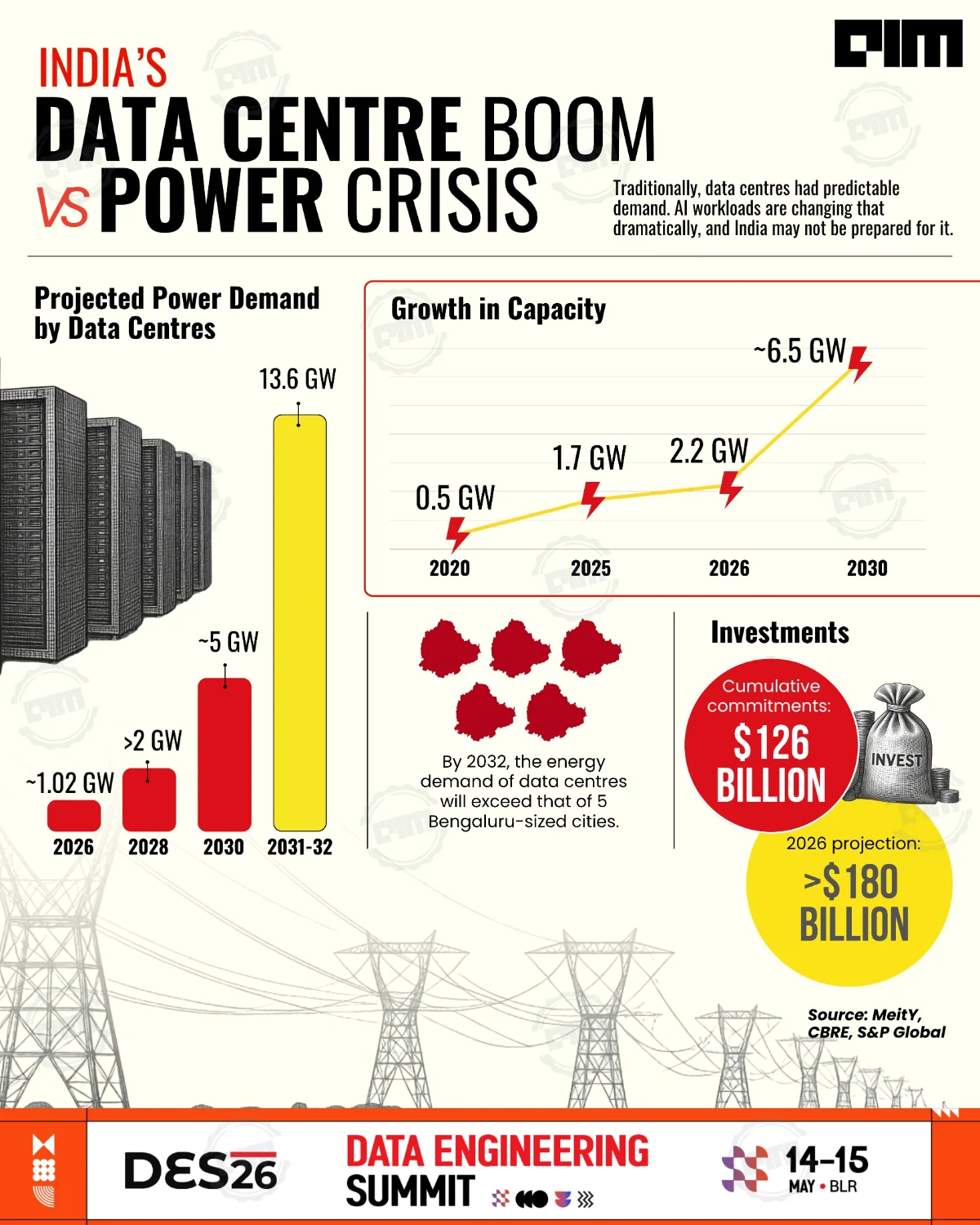
India’s data centres already consume about 1,020 megawatts (MW) of power each day, the Secretary at the Ministry of Electronics and Information Technology (MeitY) tells the committee. Within two years, that figure will more than double to over 2,000 MW. In four to five years, demand could reach four to five gigawatts (GW).
That scale is significant. Five GW roughly equals the combined output of four thermal power plants. This is not a marginal increase; it is a structural shift in how India consumes electricity.
“Data centres are inherently energy-intensive," says Venkat Manthripragada, Founder and Managing Director of DigitalManthri. "Their proliferation amplifies existing structural pressures, rising electricity demand in already strained grids, increasing carbon footprints, and added stress on urban infrastructure."
Energy Shock Exposes Fragility
Recent events highlight how fragile India’s energy system remains. In February, escalating conflict in West Asia disrupted the Strait of Hormuz, cutting India’s LPG inflows by 30%. Cylinder prices doubled, and households shifted rapidly to electric cooking, pushing up power demand.
At the same time, digital infrastructure continues to scale aggressively. This creates a tension between competing uses of electricity.
‘India cannot afford to funnel scarce electricity to hyperscale AI platforms while large sections of the country still depend on firewood for cooking,’ Manthripragada says.
The Scale of What's Coming
Investment momentum in data centres remains strong. According to a CBRE report, investments reached $56.4 billion in 2025, taking cumulative commitments to $126 billion. That figure could exceed $180 billion in 2026, implying a 45% year-on-year increase.
Power demand projections are even more striking. The Ministry of Power estimates that data centre consumption could reach 13.6 GW by 2031–32. That is equivalent to the electricity used by five cities the size of Bengaluru each day.
“Rapidly scaling AI and cloud infrastructure is placing unprecedented strain on power grids in high-density data centre hubs,” says Ram Chandnani, Managing Director, Leasing, CBRE India. “Renewable energy procurement is becoming a structural pillar of supply-side strategy, balancing sustainability with long-term power security.”
Geography compounds the challenge. Mumbai accounts for roughly a quarter of India’s data centre capacity, followed by Chennai, Hyderabad, and Bengaluru. These cities already face pressure on land, water, and power infrastructure. Adding hyperscale facilities intensifies that stress.
“With so many data centres coming up, the load on transmission lines and substations has become extremely high,” says Sunil Gupta, Managing Director and Chief Executive, Yotta, in an interview with Outlook Business.
“This is the same phenomenon seen in Ashburn, US and in Singapore, where rapid concentration of data centres ran up against local grid constraints.”
AI Changes the Energy Equation
AI workloads are transforming how data centres consume power. Traditional facilities handling storage and streaming had relatively stable demand profiles. AI systems do not.
Individual AI racks require 80–150 kilowatts (kW) of electricity, several times the power of conventional servers. These facilities run continuously, but also experience sudden spikes during intensive processing.
Narendra Sen, the Founder of NeevCloud, outlined the challenge in straightforward terms, stating that data centres use more electricity than many cities. He explained that increased queries require more computation, which demands more power. He noted it's not just the computation; a GPU server consuming 100 units may need 80 more for cooling.
Cooling alone adds a significant layer to energy demand, particularly in India’s climate.
S&P Global Commodity Insights predicts India’s data centre power demand could increase nearly fivefold to 57 TWh by 2030, growing about 28% annually. Its share of total electricity demand might rise from 0.8% in 2024 to around 2.6%. This represents exponential growth in a few years.
The Grid is Not Ready Yet
As demand rises, infrastructure lags. The MeitY Secretary informs the parliamentary committee that data centres should be located near 400-kilovolt substations and that planning is underway.
However, planning doesn't guarantee execution.
Transmission infrastructure takes far longer to build than data centres.
In 2024–25, India commissioned 8,830 circuit kilometres (ckm) of transmission lines against a target of 15,253 ckm, leaving a 42% gap. Additions to the Inter-State Transmission System (ISTS) fell to their lowest level in a decade, according to a report by the Institute for Energy Economics and Financial Analysis and JMK Research.
In 2024–25, India built 8,830 circuit kilometres (ckm) of transmission lines, 42% below the target, with the lowest Inter-State Transmission System (ISTS) additions in a decade, according to a report by the Institute for Energy Economics and JMK Research.
“Transmission and distribution is the biggest challenge today,” Gupta says. “Upgrading that infrastructure will require large investments, which could either reduce power availability for local users or increase tariffs as costs are passed on.”
Meanwhile, Mahak Agrawal, Head of India at Riding Sunbeams, emphasised that electrifying systems for climate action is different from powering them through grids still reliant on coal and imported gas.
“Decarbonising the electricity that feeds data centres, means accelerating domestic renewable capacity, hardening transmission infrastructure, and retiring fossil fuel dependencies on a credible timeline, is no longer a long-term aspiration. It is an immediate strategic necessity, particularly as fuel supply disruptions from the West Asia crisis remind us how fragile import-dependent energy systems truly are. A data centre boom built on a fossil-powered grid is not a digital future. It is a digital risk,” Agrawal says. “That is no longer a long-term goal. It is an immediate necessity.”
A Widening Gap
International experience shows caution. Pahle India Foundation reports that US areas with dense data centres saw wholesale electricity prices rise by as much as 267% in five years. In Georgia, residential bills increased sixfold in two years, partly due to data centre demand. Citizen protests delayed over 25 projects in 2025.
India’s political economy differs, but the underlying arithmetic does not.
'A smart grid appears regularly in policy documents and speeches,’ Agrawal says. “What appears far less consistently is coordination between the Ministry of Power and state electricity boards. In the meantime, data centres are arriving faster than the grid can absorb them.”
The scale of the coming shift underscores the urgency. The Council on Energy, Environment and Water (CEEW) estimates that data centre demand could jump from around 1.2 GW in 2026 to 10 GW by 2030.
That is not incremental growth. It is a structural shock to the power system.
India’s digital ambitions continue to accelerate. But unless power planning catches up, the country risks building a data centre ecosystem that outpaces the grid designed to support it.