Key takeaways
- Explore Anthropic's Model Context Protocol (MCP) as the standard for AI system connectivity.
- Utilize MCP to simplify integration of AI assistants with various data sources and tools.
- Understand MCP's architecture, featuring client-server support and open-source servers for developers.
- Recognize MCP's potential to enhance AI response relevance and reduce integration complexity.
What if there was a USB-C port for AI applications—a universal connector for AI systems? Meet Anthropic’s Model Context Protocol (MCP), the newest kid on the block. This open-source protocol allows different AI models to connect with the same tools and data sources, much like standard ports enable different devices to work together.
With the curiosity surrounding it, there is a surge in people talking about MCP, its benefits, and how it can make things convenient for developers. Could it be the torchbearer in accelerating the ease of AI integration?
What is MCP?
Simply put, MCP is a standard for connecting AI assistants to the systems where data lives, including content repositories, business tools, and development environments. It aims to help frontier models provide more relevant responses.
There are three components of the protocol for developers: the MCP specification, local MCP server support, and an open source repository of MCP servers. It follows a client-server architecture, where a host application can connect to multiple servers.
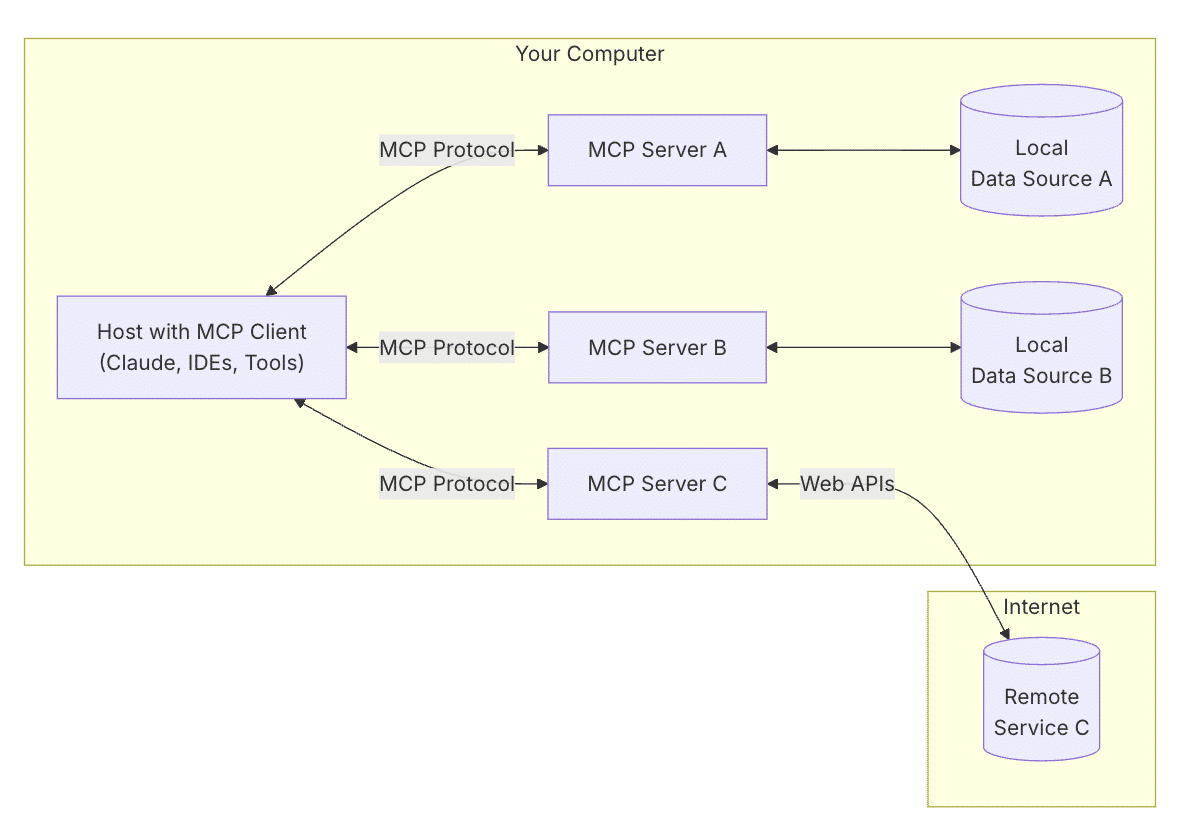
Santiago Valdarrama, a computer scientist, explains it as an extra layer when it comes to connecting AI agents to services like Slack, Gmail, or a database, on top of how it works traditionally. He said that MCP reduces complexity, even though it is an added layer.
Valdarrama further explains that the extra layer is an MCP server, which makes it possible for developers to replace the AI agent, and still make the integrations work without any extra work. One can use this to add improved functionality to AI coding tools like Windsurf or Cursor.
Is it the Same as APIs?
In an X thread, Valdarrama explained that MCP is not just another API lookalike. An API exposes its functionality using a set of fixed and predefined endpoints, such as products, orders, or invoices.
Whether you want to change the number of parameters for such endpoints, or add new capabilities to an API, the client will also need modifications.
However, when dealing with MCP, Valdarrama said, “Let's say you change the number of parameters required by one of the tools in your server. Contrary to the API world, with MCP, you won't break any clients using your server. They will adapt dynamically to the changes!”
He added, “If you add a new tool, you don't need to modify the clients either. They will discover the tool automatically and start using it when appropriate!”
It is as Boring and Exciting as HTTP
Matt Pocock, an AI educator, finds MCP both boring and exciting at the same time—for the same reasons that tech like REST, HTTP, SOAP, and GraphQL got traction. He added that MCP helps reduce friction and makes LLMs cooler.
Robert Mao, founder of ArcBlock, a platform to help build decentralised apps, also shared the sentiment. “HTTP is a protocol for browsers, while MCP is a protocol designed for AI,” he wrote on X.
Use Cases of MCP
There have been numerous developments by companies and individuals leveraging MCP.
Perplexity has built an MCP server for Sonar, its AI answer engine, to enable AI assistants to provide real-time web search research capabilities.
Composio, an AI startup that helps build AI apps, launched fully managed MCP servers with auth support. This will help integrate several apps like Google Sheets, Zoho, Salesforce, and more with AI coding platforms like Cursor, Windsurf, and Claude Code desktop app easily.
A developer integrated Cloudflare’s MCP-worker to 10x his Cursor’s workflow experience. While another one made an MCP server with tools for accessing all models on Replicate, a platform to run and deploy AI models. It was further connected through Claude to generate art.
This is so magical 💖 I gave Claude access to @replicate and we generated some art together!
— web weaver (@deepfates) January 30, 2025
How it works: I made a Model Context Protocol server that has tools for accessing all the models on Replicate. Claude puts them together intelligently into a workflow.
Link below 👇 pic.twitter.com/FpxsFQpLYC
Google’s Firebase, a mobile and web app development platform, integrated MCP support to its AI framework, Genkit. Cline, an autonomous coding agent, lets you build and use MCP servers. LangChain also introduced MCP adapters to allow its agents to connect to tools in the MCP ecosystem.
Not just limited to MCP’s popularity in terms of usage, the concept encouraged IBM to introduce a similar protocol, Agent Communication Protocol (ACP), which could also be a signal to the protocol solving something useful.
At the same time, there have been some mixed reactions. When a user on X asked Andrej Karpathy, founder of Eureka Labs, for his thoughts on MCP, he said, “Please make it stop.”
Learn more about the technical aspects of MCP on its documentation website.
Spotted an error? Tell our editors. Read our editorial standards and corrections.