
After five frenetic days of ambition, uproar and high-stakes announcements, the IndiaAI Impact Summit in Delhi has drawn to a close—almost. While the formal programme ended on February 20, the expo will remain open to the public for one final day, a subdued epilogue to an otherwise turbulent gathering.
From the outset, the optics were as dramatic as the scale. Thousands thronged the venue, but day one descended into confusion: long queues, patchy access and frustrated founders venting online. The backlash grew loud enough that Union IT Minister Ashwini Vaishnaw publicly apologised to attendees and start-up representatives who had borne the brunt of the mismanagement.
Then came the image that travelled the world. A carefully choreographed group photograph of global tech leaders alongside Prime Minister Narendra Modi was meant to symbolise unity. Instead, it was dissected for an awkward detail: while most clasped hands in synchrony, OpenAI CEO Sam Altman and Anthropic CEO Dario Amodei appeared momentarily out of step. The fleeting gesture became meme material within hours, a reminder that in the age of AI, optics still reign supreme.
Go Galgotias
The summit’s most talked-about episode, however, had nothing to do with policy or pledges. It involved a robot dog.
At the expo, a representative from Galgotias University showcased a quadruped robot named ‘Orion’, describing it as a surveillance and monitoring system developed at the university’s centre of excellence. Confident and polished, the pitch suggested indigenous innovation.
Social media, however, was swift and unforgiving. Users claimed the robot resembled models from Unitree Robotics. The allegation snowballed into a full-blown controversy over misrepresentation. Within hours, Galgotias was asked to vacate the premises.
The episode raised uncomfortable questions about due diligence at an event billed as a showcase of sovereign capability. As Abhishek Singh, Additional Secretary at MeitY and CEO of the IndiaAI Mission, put it bluntly, “They misled. The whole world is here.”
The debate soon broadened to other exhibitors displaying similarly sourced machines—albeit without claiming original manufacture—blurring the line between branding and building.
A World of LLMs
Away from the noise, serious announcements unfolded.
Rivals Sarvam and BharatGen unveiled long-awaited large language models. Among the releases were Shutram, an LLM-based automatic speech recognition platform; Sooktam, a text-to-speech model; and Patram, a vision-language system designed for document intelligence. Together, they signalled India’s push towards language sovereignty across speech, text and vision.
Sarvam also introduced Sarvam 30B and Sarvam 105B, models currently supporting 11 Indian languages, with plans to expand to 22. The subtext was unmistakable: linguistic plurality is India’s AI frontier.
Meanwhile, Gnani.ai launched Inya VoiceOS—a voice-to-voice foundational model that operates directly in acoustic and semantic space, bypassing traditional speech-to-text and text-to-speech pipelines. It marked a step closer to real-time, natural spoken intelligence.
The Prime Minister’s AI Moment
When PM Modi inaugurated the summit, artificial intelligence was not merely the theme—it was the medium.
His speech was dubbed live into 11 languages—Assamese, Bengali, English, Gujarati, Kannada, Malayalam, Marathi, Odia, Punjabi, Tamil and Telugu—using AI tools. Real-time sign-language interpretation ensured accessibility, with multilingual feeds streamed across X.
It was theatre with purpose: AI not as abstraction, but as inclusion.
Capital Commits
If policy set the tone, capital delivered the scale.
Mukesh Ambani, Chairman of Reliance Industries, pledged ₹10 lakh crore over seven years to build AI infrastructure across India. He described it as “patient, disciplined nation-building capital”, a phrase designed to distinguish strategic investment from speculative exuberance.
Vaishnaw announced that an additional 20,000 GPUs would be added in the coming weeks, framing it as the next phase of India’s AI strategy, scaling infrastructure while embedding responsible deployment in sectors such as healthcare and education.
From Silicon Valley came reinforcement. Google CEO Sundar Pichai outlined a major India-America subsea connectivity project under Google’s $15 billion AI investment plan, linking India with the US, Africa, Australia and Asia-Pacific through new undersea cables and fibre routes, including a Vizag gateway.
Alexandr Wang, speaking in his capacity as Meta’s Chief AI Officer, confirmed forthcoming model releases integrated deeply into the company’s products. Meanwhile, Microsoft President Brad Smith announced that the company is on track to invest $50 billion by the end of the decade across the Global South, with India among the principal beneficiaries.
Altman and Amodei, despite the earlier photo chatter, spoke expansively about India’s AI promise, emphasising augmentation over automation, collaboration over competition.
The No-Shows
Not all anticipated figures made an appearance.
Bill Gates, Chairperson of Gates Foundation, withdrew at the last minute amid renewed scrutiny over his past association with Jeffrey Epstein. NVIDIA CEO Jensen Huang had earlier opted out, citing ill health.
Even absence, at an event defined by optics, carried meaning.
Pax Silica Declaration
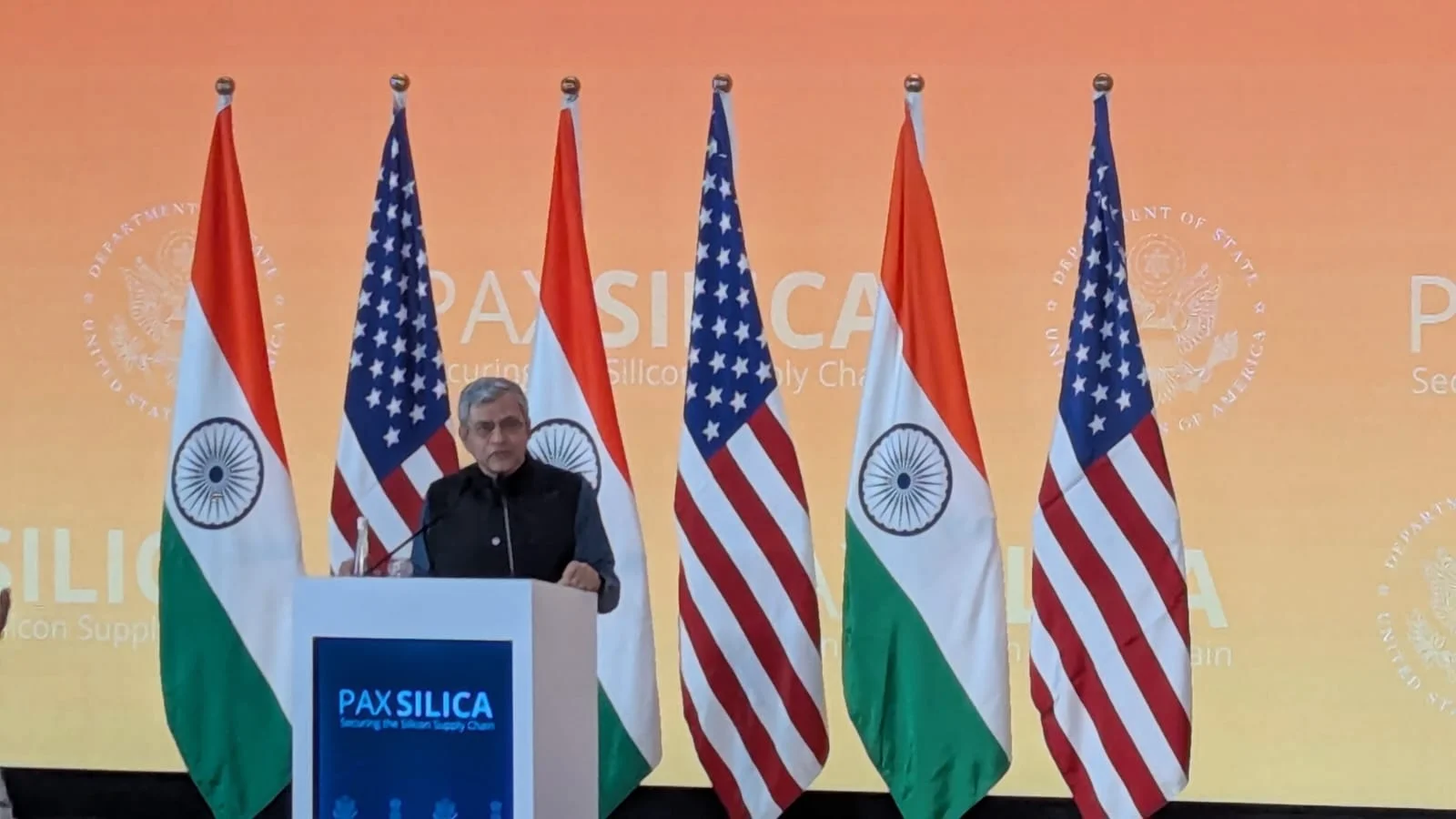
The summit concluded with India’s endorsement of Pax Silica—a United States-led initiative on artificial intelligence and supply-chain security aimed at building resilient critical mineral networks while countering China’s dominance in rare earths.
The Pax Silica Declaration underscored the importance of reliable supply chains for economic security and framed AI as a transformative force for long-term prosperity.
By the end, the summit had delivered spectacle and substance in equal measure: a viral robot dog, awkward hand gestures, billion-dollar bets and declarations of digital sovereignty.

Your reaction
Discussion
What's your take on this story?
No comments yet — be the first to share your view.