
For over a decade, India’s digital public infrastructure has steadily transformed the way money and data flow through the economy. UPI powers more transactions than credit and debit cards combined. Now, as the digital ecosystem matures, new challenges have come to the fore.
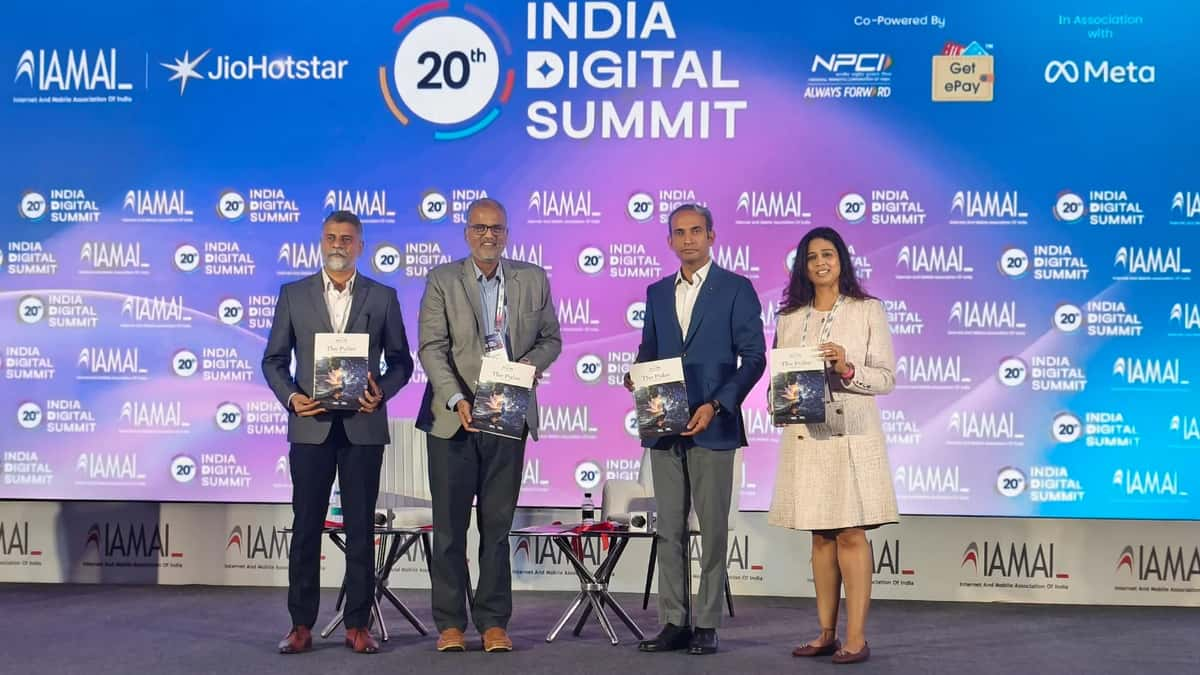
At the India Digital Summit 2026 in Bengaluru, public institutions and private fintech firms outlined how the country’s financial infrastructure is evolving and how businesses are navigating the global financial landscape.
Speaking at the session “Building New Digital Infrastructure for India’s Financial Ecosystem”, Sahil Kini, CEO of RBI subsidiary Reserve Bank Innovation Hub (RBIH), described how India is now building systems beyond payments, aimed at credit, fraud prevention, and financial safety.
“Digital infrastructure is like roads. If you don’t build the pipes for money and data, entire markets cannot exist,” Kini said.
Designing for Population Scale
Kini’s perspective is shaped by his early role at the Unique Identification Authority of India (UIDAI), where he joined just a month before the first Aadhaar number was issued in 2010.
When one builds systems that operate invisibly for hundreds of millions of people every day, restraint becomes a design principle, Kini noted, adding that Aadhaar deliberately limits itself to basic identity attributes and biometric authentication. UPI separates payment identity from bank accounts, allowing interoperability across apps and providers. These choices, Kini argued, allow systems to scale reliably.
India’s payments ecosystem today processes over 20 billion transactions a month. “When you’re building for adoption at this level, doing less is often what makes the system usable,” he said.
What RBIH is Building Next
RBIH, a wholly-owned subsidiary of the Reserve Bank of India and structured as a not-for-profit entity, is building for India’s financial ecosystem for the next 5–20 years.
Kini discussed the major digital public platforms being developed by RBIH.
The first is a Unified Lending Interface, designed to do for credit what UPI did for payments. The platform aims to make verified datasets, including GST data, land records, and other government-held information, available in a standardised, machine-consumable format. The objective is to reduce friction in credit assessment and enable faster, more informed lending decisions, benefiting MSMEs and rural borrowers.
The second initiative focuses on account protection, using data science to identify patterns that identify accounts at risk of fraud or misuse. By flagging risks early, the system aims to prevent harm before it escalates.
The third is a real-time payments intelligence platform, still in early development, that would assess the risk of every digital transaction in real-time. This would allow ecosystem participants to decide whether a transaction should proceed based on live risk signals.
AI as Embedded Infrastructure
AI plays a central role in these platforms, but Kini was careful to downplay the hype. “AI is becoming embedded, the way cloud did,” he said. “Eventually, you don’t notice it; it just becomes part of how systems work.”
Rather than building generic models, RBIH is focused on training AI within the parameters of Indian finance, especially on diversity and identifying uneven data quality. Fraud detection, prioritisation, system testing, and operational efficiency are all areas where intelligence is being integrated.
“A model trained elsewhere may be very smart, but if it hasn’t learned in this environment, it won’t work here,” he noted.
Predictability in Global Payments
That same focus on predictability surfaced in a later session, where fintech firm Xflow outlined how it is applying AI in B2B cross-border payments.
Deepakshi Dawar, head of marketing at Xflow, said the company was founded on the observation that while logistics and e-commerce tracking have become highly transparent, international payments remain opaque.
“When you order something online, you get constant updates,” she said. “But when you receive a payment from outside India, you often don’t know when the money will arrive, whether it’s stuck, or how currency fluctuations will affect it.”
Xflow operates in more than 140 countries and supports over 25 currencies, serving over 20,000 businesses. The platform also provides APIs to 50–60 fintech platforms, enabling them to offer cross-border payment services.
Its FX AI Analyst is an AI-powered tool designed to help businesses navigate currency volatility. It predicts a trading range for USD-INR over the next three days, enabling users to set rate-limit orders when booking foreign exchange.
Referring to a recent sharp movement in the rupee against the dollar, Dawar explained how sudden exchange-rate swings can materially affect business revenues. If the exchange rate reaches the specified level, the transaction is executed automatically, potentially at a more favourable rate than traditional bank bookings.
“In one case, a user ended up earning ₹3–4 lakh on their payment simply because the rupee weakened and their rate limit order was triggered,” Dawar said.
As Kini noted in his session, solving for India’s scale is not just a domestic imperative—it is how durable financial systems are built. “If we solve our problems thoughtfully, we won’t just build systems for ourselves. We’ll build models others will study.”
- AMD’s Server CPU Business Faces a New AI Boom
- How an Engineer Is Using AI to Bridge the Accessible Education Gap
- AI Agents are Making Human Customer Service a Specialist Job
- Why Nandan Nilekani-Backed F2A Believes India's Investment Opportunity Lies in Edge AI
- India Needs to Build the AI 'Brain' for Robotics, Not Just Import Hardware
- Why Enterprise AI Prototypes Break in Production

Your reaction
What's your take on this story?
No comments yet — be the first to share your view.