
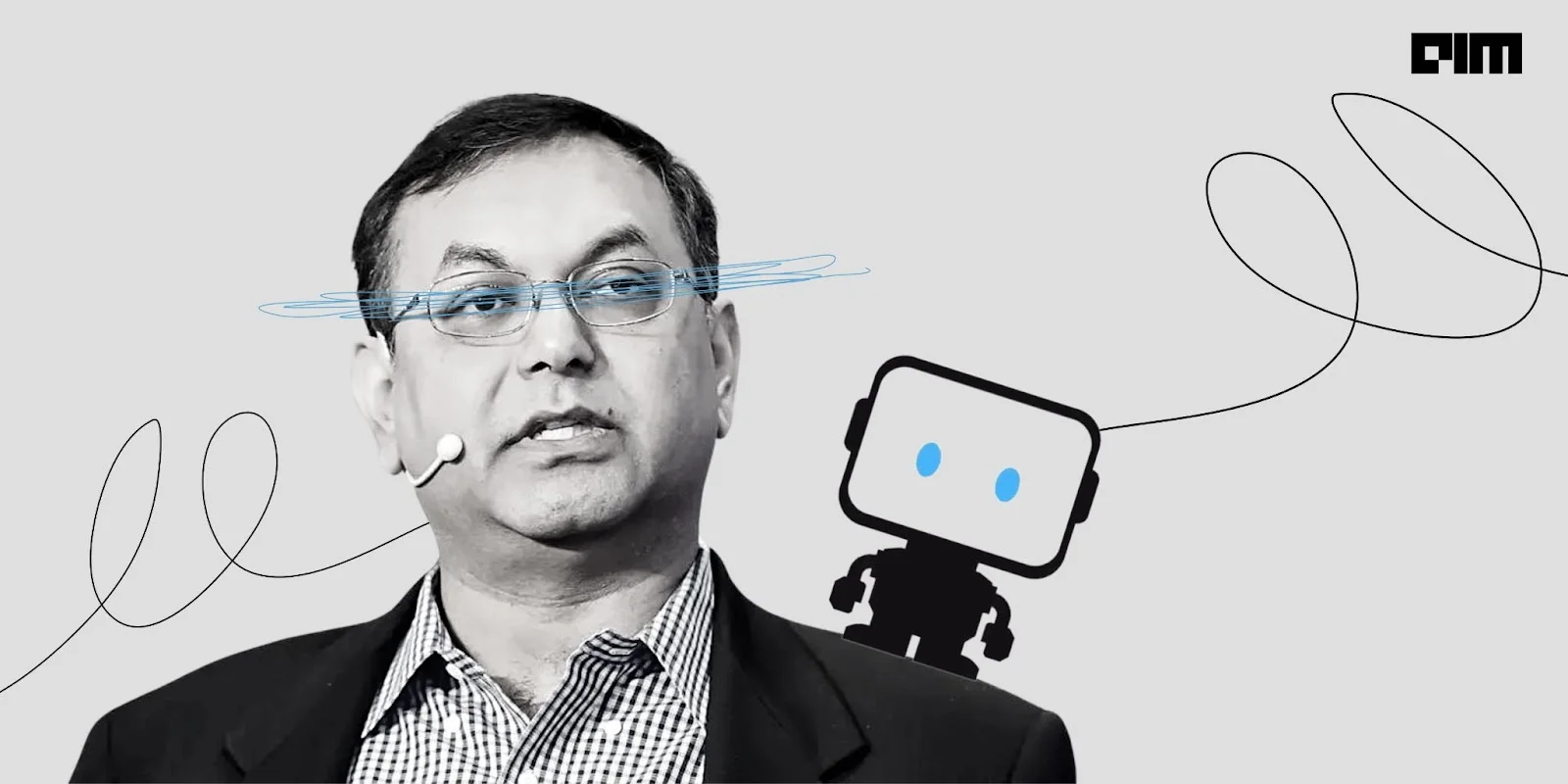
A few weeks before Debanjan Saha became the new CEO of AI cloud platform DataRobot, Analytics India Magazine caught up with him at Global AI Summit, Riyadh, where we discussed, at length, his vision for the company alongside his plans to expand its footprint in India and other emerging economies like Saudi Arabia, China and others.
Over the last few months, DataRobot has undergone significant changes to refocus on its brand positioning for long-term sustainable growth. With Saha joining the leadership team as CEO, he would be responsible for expanding AI Cloud to deliver more impact and innovation to customers globally.
Debanjan Saha joined DataRobot in February 2022 as president and chief operating officer (COO). “This is my second role in a startup,” shared Saha, saying that many years ago, he had tried his hand at a startup.
“Ultimately, what matters is, focussing on the right problem and creating value for customers that delights them, alongside aligning the whole organisation to do that. This leads to building a product which addresses the right customer,” said Saha, sharing his leadership philosophy, which is more or less inclined towards design thinking principles.
Read: DataRobot CEO Dan Wright Steps Down
Developed by data scientists, for data scientists
DataRobot was started by data scientists-turned-entrepreneurs Jeremy Achin and Thomas DeGodoy (now founder of CaspianDB). Before taking the entrepreneurial plunge, the duo worked for an insurance company called ‘Travelers’. Ten years later, the company has emerged as one of the AI Cloud leaders, which looks to deliver a unified platform across all data types, users, environments, etc., to fast track AI productisation across companies and sectors.
Currently, its AI Cloud is one of the most widely deployed and proven AI platforms in the market—delivering over 1.4 trillion predictions for customers worldwide. To date, it has worked with over a third of the Fortune 50, including banks in the US (80%), leading global manufacturers (50%), and top companies in Japan (80%).
“DataRobot actually started as an AutoML company. We are a category-defining product in AutoML. However, as AI has progressed, it is not just sufficient to build models; you have to deploy models in production,” said Saha, sharing with us the product journey.
Further, he said that they have built end-to-end capabilities, from data preparation to running and deploying the models, alongside the generation of compliance documentation of those models (for companies belonging to regulated industry).
As of last year, DataRobot has raised a total of $1 billion in funding over 11 rounds, and is backed by 40+ investors, including New Enterprise Associates, Altimeter Capital, Salesforce Ventures, Tiger Global Management, Sapphire Ventures, Meritech Capital Partners, In-Q-Tel, Intel Capital, and others.
DataRobot versus the world
The AutoML market is currently fragmented, with multiple players entering the space. This includes big giants like Google, Microsoft, and Amazon, alongside H2O, Dataiku, Qlik and others. So, how is DataRobot positioning itself in this giant ecosystem?
To this, Saha said that they like to call themselves the iPhone of AI/ML platforms. “There are a lot of phones now, but in terms of experience, that is what we bring to the table,” he added.
He said they want to be a platform that does everything from data preparation and model training to model deployment, along with providing a great user experience to its customers. He also said that they want to give people flexibility. “As an independent software vendor, the flexibility that we provide to run on-prem as well as on every cloud possible, which is not true for a lot of other platforms today,” claimed Saha.
Read: Alas, Google wins the AutoML Race
Vision-DataRobot
Saha said: “Our goal is to build a software development platform.” He said that even software development started like this—you had various tools, and ultimately all of this got together in a CI/CD (continuous integration/continuous deployment) model. “That is the platform we are trying to build,” he added.
Further, he said that they are creating a seamless user experience so that they can accommodate not only expert data scientists but also freshers. “We want to have a wide spectrum of user experience on our platform,” he added.
DataRobot, India play
In conversation with AIM, Saha lauded India for its rich talent pool and data prowess. “India with open policies, a really tech-savvy workforce and availability of data is going to be at the forefront of driving AI-related success,” he added.
Saha said that he has lived in three different cultures, where he grew up in India, spent most of his adult life in the US, and spent two years as an expat in Shanghai, China. “I think India is poised to do really, really well, given how technical-savvy the workforce is, how young the workforce is, and how much opportunity there is,” said Saha.
On the contrary, DataRobot is yet to have a massive footprint/presence in India. “We have a technical team in India, and we do have a few customers in India. But, we haven’t been to India in a big way. That I would like to,” said the chief of DataRobot. Meanwhile, its competitors Amazon SageMaker, Google Cloud AutoML, Qlik AutoML, and Dataiku are investing heavily in India with active collaborations and partnerships.
Citing IPL (Indian Premier League), Saha said that they are looking at a lot of interesting new opportunities in India, given their expertise in sports analytics, besides financial services, insurance, healthcare, manufacturing, retail and others. “We can probably have a lot of partners to work with in all of these areas, and that is something I look forward to exploring,” he added, saying that DataRobot has been in the business for the last ten years and only recently they have started expanding into APAC regions.
As per the latest study, nearly 84% of Indian businesses with 100 or more employees are using AI in one form or another—i.e., nearly twice that of the UK (46%), whereas the US is at 68%. In another report, a staggering 98% of companies in India are using AI to automate decisions. As a result, many companies are banking on India as part of their global expansion plans.
Expansion strategy
“Sometimes, a lot of legacies is actually an obstacle to do things differently,” said Saha.
Reminiscing his IIT-Kharagpur days, where there were no cell phones and getting a telephone line was quite a hassle, he said India leapfrogged and has very few landline phones as everyone now has a cell phone. “That was actually much easier to do in India because the investment in landline phones was not that big. So, you could actually adopt new technology faster. There is motivation to do that,” shared Saha.
He said emerging economies like India, in some areas, probably do not have as much investment as mature economies. However, Saha thinks that it allows you to catch on to the next wave much more quickly than some of the mature economies with a lot of legacies that come with that.
Saha also emphasised the importance of the young talent that a majority of emerging economies have. He said that the number of young professionals in India is probably the highest compared to many other matured economies. This drives the adoption of new technology and the creation of new businesses.
In line with this, he said that AI adoption in India requires a different approach, depending on the maturity of the organisation. He said, for instance, some organisations that have matured data science teams look for a productivity platform to make their data science more productive. On the other hand, organisations that do not have a data science team look for a packaged application, a packaged solution, or a consulting service.
“The way we approach them is very different; it depends on the maturity of the organisation,” said Saha, sharing the expansion strategy in emerging markets like India.
Innovation that matters
Discussing the roadmap ahead of the company, DataRobot chief told AIM that there would be a lot of product announcements in the near future. “We realised that it is not just about the product, but the value that is going to come from applying the platform to solve real-life business problems,” said Saha, elaborating further that they want to be the number one applied AI platform in the world.
“I would like to call this—Innovation that matters,” said Saha, “There are a lot of people who are doing science. Unless you can solve business and customer problems, I do not think that is really useful.”

Your reaction
Discussion
What's your take on this story?
No comments yet — be the first to share your view.