
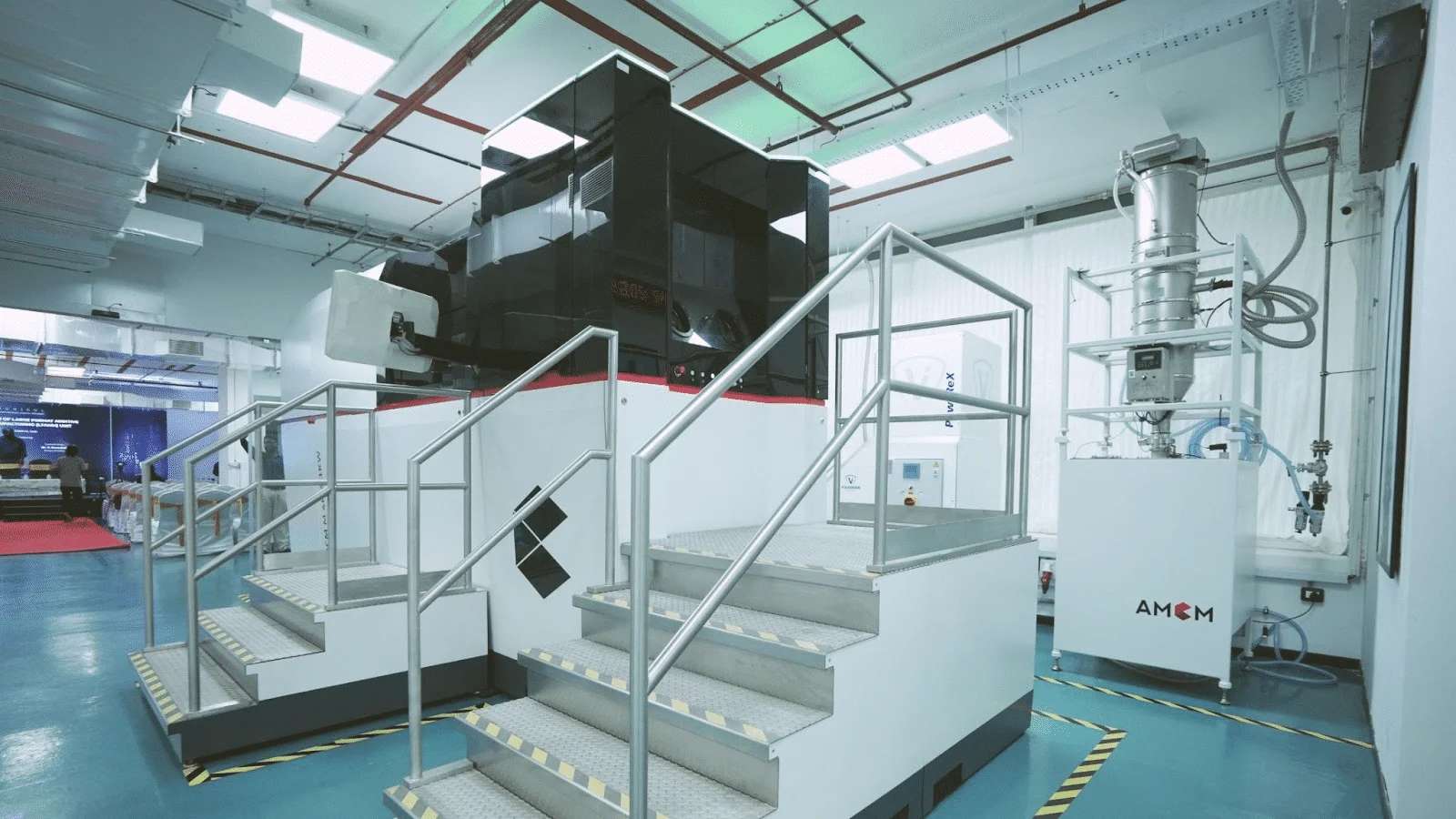
Chennai-based space tech startup Agnikul Cosmos has commissioned India’s first large-format additive manufacturing facility for aerospace and rocket systems in Chennai. The facility will enable the company to design, print, test and deliver large-scale rocket engines and components more efficiently and at lower costs.
The company said the facility can 3D print components up to one metre in height, enabling production of parts that were previously difficult to manufacture. According to Agnikul, this capability will reduce the cost of building for space by half and cut delivery time for flight-ready hardware to just a few days.
Co-founder and CEO Srinath Ravichandran said, “By developing not just printing capacity but also full-scale machines in-house, we are equipping ourselves to build space transportation systems faster, bringing us one step closer to taking Agnikul’s innovations and our customers to space.”
The facility includes an indigenously developed de-powdering machine for post-processing. Built in-house, it ensures surface finish and space-grade quality without depending on external suppliers.
Agnikul already holds a US patent for single-piece 3D-printed rocket engines. With the new plant, the company can produce engines one metre in size, delivering seven times more thrust than earlier models. These engines can now be manufactured in-house within days.
Moin SPM, the company’s co-founder and COO, said, “Our goal has always been to make access to space reliable and cost-effective. With this facility in place, we are advancing our own launch readiness and also helping shape the foundation for a self-sustaining and globally competitive space industry in India.”
The company, incubated at IIT Madras, is building launch vehicles named Agnibaan to carry small satellites to orbit on demand. Agnikul has a total capital raise of $45 million to date from investors, including Celesta Capital, Rocketship.vc, Mayfield India, pi Ventures and Speciale Invest.
This startup, alongside Skyroot Aerospace of Bengaluru, has been leading the charge of building India’s private space ecosystem, focusing on private launches. They aim to give India its own SpaceX by standing as a platform addition to ISRO and its launch site in Sriharikota.
- Anthropic Sued Over Alleged Use of Elvis Presley Songs to Train Claude, Denies Claim
- CoRover Lists Three BharatGPT Models On Government-Backed AIKosh Platform
- Cent Raises $15 Million to Expand AI-Powered Preventive Healthcare
- Cohere Says Alibaba’s Qwen Model Tried to Upload Test File to Beijing Server
- Tech Mahindra and Mastercard Partner to Integrate B2B Payments Into ERP Platforms
- HCLTech Completes Acquisition of Croatia-Based Robotiq.ai