
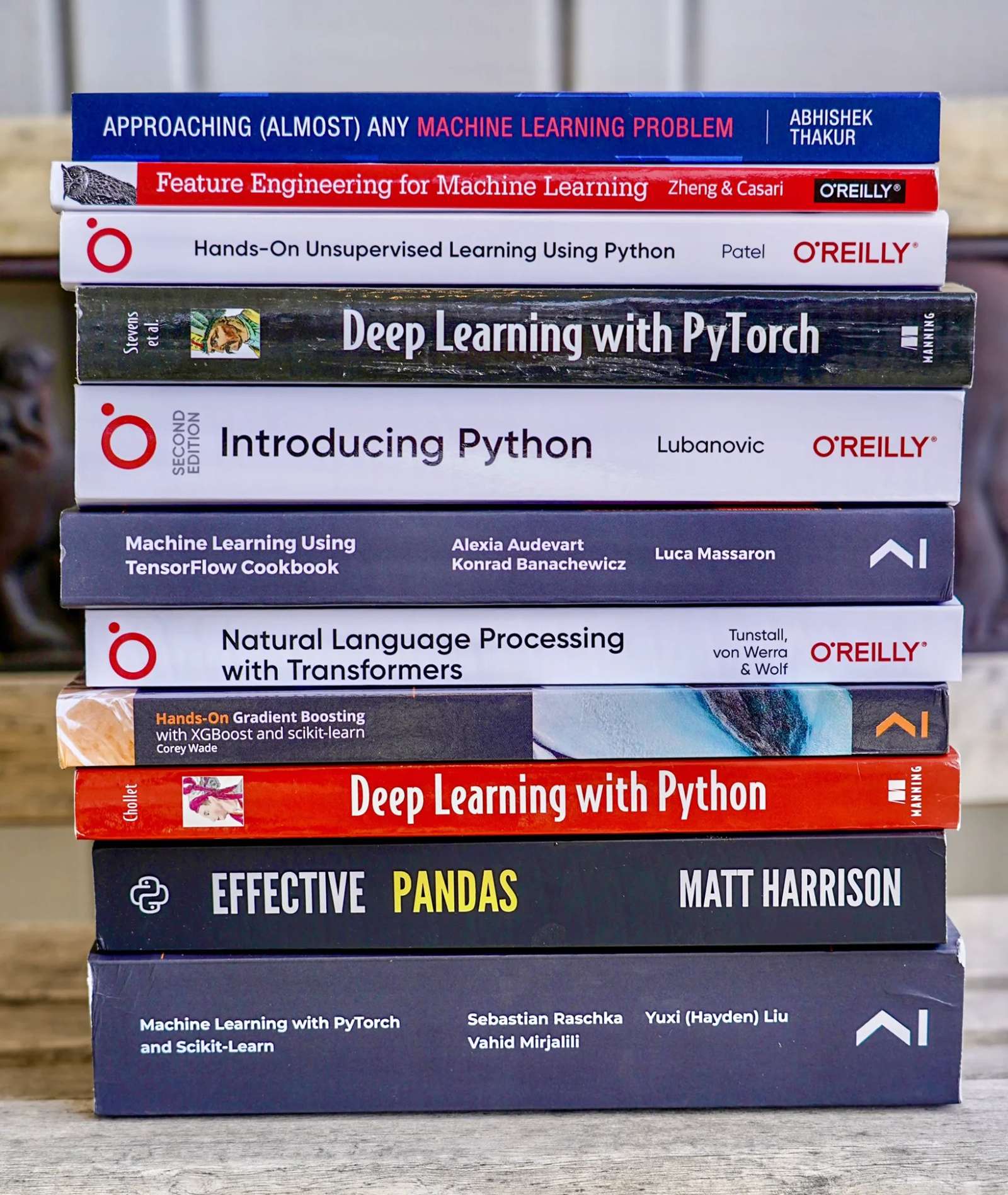
Bojan Tunguz, a senior systems software engineer at NVIDIA, tweeted a snapshot of his collection of books on coding, data science and machine learning. The tweet went viral and attracted lots of responses from the data science and machine learning community. “This collection would get you close to 98%-99% of all the necessary core skills to be good data scientists,” he said.
Register for our FREE Masterclass on AI innovation >>
Here is a snapshot of a (small) subset of all of my Coding, Data Science and Machine Learning books. This collection would get you close to 98%-99% of all the necessary core skills to be a good Data Scientists. 1/6 pic.twitter.com/c1M4wpEXWt
— Bojan Tunguz (@tunguz) March 23, 2022
Bojan’s list includes:
- Approaching almost any machine learning problem - Abhishek Thakur
- Feature engineering for machine learning - Zheng and Cesari
- Hands-on unsupervised learning using Python - Ankur A. Patel
- Deep learning with Pytorch - Eli Stevens, Luca Antiga, Thomas Viehmann
- Introducing Python - Lubanovic
- Machine learning using TensorFlow cookbook - Alexia Audevart, Konrad Banachewicz, and Luca Massaron
- Natural language processing with transformers - Lewis Tunstall, Leandro von Werra, Thomas Wolf
- Hands-on gradient boosting with XGboost and Scikit - learn - Corey Wade
- Deep learning with python - François Chollet
- Effective Pandas - Matt Harrison
- Machine Learning using Pytorch and scikit - learn
While Bojan’s collection covered most notable books on coding, data science & ML, we have found a few quote tweets mentioning the important books he has missed out such as:
- Deep learning for coders with Fastai and Pytorch - Jeremy Howard and Sylvain Gugger
- Deep learning - Ian Goodfellow
- Hands-on machine learning with scikit- learn, Keras and Tensorflow - Geron Aurelien
- Pattern recognition and machine learning - Bishop
Meanwhile, Alex Engler, a research fellow in Governance Studies at The Brookings Institution, opined the list doesn’t have books on data collection (tools or theory), SQL, data viz or communication, experiments, causal inference, or domain knowledge.
In his response, AI_digator highlighted the severe bias of the data science community against the coding language R. Meanwhile, Leon Palafox, the director of artificial intelligence at Grupo Salinas, said the collection has no books on theory.
Bojan Tunguz’s tweet represents an ongoing trend on social media where subject matter experts are posting their cache of books on data science, artificial intelligence and machine learning. Check out a few posts below:
Ranabir Devgupta, a business intelligence engineer at Amazon Payment Products, showcases his book collection on ML:
This trend is not restricted to book but all kinds of resources that aspirants can use to get a deep understanding of machine learning, data science and AI.
Here we go, in no ranking order and does not include other books (digital statistitcs,R,comp sci/unix books)😜 pic.twitter.com/w0gOZs16k7
— RK (@rprabha) March 24, 2022
Here goes my journey over last 6+ yrs. Bottom most is my oldest buy & top most latest buy
— Arnab Biswas (@arnabbiswas1) March 24, 2022
Didn't read most of these. But this pic summarizes my journey well:
Statistics -> Theory of ML(R) -> Tool based application oriented (Python)
If I start today, I will do it other way pic.twitter.com/Qfzv9Tcv9R
Meanwhile, the trend continued on Linkedin too:
- Coforge Revenue Rises 54% as AI Engineering and Deal Bookings Gain Momentum
- Tech Mahindra Partners With SpaceXSI to Bring AI Into Software Engineering
- Infosys AI Revenue Rises 29% in Q2, FY27 Growth Guidance Cut
- LTM Launches BlueVerse Industrial AI Lab in Chennai
- Chariot Launches Speech Recognition Model for 10 Indian Languages
- Meta Expects Up To $145 Billion In Capex As AI Investments Expand