
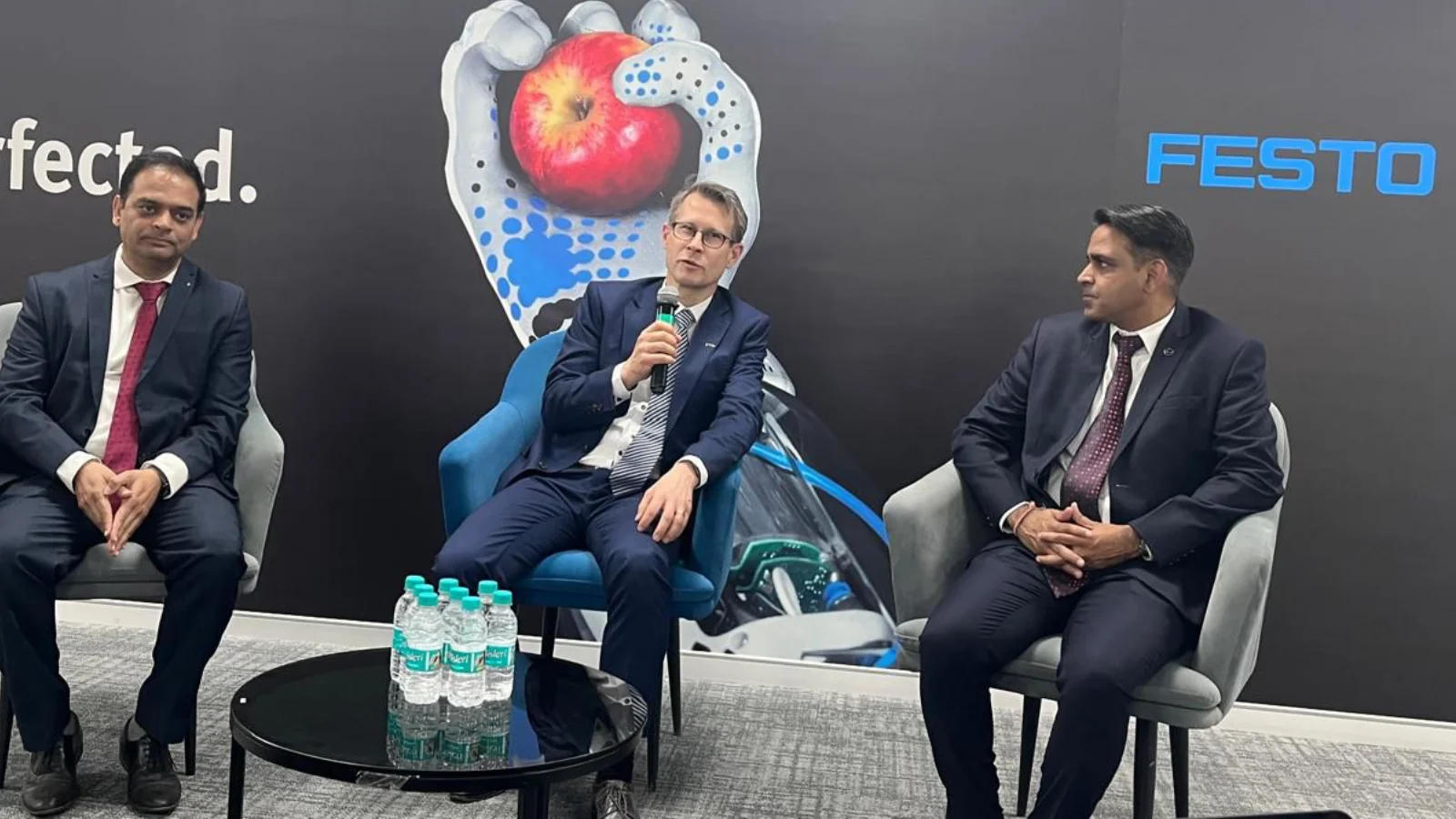
Festo, a global leader in automation technology and technical education, marked 40 years of operations in India and inaugurated a new global capability centre (GCC) in Bengaluru.
The centre will scale to support up to 600 professionals over the next three years, positioning India as a key hub for Festo’s global innovation and digital engineering efforts and reinforcing its long-term commitment to Industry 4.0, automation, and smart manufacturing.
The newly launched 71,000-square-foot GCC near Electronics City will serve as a strategic hub for advanced engineering, digital solutions, software development, data analytics, cybersecurity, product testing, and process excellence. It will support Festo’s global operations by embedding software and AI capabilities into automation products, particularly in areas such as predictive maintenance, device integration, and intelligent manufacturing systems.
“Our GCC in Bengaluru is aligned with Festo’s vision of automation for a sustainable future. The centre will play a significant role in driving global R&D initiatives while fostering collaboration with India’s rich technology and engineering talent pool,” Ravi Sastry, Managing Director, Festo India, said in a statement.
Currently employing over 250 professionals, the Bengaluru GCC is expected to grow to 600 employees within three years. The expansion will focus on multidisciplinary engineers with expertise across software, electronics, and mechanics, reflecting the convergence of technologies shaping modern industrial automation.
“India has been a key growth market for Festo for four decades. Following this milestone, our team in India will grow twofold,” Alok Maheshwari, Head of GCC, Festo India said. He added that the company is focused on building “local talent with global impact,” using AI and automation to increase productivity and deliver higher volumes of work with greater efficiency.
Highlighting the strategic importance of India, Sebastian Beck, Member of the Management Board – HR & Finance, Festo, said, “Forty years of Festo in India is a powerful reflection of our long-term vision and belief in the country’s industrial and technological potential. What began as a market presence has evolved into a strong partnership built on trust, engineering excellence and shared values. India will continue to play a strategic role in shaping Festo’s global innovation, digital capabilities and sustainable growth.”
Festo’s GCC will focus on practical, business-driven AI adoption, embedding intelligence into automation products where there is clear economic and technological value. Key use cases include predictive maintenance solutions that help customers reduce costly downtime in sectors such as automotive manufacturing.
Festo entered the Indian market in 1963 and established its incorporated presence in 1986. Today, Festo India employs over 1,000 people and works with more than 25,000 customers, institutions and industry partners, playing a key role in advancing industrial automation, technical education and Industry 4.0 readiness across the country.
“Our GCC embeds shared services that include central technical support, device integration, research and innovation, product testing, and cybersecurity,” Sastry told AIM, adding that these capabilities work closely with the company’s R&D teams in India and globally. “All this software-related support is delivered to Festo worldwide from this GCC.”
A key focus area for the centre is applying AI where it delivers measurable business value—particularly in industrial environments where downtime is costly. “If there is downtime, it costs a lot of money,” he explained. “That is where predictive maintenance comes in. This predictive feature is what we embed into our products.”
Rather than adopting AI for experimentation alone, Festo takes a disciplined approach. “We use AI only if we have the right business case—one that makes sense from both an economic and a technology standpoint,” he said. “We don’t deploy AI for the sake of deploying it. We use it wherever required and to the extent required.”
The GCC leverages a broad technology stack, including large language models and automation platforms, to improve machine predictability, performance and lifecycle efficiency—such as optimising welding lines in automotive manufacturing.
As of today, the Bengaluru GCC employs over 250 professionals and is expected to grow to 600 within the next three years.
“Everything is converging. We need engineers who understand the interplay of mechanics, electronics and software.”
Beyond scale, productivity is a strategic priority. “We want to triple the headcount first, but more importantly, use automation and AI so that we can do a 2,000-person job with 1,000,” he clarified. “This is not about job cuts. It’s about being more effective and increasing the volume of work.”
Summing up the philosophy behind the expansion, Sastry described the GCC’s mandate succinctly: “Local talent, global impact.”

Your reaction
Discussion
What's your take on this story?
No comments yet — be the first to share your view.