
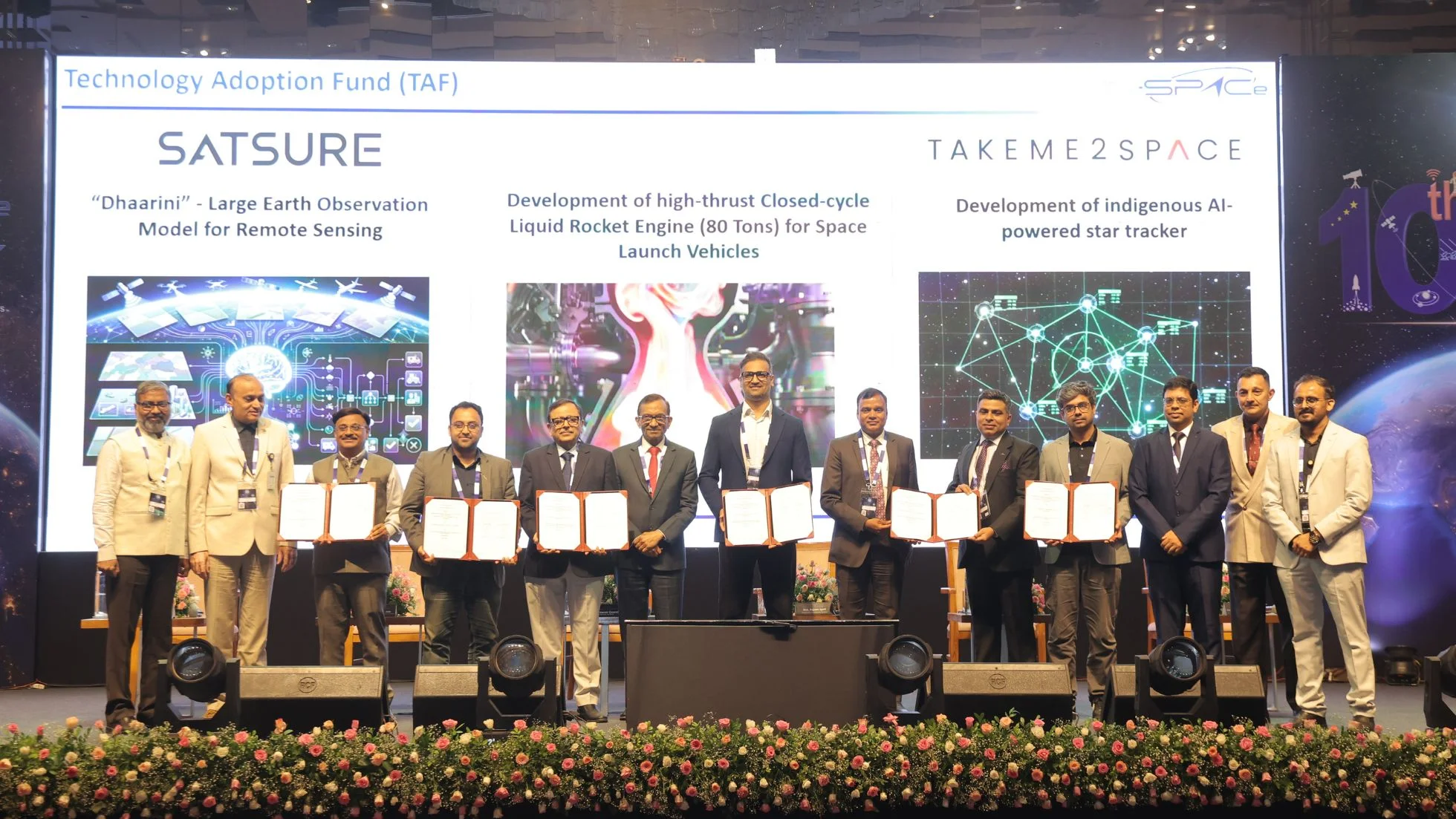
The Indian National Space Promotion and Authorisation Centre (IN-SPACe) has selected three Indian space startups for funding under its Technology Adoption Fund (TAF) scheme, backing projects in rocket propulsion, Earth observation AI, and satellite navigation systems.
The agency said that Bengaluru-based Astrobase Space Technologies and SatSure Analytics India, along with Hyderabad-based TakeMe2Space (TM2S), will receive financial support. This will take place after a multi-stage evaluation process involving experts from ISRO, the Department for Promotion of Industry and Internal Trade, the Department of Science and Technology, industry, academic institutions, and IN-SPACe.
The selected projects aim to strengthen India’s domestic space capabilities and reduce dependence on foreign technologies. The three companies are the first non-government entities (NGEs) selected under the TAF scheme, which aims to help Indian firms absorb, adapt and commercialise advanced space technologies.
Pawan Goenka, Chairman of IN-SPACe, said in a statement, “With this fund, our vision is to bridge the critical gap between early-stage development and commercial success. These projects are not just innovative concepts; they are practical, market-ready solutions that will increase our footprint in the global space economy.”
Bengaluru-based Astrobase Space Technologies will develop a high-thrust reusable liquid rocket engine for launch vehicles. The company said it is building an 80-ton Full Flow Staged Combustion LOX-methane engine with an 800 kN thrust class and a modular design for medium-to-heavy lift launch vehicles.
Astrobase said the engine is already undergoing hot-fire testing at its propulsion facility in Anantapur, Andhra Pradesh. The startup operates a 46,000 sq ft assembly facility in Bengaluru, where it designs and builds propulsion and vehicle systems. It said the engine programme forms part of its effort to develop indigenous propulsion systems and reduce India’s reliance on imported technologies.
Also, SatSure Analytics India will build Dhaarini, a Large Earth Observation Model designed as an AI platform for remote sensing applications. The model will be trained on satellite and aerial datasets to generate insights across agriculture, infrastructure, and disaster management.
Meanwhile, TM2S will develop StarSense, an indigenous AI-powered star tracker system for satellites. The company plans to build two variants: StarSense Lite for CubeSats and StarSense Pro for satellites weighing more than 50 kg.
Star trackers help satellites determine pointing direction with high accuracy for imaging and communication missions. TM2S said Indian manufacturers currently import most such systems from the United States and Europe, making the technology one of the key satellite subsystems still sourced from overseas.
The company said the StarSense project follows a 24-month development timeline from laboratory testing to a fully qualified flight-ready model. TM2S added that the technology has already completed space qualification across two orbital missions in 2024.
Rajeev Jyoti, Director of Technical Directorate at IN-SPACe, said the selected projects address “critical technology gaps” in India’s space ecosystem.
India is expected to launch around 150 satellites over the next three years, according to TM2S. The company estimates this could create demand for at least 300 star trackers, as commercial missions often use dual systems for redundancy. It is also developing an indigenous lens assembly with Hyderabad-based Eon Space Labs.
Beyond satellite navigation systems, TM2S said StarSense will support its wider ambition to build a 1 GW orbital data centre through a planned constellation of 20,000 compute satellites. The company said developing critical hardware locally would help secure supply chains for the long-term project.
“Spanning a reusable high-thrust rocket engine, a foundational EO-AI platform, and indigenous high-accuracy star trackers, these projects address critical technology gaps and have strong real-world potential to enhance India’s space capabilities,” Jyoti said.
IN-SPACe said it will provide technical guidance, monitoring, and milestone-linked disbursement of funds to support the selected projects. The TAF scheme was created to bridge the gap between research and operational deployment of advanced space technologies in India.

Your reaction
Discussion
What's your take on this story?
No comments yet — be the first to share your view.