
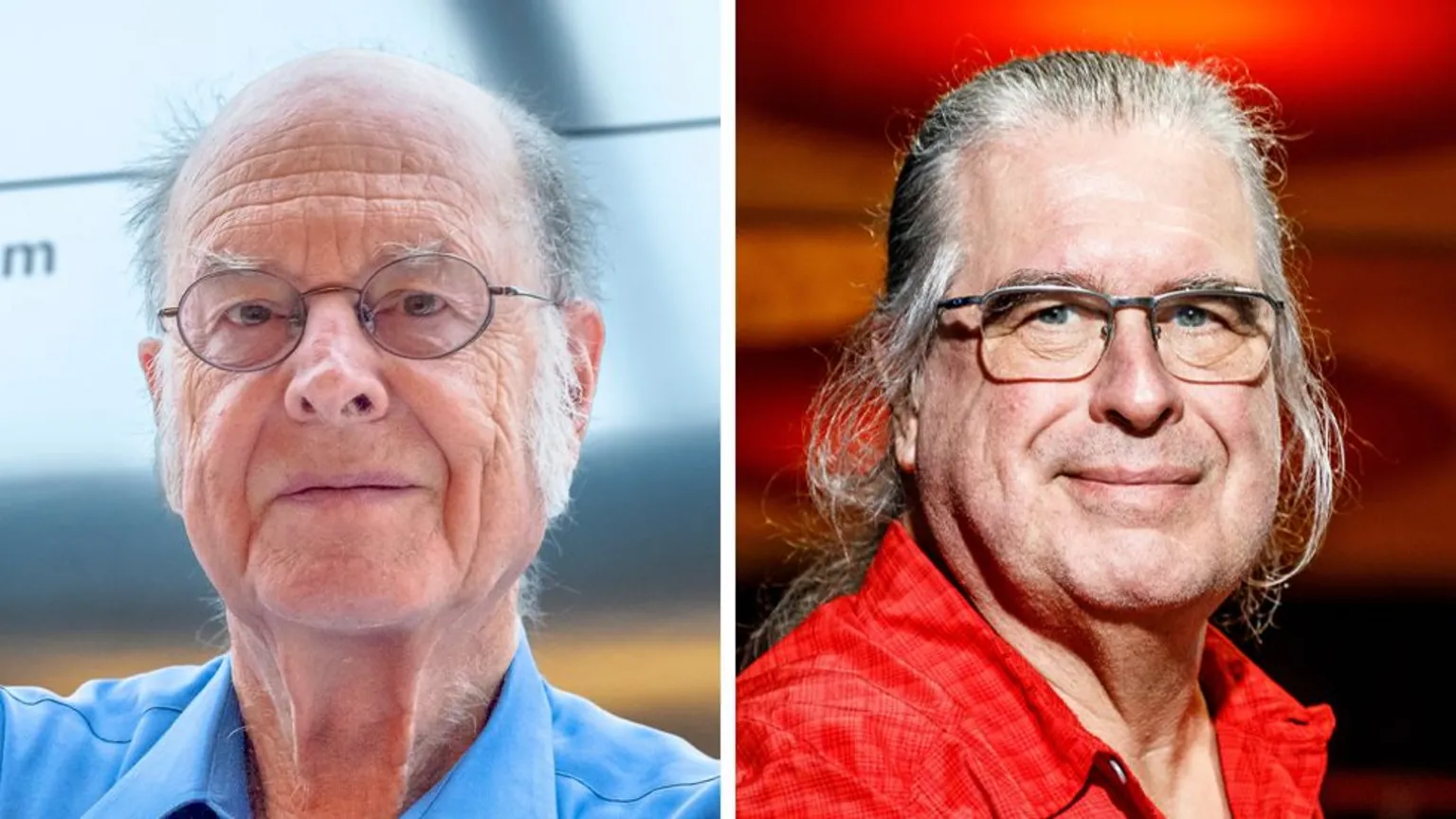
The Association for Computing Machinery (ACM) has named Charles H Bennett and Gilles Brassard as the recipients of the 2025 ACM AM Turing Award for their roles in establishing the foundations of quantum information science and advancing secure communication and computing.
The award, widely regarded as the “Nobel Prize in Computing,” carries a $1 million prize funded by Google. It is named after British mathematician Alan M Turing, who developed the Turing Machine model of computation and proposed the Turing Test for artificial intelligence.
Bennett and Brassard were recognised for introducing quantum mechanics as a framework for processing and transmitting information. In 1984, building on research physicist Stephen Wiesner’s ideas on quantum information theory and quantum money, they proposed the first practical quantum cryptography protocol, BB84.
Their paper, “Quantum Cryptography: Public Key Distribution and Coin Tossing,” showed that two parties could generate a shared secret key with security based on physical laws rather than computational assumptions.
The protocol demonstrated that “two parties could establish a secret encryption key with security guaranteed by the laws of physics,” even against adversaries with advanced computing capabilities, including quantum computers.
Their work contrasts with classical cryptography models. In 1949, Claude Shannon showed that perfect secrecy requires a pre-shared key at least as long as the message. Later public-key systems relied on mathematical problems assumed to be hard to solve. However, these assumptions were challenged when applied mathematician Peter Shor showed in 1994 that quantum computers could break widely used cryptographic schemes.
BB84 instead relies on a property of quantum information: it cannot be copied or measured without disturbance. Any attempt at interception leaves detectable traces before the data is compromised.
As quantum computing progresses, governments and industry are reassessing existing cryptographic systems. Quantum cryptography and emerging quantum-resistant classical approaches are being explored to secure communications. Variants of BB84 have already been deployed in quantum communication networks using fibre and satellite links.
Beyond cryptography, Bennett and Brassard contributed to quantum teleportation. In 1993, with collaborators, they showed how a quantum state could be transmitted using entanglement and classical communication. This work established entanglement as a usable resource. Related experimental work was recognised with the 2022 Nobel Prize in Physics.
In 1996, they introduced entanglement distillation, a method to improve the quality of entangled states. This is a step toward scalable quantum communication and future quantum networks.
Over four decades, their work linked physics and computer science, influencing cryptography, algorithms, computational complexity, and information theory. Their contributions are seen as foundational to current efforts in quantum computing and communication.
Their recognition comes as the United Nations has designated 2025 as the International Year of Quantum Science and Technology, reflecting increased global focus on quantum research.
Bennett has built his career at IBM Research since 1973, working across thermodynamics, quantum mechanics, and computation.
Brassard, a Canadian computer scientist, has been a long-time faculty member at the Université de Montréal and held the Canada Research Chair in Quantum Information Science from 2001 to 2021.
Looking ahead, research in the field is focused on fault-tolerant quantum computing, new algorithms, and long-distance quantum communication systems, including quantum networks and a potential quantum internet.

Your reaction
Discussion
What's your take on this story?
No comments yet — be the first to share your view.