
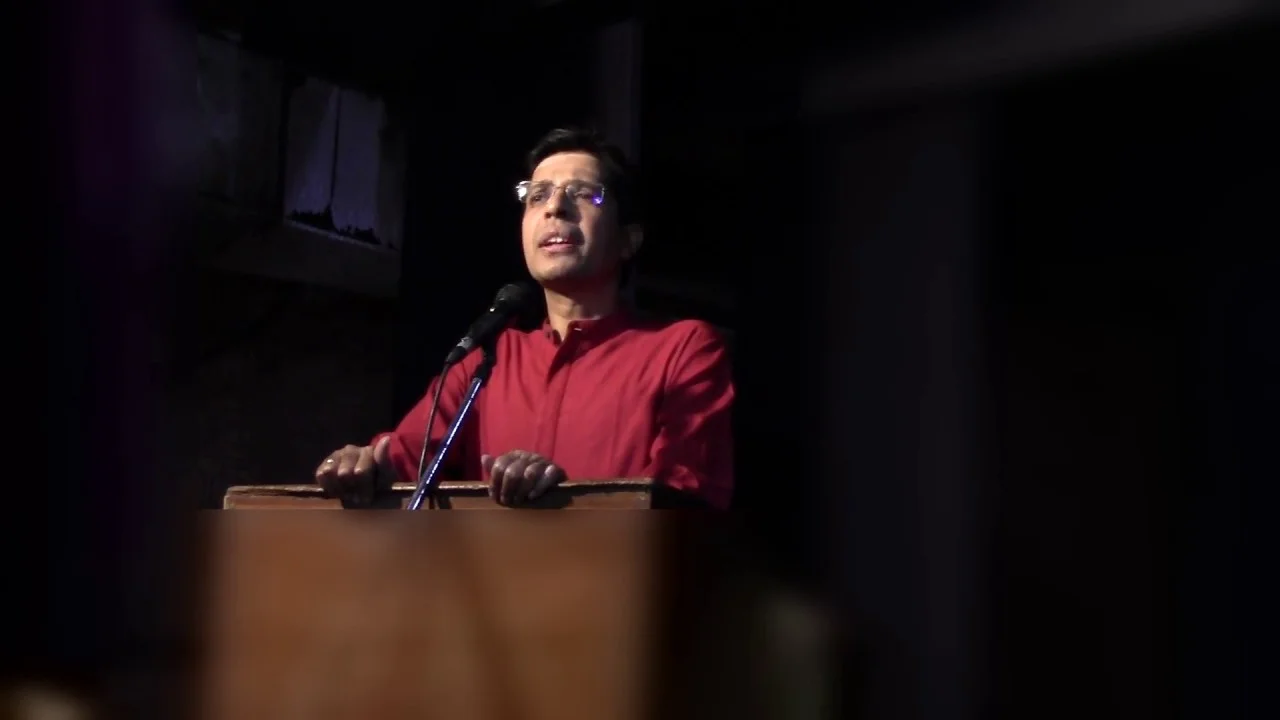
The decision to confer the Padma Shri on IIT Madras director V Kamakoti has triggered a sharp online confrontation, after the Congress’s Kerala unit questioned his credentials for India’s prestigious civilian honour. What has unsettled many academics, however, is not the disagreement itself but the manner in which one of India’s premier institutions has been dragged into a political spat.
The controversy began with a post by the Congress’s Kerala unit on X, which sarcastically congratulated Kamakoti for what it described as “bleeding-edge research on cow urine”, claiming that IIT Madras had taken “gomutra to the world stage”.
Sridhar Vembu Defends Kamakoti
The remark prompted an immediate and forceful response from Zoho founder Sridhar Vembu, who defended Kamakoti’s academic standing and contributions.
Pointing to Kamakoti’s work as a deep-tech researcher in microprocessor design, his role as director of IIT Madras, Vembu says he “richly deserves” the honour. He criticises the “colonial mindset” that dismisses research into traditional knowledge systems. Vembu adds that cow dung and cow urine contain microbiomes that could merit scientific investigation, suggesting scepticism would vanish if similar studies were published by Western institutions.
The exchange escalated when the Congress unit responded with a lengthy rebuttal. It questioned the tangible outcomes of research into cow dung and urine, citing alleged misuse of public funds in a Madhya Pradesh government-backed Panchagavya cancer research project. The post alleged financial irregularities and argued that no meaningful scientific outcomes had emerged. It also challenged Vembu to personally fund rigorous research if he believed strongly in the medicinal potential of cow urine.
The backdrop to the controversy includes remarks made by Kamakoti in January 2025 at a goshala in Chennai, where he described cow urine as “anti-fungal, anti-bacterial and anti-inflammatory”. He later shared references to peer-reviewed papers, which, he said, validated the “anti-infective” properties of cow urine. These comments attracted widespread criticism at the time, including from Tamil Nadu Congress chief K Selvaperunthagai, who said he was unfit to continue as IIT Madras director.
Academics Criticise Politicisation of IIT Madras
However, the tone and tenor of the Congress unit’s response have unsettled several academics. “What’s really in bad taste is an institution like IIT Madras being dragged into this,” says Mohandas Pai, Padma Shri awardee, chairman of Aarin Capital Partners and Manipal Global Education Services.
Kamakoti, who has served as director of IIT Madras since 2022, received the Padma Shri for his contributions to education and research. Some observers have noted that many of the institutional achievements under his tenure reflect a longer, cumulative evolution rather than the work of any single director.
Professor Balaraman Ravindran, head of IIT Madras’ data science and artificial intelligence department, and founding head of the Wadhwani School of Data Science and AI, said the Padma citation focuses on Kamakoti’s work on the Shakti processor and his broader national service, rather than on administrative outcomes. “The success of IIT Madras is the result of sustained efforts under successive directors,” he tells AIM, adding that Kamakoti’s contributions to computer architecture research have been internationally recognised.
Kamakoti completed his MS and PhD in computer science and engineering at IIT Madras and joined the faculty in 2001. Before becoming director, he led several key research initiatives, including the team behind Shakti, India’s indigenous microprocessor project. He has also served in national roles, including as chairman of the AI Task Force under the commerce and industry ministry and as a member of the National Security Advisory Board.
Pai and Ravindran Condemn ‘Selective Quoting’
Pai condemned the Congress unit’s remarks as “shameful”, describing Kamakoti as a “national treasure”. He argued that traditional substances such as cow urine have scientifically documented medicinal properties and warned against the politicisation of scientific inquiry. “Scientific temper does not mean ignoring natural science,” he tells AIM.
Ravindran also pointed to international recognition of Kamakoti’s work, noting that David Patterson, Turing Award winner and regarded as the father of Reduced Instruction Set Computer architecture, has repeatedly praised IIT Madras’s efforts on open RISC-V architecture, which eventually led to the Shakti project.
Both Pai and Ravindran criticised what they described as the selective quoting of Kamakoti’s personal remarks on cow urine, reportedly made at a goshala, arguing that they had been taken out of context. “An occasion meant for celebration is being turned into a melee by people who cannot see beyond their noses,” Ravindran said.

Your reaction
Discussion
What's your take on this story?
No comments yet — be the first to share your view.