
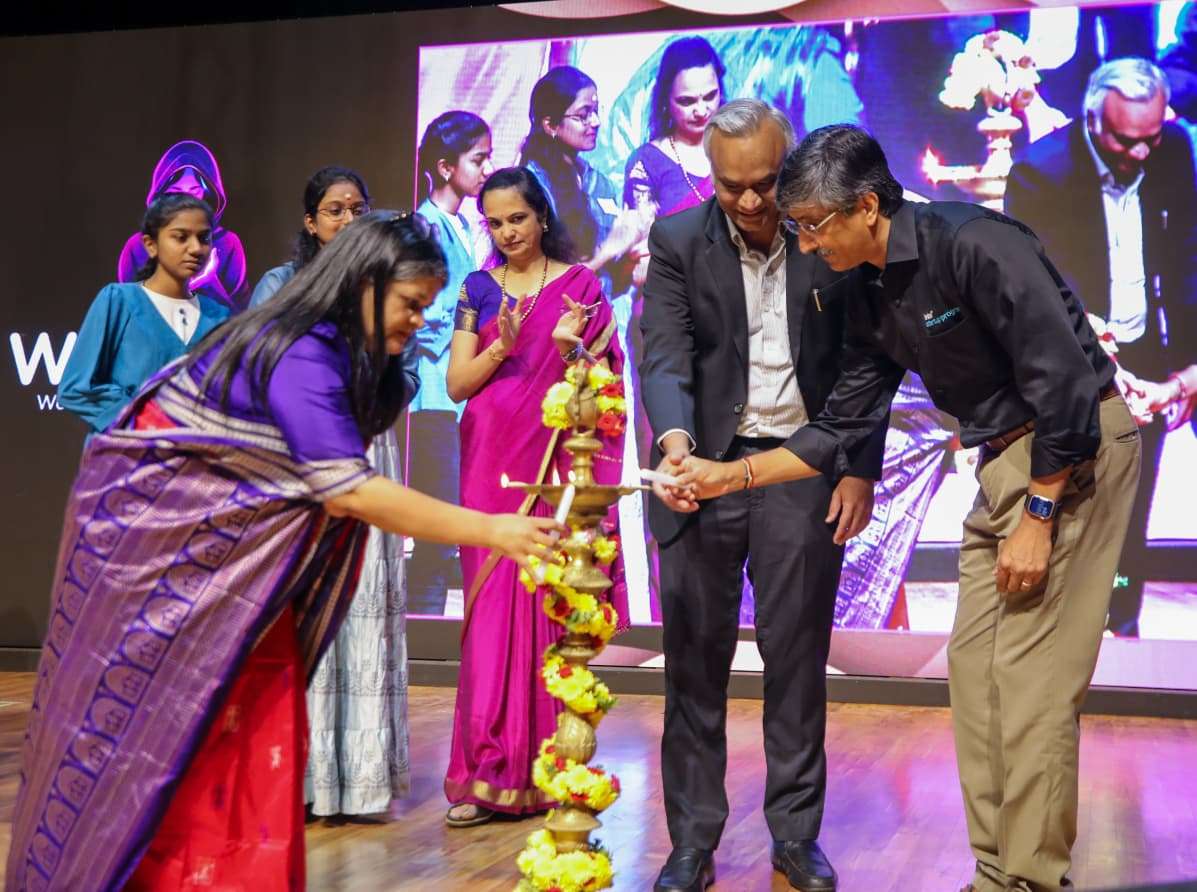
Young innovators from across India took centre stage at the grand finale of WitchHunt 2026, a women-first AI hackathon that saw participants develop 373 functional prototypes, aimed at solving real-world challenges across healthcare, education, climate action and smart cities segments.
Organised by HopeWorks Foundation in partnership with AI4India and the Karnataka Digital Economy Mission (KDEM), the four-month programme concluded at Jyoti Nivas College Autonomous in Bengaluru. The event brought together 6,151 participants from 23 states, making it one of India’s largest women-focused AI innovation initiatives.
Teams from Nellore, Udupi and Delhi emerged as winners across different categories. Bytebusters from Nellore won the Climate Action track with an AI-powered farming solution, while aipaglus from Delhi secured the Health and Wellbeing category for developing an AI maternal health companion called MaaSakhi. Karnataka-based team We4 won the Education track with CallSakhi, while an offline voice-first mentor designed for rural girls and female coders from Delhi topped the Smart Cities category with a localised urban infrastructure monitoring platform.
The event was inaugurated by Karnataka IT and BT Minister Priyank Kharge, who encouraged students to focus on solving meaningful problems rather than replicating existing business models.
“Move up the value chain. Replicating another e-commerce platform is great, but India needs real innovation. My request to youngsters is to upskill fast and start creating and building for the world rather than just servicing it,” Kharge said.
He also highlighted Karnataka’s efforts to support startups through initiatives such as the ₹300 crore Nipuna Karnataka reskilling programme and the state’s upcoming government-first policy, which aims to enable startups to test solutions in government-backed sandbox environments.
A recurring theme throughout the event was India’s need to become a creator of AI technologies rather than merely a consumer. Debjani Ghosh, Distinguished Fellow at NITI Aayog, stressed the importance of building indigenous AI capabilities.
“India is one of the largest users of AI today, but it must also become one of the largest builders of AI. Women must play a larger role in shaping the future of artificial intelligence,” she added.
Gokul V Subramaniam, President of Intel India, echoed the sentiment, urging students to focus on frugal innovation tailored to real-world challenges such as limited connectivity and affordability.
The hackathon recorded a nearly 50% idea-to-prototype conversion rate with participants developing 373 working solutions from 779 submitted ideas. More than 300 industry mentors and 70 AI experts supported the programme.
A total prize pool of ₹19 lakh was awarded to winning teams, while organisers announced plans for the next edition of WitchHunt, aiming to further strengthen women’s participation in India’s growing AI ecosystem.
- Coforge Revenue Rises 54% as AI Engineering and Deal Bookings Gain Momentum
- Tech Mahindra Partners With SpaceXSI to Bring AI Into Software Engineering
- Infosys AI Revenue Rises 29% in Q2, FY27 Growth Guidance Cut
- LTM Launches BlueVerse Industrial AI Lab in Chennai
- Chariot Launches Speech Recognition Model for 10 Indian Languages
- Meta Expects Up To $145 Billion In Capex As AI Investments Expand