
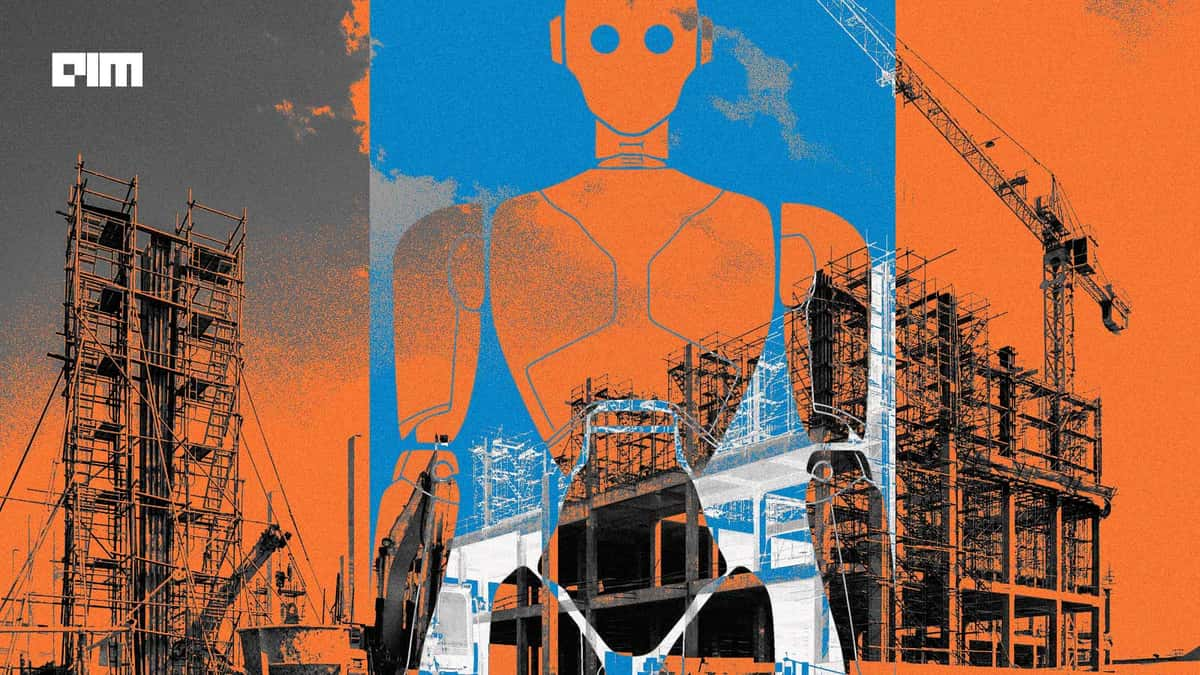

On a construction site in India, a robot navigates uneven ground, hauls heavy materials into a hoist, rides it up over 10 floors, and delivers supplies to the exact mapped location, all without a single human operator.
This is not a pilot project or a proof of concept. This is Flo Mobility, one of the portfolio companies backed by Mela Ventures, a Bengaluru-based deep tech venture fund that has quietly been building a thesis most Indian VCs have shied away from: physical AI.
"AI is going to move beyond the traditional enterprise tech application and into what we call the physical AI aspect," Krishnakumar Natarajan, Co-Founder and Managing Partner of Mela Ventures, tells AIM. "Robotics is clearly one of the key areas."
Building on Hard Ground
India's construction industry depends heavily on migrant labour, but workforce management remains a persistent challenge. Companies often cite worker mobility, holidays, and accidents as causes of delays, while continued reliance on manual and semi-automated processes introduces inefficiencies and safety risks. Together, these factors drive up project costs and extend completion timelines.
Flo Mobility addresses this gap head-on. Its autonomous mobile robots (AMRs) are designed specifically for construction environments, where ground conditions are uneven, slopes are abrupt, and heavy materials need to be moved across dozens of floors.
What sets the company apart, Natarajan argues, is not the hardware—motors, actuators, and sensors are largely standard—but the software layer that drives it.
"The software is written to take care of such unique use cases," he says. "The robot needs to accurately assess the location of the hoist, go inside, position itself so that the hoist can close the outer panel, move up to the required floor, and then deliver the materials to the mapped location."
Natarajan notes that the strongest use cases emerge in buildings with at least 10 floors, where construction timelines span 24 to 30 months, creating consistent, long-term demand for the solution. Customers confirm the impact, reduced dependency on migrant labour, fewer safety incidents, and measurable improvement in material movement volumes.
From Drones to Robots
Mela Ventures received its first SEBI approval in May 2020 and made its first investment in September of the same year. Its initial portfolio leaned into enterprise SaaS, but an encounter with an innovation from IISC Bangalore permanently changed the fund's direction.
The opportunity was in agricultural productivity, a sector where India's output remains among the lowest globally, despite agriculture contributing significantly to GDP. The specific problem was pesticide spraying: manual sprayers carried on farmers' shoulders led to inconsistent application, widespread overspraying that degrades soil quality, and alarming rates of lung-related infections in rural communities.
The solution was a drone, but not simply a hardware device. "A drone is a combination of hardware, materials, and software," Natarajan explains. The nozzles are crafted from specific carbon fibre materials for maximum spray efficiency.
The software maps irregular land parcels, programs flight paths, and applies the right quantity of nutrients based on the crop's specific needs. A chilli plant, for instance, requires spray on both the top and bottom of its leaves across 10 separate spraying sessions in a three-month growth cycle, a nuance that only precision agriculture technology can consistently deliver, he argues.
This investment cemented Mela Ventures' evolving definition of deep tech: hardware, software, material science, and mapping converging to deliver measurable efficiency and long-term soil health. "Five years back, when we invested in the drone company, there was no definition of deep tech," Natarajan says. "We started evolving on our own."
The Funding Gap No One Is Talking About
While India's startup ecosystem has matured significantly, deep tech sits in an uncomfortable funding gap. Early-stage capital exists. Growth capital for consumer tech, fintech, and SaaS scales rapidly. But for deep tech companies attempting to raise a $50 million growth round, Natarajan says the ecosystem simply isn't ready.
"There are not many people who are in what I call the growth stage investment for deep tech companies," he says. "The growth investor ecosystem is still not developed."
Government institutions are stepping in to partially fill the void. It is increasingly making direct investments in deep tech companies seeking growth capital, and its Fund of Funds has been a key LP for Mela Ventures. The RDI's recently announced fund has attracted applications from growth-stage VC investors, with some expected to float deep tech-specific growth vehicles. But Natarajan is candid that these are stopgap measures, not structural solutions.
Mela Ventures itself was built around a carefully curated LP base, largely technology leaders from India's IT industry and a few large family offices, who were told upfront that exits would take eight to ten years. "This is a long game," Natarajan says. "They are all aware that they need to be patient." Of Mela's 15 portfolio companies, 11 have crossed the $1 million(₹10 crore) revenue mark. Not a single company has shut down.
Separating Real AI from PowerPoint AI
As "AI-first" becomes a badge every startup claims, Natarajan has developed a rigorous framework to distinguish substance from narrative. When a company presents itself as AI-native, its team drills into data architecture, model selection methodology, the proportion of open-source versus licensed foundational models, integration layers, synthetic data usage, and mechanisms for detecting and correcting model hallucination and deterioration.
"How much of it is real and how much of it is PowerPoint?" he asks pointedly.
On sovereignty, he sees the conversation expanding beyond national borders to the enterprise level. Companies are increasingly reluctant to host sensitive applications on public cloud infrastructure, prompting solution providers to develop small language models that run entirely within a company's physical infrastructure, on CPUs rather than GPUs.
What Comes Next
Natarajan's ambition for Mela Ventures is anchored in a simple but demanding goal: solve hard problems in India, achieve scale, and take the technology global. He points to the rapid acceleration of the physical AI ecosystem, vertical-specific robotics, multi-axis CNC systems, IoT sensor layers across manufacturing value chains, and the emergence of secure IoT infrastructure as evidence that the physical world is finally catching up to the digital at speed.
"Five years from now," he says, "at least four or five of the deep tech companies we've invested in should not only be solving large problems in India, but they should be successful in global markets."
For an ecosystem long obsessed with software and scale, that is a different kind of bet. But if the robots on India's construction sites are any indication, it may also be the most grounded one.
- The Bengaluru Founder Building a Bridge to San Francisco
- This Bengaluru Startup Is Building AI Agents for Hardware Design
- Drizz Is Taking on the Reliability Challenge in AI App Testing
- How This Indian AI Unicorn is Disrupting Hollywood With Digital Humans
- The AI Underwriting Engine Behind Recur Club’s ₹500 Cr Festive D2C Capital Push
- Loan Collection in India is Still Largely Manual. This AI Startup is Changing That