
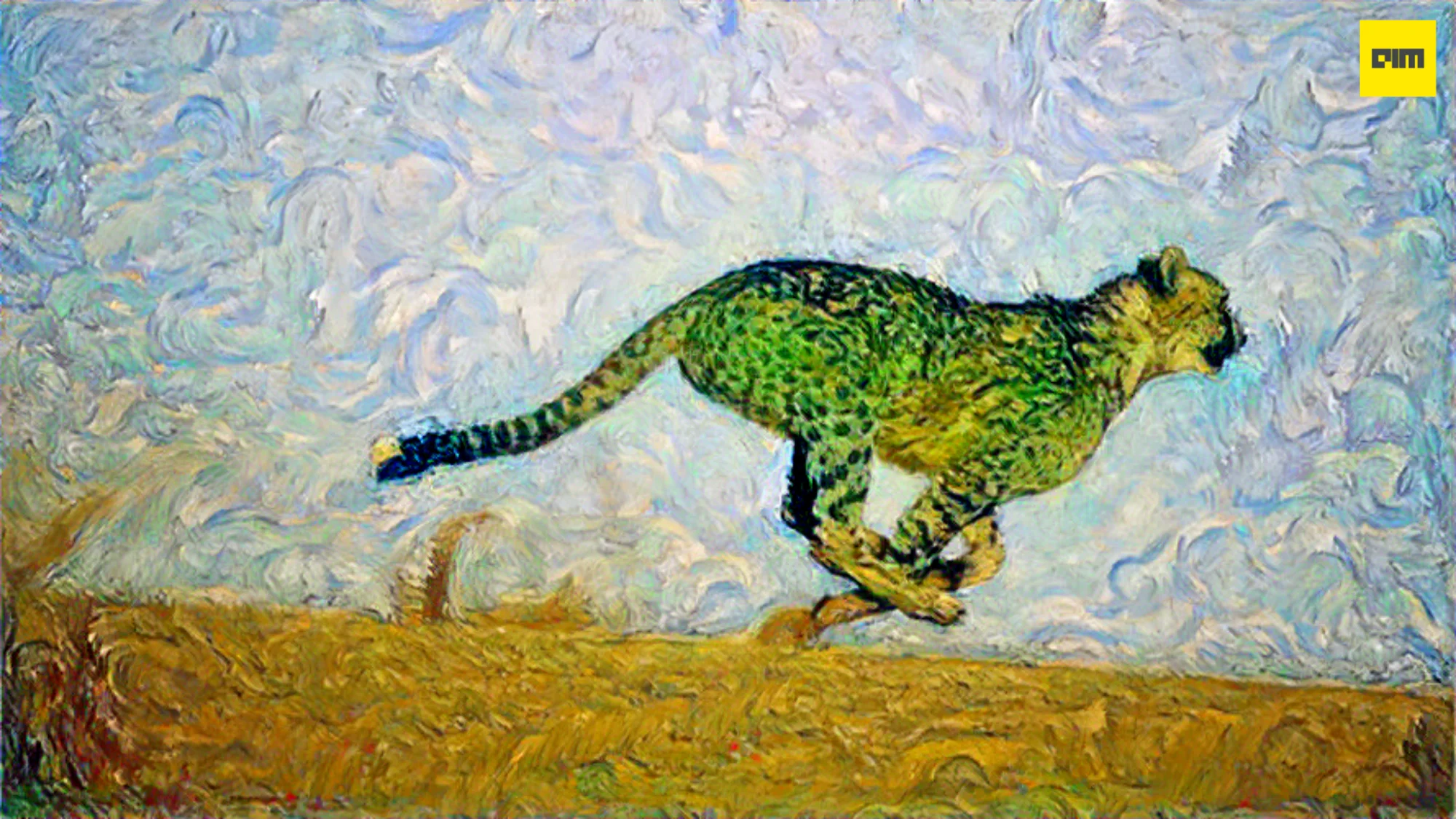
Since the 20th century, researchers have worked on different algorithms to create appealing artwork to attract artists’ attention. We have seen various algorithms, including strokes based rendering, region-based techniques, example-based rendering, and many more. The idea has always been to select two images, an arbitrary input image and a random style image, to combine them to create astonishing artistic output.
In 2015, a group of researchers Leon A. Gatys, Alexander S. Ecker, Matthias Bethge gave birth to “A Neural Algorithm of Artistic Style” Since then, there are more than 240 implementations of the research paper in several frameworks like torch, MXNet, TensorFlow, PyTorch, etc. Neural Style Transfer(NST) is a technique in which we use deep neural networks for image creation to create the visual style of another image. NST uses a Convolution Neural Network(CNN) such as VGGNet and AlexNet, to render an input image in different artist styles.
Taxonomy of Neural Style Transfer(NST)

Source: Neural Style Transfer: A Review
In this article, we will learn about Pystiche, a framework for NST implementation, built and fully integrated with PyTorch. It solves the problem of quickly testing and deploying an NST algorithm to create new style images. Philip Meier and Volker Lohweg have created Pystiche, which has recently been published in the journal of open-source software.
NST can be simply explained by the below image, two symbols, and three images.

Source: https://pystiche.readthedocs.io/en/latest/gist/index.html
Installation:
pip install pystiche
You can also install it from Github
pip install git+https://github.com/pmeier/pystiche@master
#setup
 import pystiche
 from pystiche.image import read_image
 from pystiche import demo, enc, loss, ops, optim
 from pystiche.image import show_image
 from pystiche.misc import get_device, get_input_image
 print(f"I'm working with pystiche=={pystiche.__version__}")
 device = get_device()
 print(f"I'm working with {device}")
Model
We are going to load VGG19 and feed the input tensor to the model, to extract a feature map of the content, style, and output image.
VGG19 model relatively(compared with ResNet, Inception,etc) generate better output for neural style transfer
#multi-layer encoder
 multi_layer_encoder = enc.vgg19_multi_layer_encoder()
 print(multi_layer_encoder)
Pystiche provides a MultiLayerEncoder, which enables to obtain all the necessary encoding after a single forward pass.
Content Loss
Content loss calculates the content representation in the content image, which gets captured in a generated image. In this example, content_layer generates encoding then passes it to content_encoder to extract features and thus with the content_weight gives output to content_loss. It is also the distance between the content image, which we want to preserve, to generate the output image.
#content loss
 content_layer = "relu4_2"
 content_encoder = multi_layer_encoder.extract_encoder(content_layer)
 content_weight = 1e0
 content_loss = ops.FeatureReconstructionOperator(
     content_encoder, score_weight=content_weight
 )
 print(content_loss)
Style Loss
Style loss, measure the distance in style between the output image and style image.
#style loss
 style_layers = ("relu1_1", "relu2_1", "relu3_1", "relu4_1", "relu5_1")
 style_weight = 1e3
 def get_style_op(encoder, layer_weight):
     return ops.GramOperator(encoder, score_weight=layer_weight)
 style_loss = ops.MultiLayerEncodingOperator(
     multi_layer_encoder, style_layers, get_style_op, score_weight=style_weight,
 )
 print(style_loss)
Perceptual Loss
Perceptual loss is a metric of comparing two different images that look similar. It compares the high-level differences in content and style images. Perceptual loss uses feed-forward neural networks for image transformation. We combine the content_loss and style_loss into a joined PerceptualLoss, which will serve as the optimization criterion. The content_loss and style_loss together create the perceptual loss.
#computing perceptual loss
 criterion = loss.PerceptualLoss(content_loss, style_loss).to(device)
 print(criterion)
#load a input image
 content_image = read_image("cheetah.jpeg", size=size, device=device)
 show_image(content_image, title="Content image")

#load a style image
style_image = read_image("Van-Gogh-Wheat-Field.jpeg", size=size, device=device)
show_image(style_image, title="Style image")

#targets for the optimization criterion
 criterion.set_content_image(content_image)
 criterion.set_style_image(style_image)
#Initialise the input image for training
starting_point = "content"
input_image = get_input_image(starting_point, content_image=content_image)
show_image(input_image, title="Input image")
#start the style transfer training
output_image = optim.image_optimization(input_image, criterion, num_steps=1000)
#write the image to current folder
write_image(output_image,'test.png', mode=None)
#show the output
show_image(output_image, title="Output image")

Conclusion
In this article, we have learned about Pystiche with code implementation. Pystiche is a fantastic tool to create new render images in the required style. Please check the full code at GitHub and documentation.

Your reaction
Discussion
What's your take on this story?
No comments yet — be the first to share your view.