

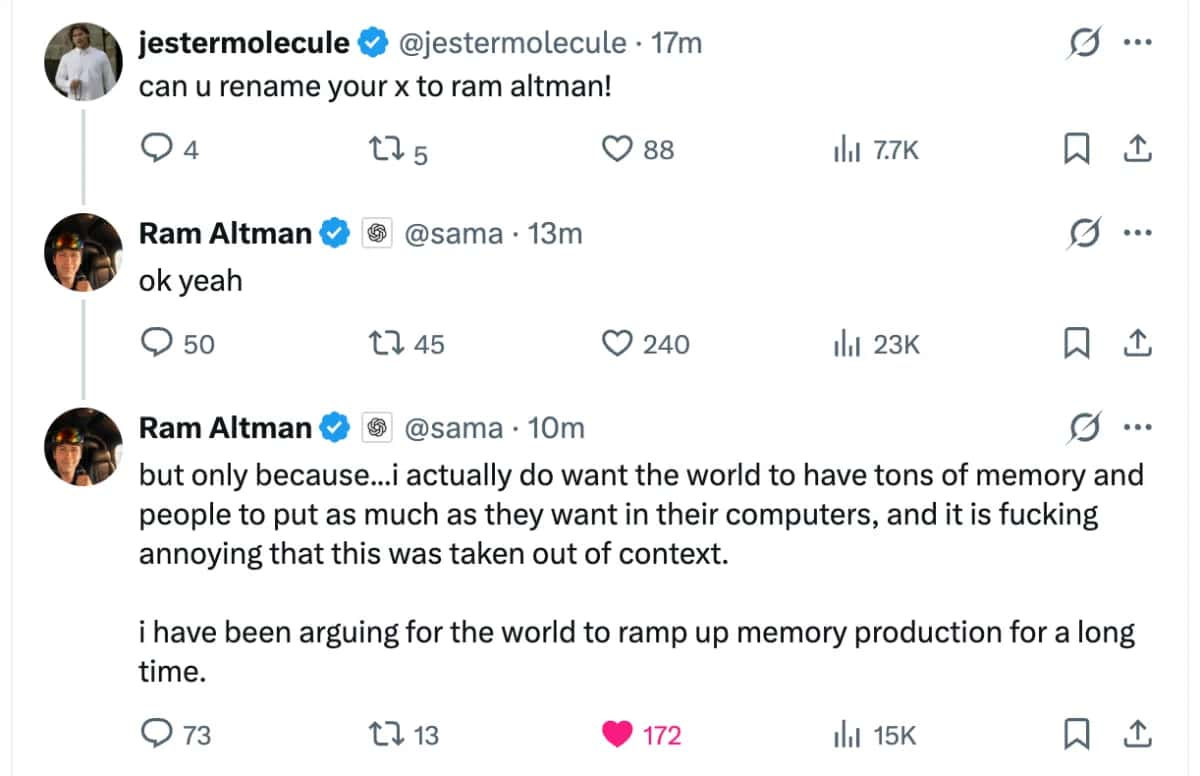
With Diwali around the corner, Ram has made an unexpected appearance on X. Sam Altman, the OpenAI CEO, briefly changed his name to ‘Ram Altman’, though the name change had nothing to do with Lord Ram or the festival of lights.
Sam was addressing a different ‘RAM’: the memory chips at the centre of a global supply chain crunch.
Altman was responding to backlash over his comments that the world’s limited supply of Dynamic Random Access Memory (DRAM) would be better utilised in data centres than sitting idle in personal computers.
Altman explained that he changed his name because he genuinely wanted the world to have abundant memory and supported people installing as much as they desired in their personal computers. He said he was frustrated that his remarks had been taken out of context, and he had long advocated increasing global memory production.
What triggered the name change?
The controversy began when Altman appeared on Cheeky Pint, a podcast hosted by Stripe co-founder John Collison, on October 29.
During the conversation, Collison asked Altman about rising prices for memory chips, GPUs, and other components needed to build AI infrastructure. He also asked why higher prices hadn’t encouraged more manufacturers to increase production.
When asked how the industry was coping with the shortage, Altman gave a terse response, saying it was being handled badly.
“I think the invisible hand is failing right now,” he added, questioning whether market forces alone would be enough to address the supply constraints.
Altman explained that memory manufacturing had historically been a difficult business. DRAM manufacturers would invest around $20 billion in capital expenditure to generate $19 billion in revenue, with the industry going through repeated boom-and-bust cycles.
However, he said manufacturers could now generate around $100 billion in free cash flow annually, but they remained cautious about expanding production because of past experiences.
“I think they all remember their history. How many times they almost went bankrupt by making too many fabs and being promised this time it was different,” Altman said.
Why Altman thinks RAM belongs in Data centres
Altman also spoke about running AI models locally on personal computers rather than accessing them through the cloud. He argued that open-source models running on personal computers wouldn't necessarily solve the industry's infrastructure constraints.
“A lot of people want local inference. And somehow, they assume that the problem is solved now because we are going to have open-source models,” he said, questioning the allocation of memory across personal computers and data centres.
“From a global allocation perspective, actually, it’s quite terrible to have everybody have a bunch of the world’s limited supply of DRAM sitting in their own computer,” Altman said. He added that personal-computer memory is used only about 5% of the time, while cloud infrastructure can keep it in much greater use.
“You want maximum utilisation in the cloud if you're trying to deal with this very supply-constrained environment,” he added.
His comments drew criticism from PC enthusiasts and developers, who argued that consumers shouldn't have to give up control of their own hardware to meet AI infrastructure requirements.
“The guy who signed for up to 900k DRAM wafers a month, about 40% of global output, is lecturing us about DRAM allocation,” wrote a user on X. “The RAM in my computer is already paid for. Running a model on it takes nothing from anyone. Your data centres are a big reason RAM prices went crazy.”
Samsung Electronics and SK Hynix, two of the world’s largest memory chip manufacturers, have been working with OpenAI to expand the supply of advanced memory chips for its Stargate infrastructure project.
In October last year, OpenAI announced partnerships with the two South Korean companies. The arrangements included plans to scale advanced memory production, with OpenAI’s projected requirements reaching up to 900,000 DRAM wafer starts per month.
Why RAM and DRAM prices are rising
The buildout of AI infrastructure and data centres has also squeezed memory supply for consumer electronics, including laptops and smartphones.
Memory manufacturers are increasingly prioritising products for AI servers, which is driving up prices for components used in personal computers.
Altman argued that the industry needs to produce more memory rather than restrict its availability. He said the cost of energy, chips, and other components needed to generate AI tokens should fall.
DRAM is the most widely used type of RAM in PCs, laptops, smartphones and servers. HBM is another type of DRAM, built by stacking memory dies vertically to provide much higher bandwidth for AI accelerators.
The rise in generative AI has changed the demand for these products. AI data centres require large quantities of high-bandwidth memory (HBM) to support GPUs and other accelerators used to train and run AI models. They also need conventional server DRAM to handle workloads running alongside these processors.
This has increased competition for manufacturing capacity. Producing HBM requires advanced manufacturing processes and specialised packaging. As chipmakers use more of their capacity to make HBM and high-end server memory, less is left for conventional DRAM used in PCs, laptops and smartphones.
The economics also favour AI memory. HBM and high-capacity server memory offer manufacturers better margins than several conventional memory products. Consequently, Samsung, SK hynix and Micron have prioritised AI-related orders.
According to TrendForce’s September 30 forecast, conventional DRAM contract prices are expected to increase by 10–15% quarter-on-quarter in the fourth quarter of 2026. NAND flash prices are forecast to rise by 15–20% over the same period.
- Jev Isn’t An Overnight Fix For Your Lack of AI Fundamentals
- Internet on Alert as AI Uncovers Critical Flaws in PHP Used by 70% of Websites
- From Claude Code Mods to Super Mario: What People Are Building on Jev
- 8 Reasons Why Anthropic’s New Report is an AI Doomer’s Worst Nightmare
- How VECV Built a Real-Time Data Backbone for 2,50,000 Connected Vehicles
- Anthropic Stands Alone Against Open Models