
Across factories and warehouses worldwide, robots have long moved pallets, sorted parcels and navigated fixed routes. The next phase of industrial automation aims to go much further—introducing humanoid machines that can operate in spaces designed for humans.
Globally, humanoid robots have moved from research labs to early pilots, driven by labour shortages, rising safety concerns, and advances in machine perception and learning.
Companies in China, the US, and Europe are racing to build general-purpose humanoids that can walk, handle objects, and adapt to unfamiliar environments. However, most remain at the proof-of-concept stage, with limited commercial deployment.
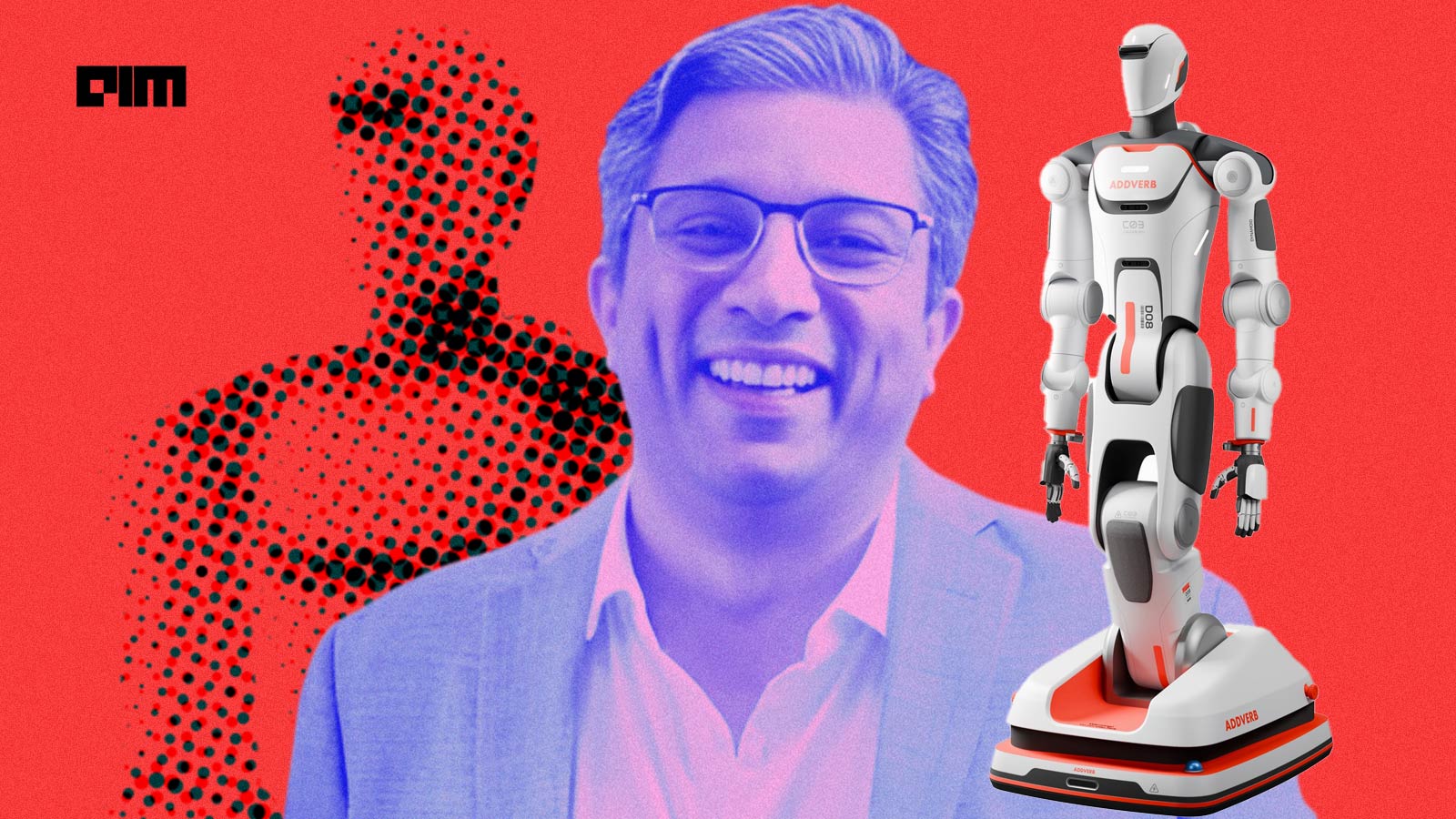
India is now entering this race. While the country has built capabilities in warehouse automation and mobile robotics, humanoid platforms remain rare. That seems to be changing now, with Addverb, a Noida-based automation company, unveiling Elixis-W, its first wheeled humanoid robot.
Launching Elixis-W at the logistics and supply chain solutions conference LogiMAT India 2026 in Mumbai on February 5, Addverb marks a formal entry into humanoid robotics, expanding its portfolio beyond autonomous mobile robots and collaborative arms. The company states this humanoid is designed for industrial environments and will be introduced through a limited number of controlled deployments.
In an exclusive interview with AIM, Sangeet Kumar, Co-founder and CEO of Addverb, reveals that while it is rolling out a wheeled humanoid, a legged version is also ready.
“We are also ready with our leg version, but the wheeled version is what will be available for the first set of customers for proof of concept or initial deployment,” he says.
Addverb plans to keep early deployments limited and tightly monitored. In the first year, it aims to move slowly and deploy to no more than four or five customers, then scale based on areas for improvement.
Kumar also expands on the use of the humanoid internally. The company will leverage its partnership with Reliance and test it in Reliance factories before a large-scale rollout.
Why Wheels Before Legs?
Kumar explains the choice to prioritise wheels reflects the practical needs of industrial sites. “The wheeled version is so there is no limitation of legs, because wheels are much better,” he says, referring to the suitability of wheeled platforms for factory and warehouse layouts.
Elixis-W is approximately 6 feet tall and weighs 75 kg. It offers 43 degrees of freedom without fingers, and an additional 12 degrees per hand when fingers are included. It can also lift 10 kg with both hands put together.
In robotics, degrees of freedom refer to the flexibility and dexterity of the robot, enabling motions like pitch, yaw, roll, and other movements.
The robot is equipped with multiple sensors and cameras to perceive its surroundings and support navigation and manipulation. It runs a vision, language and action (VLA) model directly on the humanoid, Kumar notes.
The company will roll out an initial manufacturing batch of a hundred humanoids in the first year. Its early buyers would be companies prepared to invest in emerging technology in the next three or four years.
However, Addverb has not disclosed pricing. Kumar said current humanoids remain expensive globally. “Any humanoid from China today would be costing more than ₹60-70 lakh, and the American ones would be ₹1.5–1.6 crore,” he says.
The company aims to keep the pricing within the mentioned range.
Dangerous Jobs First, Not Consumer Homes
Addverb will focus only on industrial applications during the early phase. Kumar said initial use cases will centre on safety-critical and high-risk work. “We are looking at customers who will deploy on really dangerous jobs,” he says, referring to nuclear power plants or factories where humans handle very dangerous chemicals and catalysts.
In India, humanoids are more likely to appear in hazardous environments than in logistics picking or consumer settings. Overseas markets may follow a different path. “For the overseas market, it can be a totally different case, because for much of the work, humans are not available at all,” Kumar says.
Kumar also addressed concerns that humanoid robots will displace workers.
“See, humans are the best machines available, and it would continue to be like that for the next 15 years,” he remarks.
He adds that current humanoids remain far from human-level reasoning and adaptability. “It will take at least five to 10 years for this technology to mature and become as good as a human, or 90% of a human,” he says.
Kumar compares present fears to earlier technology transitions. “Whenever there was a new technology, people felt that their job would go,” he explains. “But I don’t think even with AI and with physical AI, there will be a lot of newer jobs.”
While Addverb’s roadmap remains industrial-first, Kumar acknowledges that humanoids will eventually move into other sensitive domains, such as healthcare and defence. “Humanoids will be there in homes.”
He also acknowledges concerns around privacy and safety. “Like any other technology, there will also be risk of privacy and safety,” Kumar reiterates.
India, Global Competition, and the Long Race
Addverb’s humanoid programme has entered an increasingly crowded global market. According to an AFP report, China has more than 150 companies making humanoid robots.
Kumar says Indian firms must think beyond domestic demand. “The whole world is a market, and Indian companies have to become a credible supplier of these technologies,” he asserts, while also stressing the strategic importance of humanoids for domestic sectors.
The entrepreneur emphasises the need to invest in these technologies and apply them in a way that supports both the wider industry and long-term strategic goals. He also notes that Addverb is still in the early stages of developing humanoids, consistent with its global peers, with most players currently at the proof-of-concept stage.
He points to training data as a major bottleneck. “We also have our own data factory where we are training these robots for different activities and for one task,” Kumar notes.
Despite the long development cycle, Kumar maintains that Addverb intends to compete at the highest level. “We think we are positioned well to be amongst the top five companies in the world,” he says.

Your reaction
Discussion
What's your take on this story?
No comments yet — be the first to share your view.