
“The world forgetting, by the world forgot. Eternal sunshine of the spotless mind!”
Alexander Pope
The role of memory in shaping human experiences lies at the heart of our evolution as a species. What separates us from animals is our quintessential ability to use our memory (and the iterative wisdom) to plan our lives. Despite the paramount importance of memory, we fail at committing 80% of our experiences to long term memory. Taking the cue, humans have endeavoured to build short and long term memory repositories outside the scope of our body, from time immemorial. From cognitive revolution to language, from printing press to modern computers, everything that defines us is a function of our unique memory.
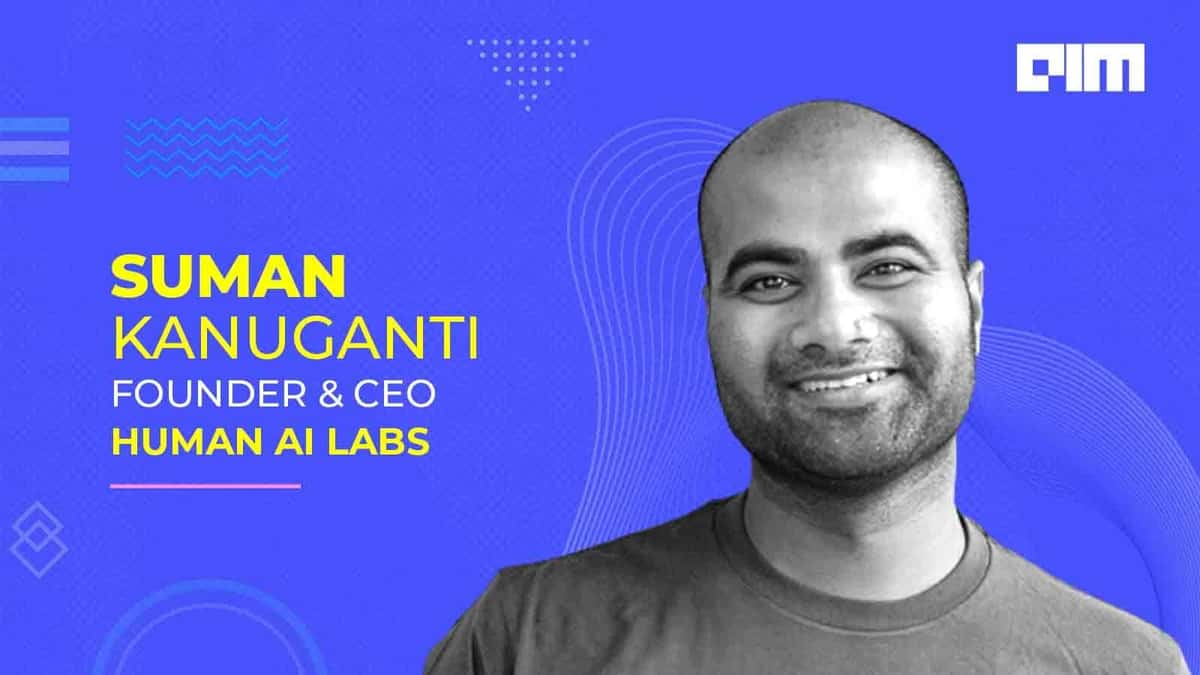
To that end, our efforts to perfect a fool-proof memory storage system are on the right track. Exhibit A: Personal AI. Founded in 2019 by Suman Kanuganti, Sharon Zhang and Kristie Kaiser, this California-based startup builds technology to safe-keep human memories and recall them at will. We spoke to Suman Kanuganti to understand how the startup is leveraging technology to build a personal AI for all. Formerly known as Luther.ai, Personal AI has been developing AI extensions for humans to forget less and recall more with the help of a personal AI.
Down The Memory Lane
Suman Kanuganti, the founder and CEO of Personal AI, comes from a small town called Warangal in Telangana. After finishing his bachelors in electrical engineering from Kakatiya University in Telangana, he pursued masters in robotics from the University of Missouri, Columbia.
He has also founded Aira, an augmented reality startup for the blind. With Aira, Suman focused on providing people who are blind with instant access to visual information through technology. In the same vein, Personal AI is not trying to fix biological memory, but offer a tech-powered version of human memory and recall functions.
Suman claimed Personal AI is the only solution currently available in the market that deals with cognitive technologies and human memories.
“Personal AI isn’t an AI assistant like Alexa, neither a chatbot nor a note-taking device or application. It rather focuses on building something personalised to the individual.”
The company swears by the authenticity of an individual’s voice and thoughts and leverages blockchain to secure data ownership.
The Use Of AI
Personal AI focuses on three prime aspects of artificial intelligence: privacy, fewer data per user and AI for personal use. Thus, to create a private AI with no data sharing, the startup leverages user feedback to measure and enhance model accuracy for the specific individual. The key focus is to develop user-specific models that can utilise data from individuals’ personalised thoughts rather than aggregating data from many individuals.
The system layers in both implicit and explicit feedback into the data structure to assess and improve model performance. Further, it uses active learning techniques by engaging the users to give feedback on the subset of predictions to achieve greater accuracy.
Considering each individual possesses a unique language pattern, to build a personal AI for each individual, Personal AI uses domain adapted machine learning models trained on the specific individual’s vocabulary and style. Additionally, it adapts generic speech models with user-specific terminologies to improve the accuracy of automatic speech recognition. Further, Personal AI uses self-supervised learning on the users’ data and applies encoder-decoder architectures. This helps in learning user-specific data and managing the generating texts based on user concepts.

To protect privacy, Personal AI’s infrastructure is centred on building user-specific pods by leveraging Oasis Labs’ blockchain technology. This allows encryption for data storage and enables a secured model execution.
Suman mentioned AWS, Lambda, ECS, Margate, JavaScript, PyTorch, and other transformer technologies are the core tools used by their developers for the frontend and backend.
Wrapping up
Personal AI has recently closed a funding of $3.2 million in a seed round with a view to create an AI extension of human memory.
“Although the company was built with the entire team being virtual, we were able to connect, bond and grow as a company together - and even eventually raise funding with our investors, all without ever meeting the team or the investors in person.”
Personal AI aims to bring like-minded, fun and overall good human beings on board to build great products. In Suman’s own words, Personal AI is “building a personal AI for individual humans to go beyond search and to create recall experiences.”
- From Humanoid Robots to Telecom Trials, 12 Major Announcements at NVIDIA GTC Berlin 2026
- Anyone Can Make a Robot Move, Few Can Make It Stop
- After ISRO’s PSLV Failure, TakeMe2Space Looks to SpaceX for Reliable Launch
- Why AI Agents are the Next Frontier in Quantum Security
- Physical AI Squeezes Labour Market, And Low-Skilled Immigrant Jobs May Be First to Fall
- Rocket Math Isn’t Mathing: Why India’s Space Launches are Expensive